



You don’t need me to tell you that many of the finest paintings in Britain can be found in London, or that a good chunk of those are clustered in the National Gallery. What, though, of art beyond the capital? Recently, my editor set me a challenge: to identify the United Kingdom’s 100 greatest paintings on public display outside London.
Such is the strength in depth of the nation’s holdings in art beyond the M25 that whittling down the list proved tough, but a couple of principles guided me. First, I wanted to ensure geographical variety, to represent almost every corner of the UK, from the Isle of Bute to the Isle of Wight.
Second, I was after a chronological sweep, so that the list would simultaneously provide a history of art and collecting in this country. Various entries reflect, say, the cosmopolitanism of the arts under Charles I, or the longstanding interest of British collectors in 17th-century Dutch painting. The importance of royal portraiture is a principal theme; likewise, the impact of the Italian Renaissance.
Inevitably, the final list is partial and subjective; no doubt, I’ve ignored some first-rate paintings (consciously or otherwise). Perhaps I have overlooked your favourite. Please let me know what I may have missed.
Entries are organised first by region (you can skip to the relevant one below), and then in chronological order within each region.
Best art by UK region
- East Midlands
- East
- North East
- North West
- South East
- South West
- West Midlands
- Yorkshire and the Humber
- Scotland
- Wales
- Northern Ireland
England
East Midlands
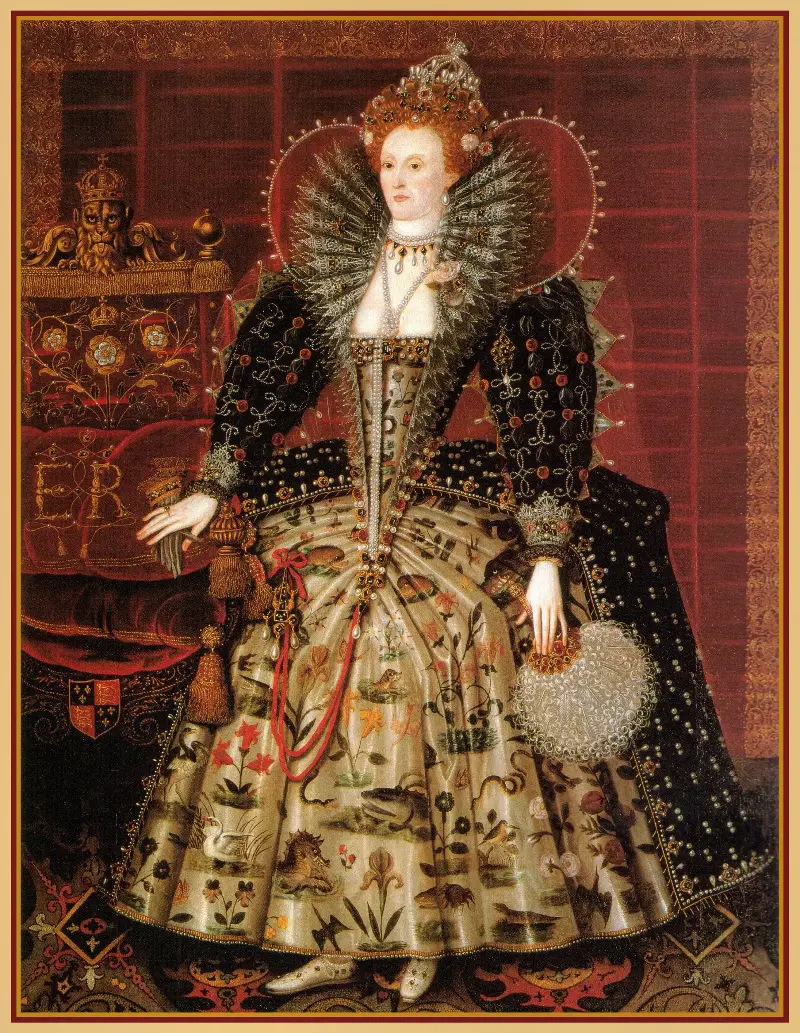
1. Elizabeth I attributed to Nicholas Hilliard, c1598-99
The anatomy may be off in this full-length portrait of Queen Elizabeth I, painted towards the end of her life, but I can’t get enough of her resplendent dress embellished with flowers, birds, and sea monsters. Visual symbols were an important part of the Virgin Queen’s self-presentation; here, the pearls that also decorate her dress represent purity.
Hardwick Hall, Derbyshire
2. Robert Rich, 2nd Earl of Warwick by Daniel Mytens, 1633
Dutch painter Daniel Mytens enjoyed success at the courts of James I and Charles I – until his younger, more talented Flemish rival Anthony van Dyck turned up. Here, Mytens depicts the Puritan Earl of Warwick in a scarlet costume that’s anything but austere. Warwick wore the same flamboyant outfit for his portrait by van Dyck, now in New York’s Metropolitan Museum.
Hardwick Hall, Derbyshire
3. Portrait of a Man by Rembrandt Harmenszoon van Rijn, 1639
Who is this stern, bearded man in a white turban? He could be a rabbi, a figure from the Old Testament, a portrait of Rembrandt’s father – or, simply, as the 3rd Duke of Devonshire believed when he bought the picture in 1742, “An Old Man in Turkish Dress”. Still, talk about presence.
Chatsworth, Derbyshire
4. A Dead Swan and Peacock by Jan Weenix, 1708
Dutch painter Jan Weenix’s meticulous still lifes of dead game and birds appealed to collectors eager to associate themselves with the aristocratic pastime of hunting. This lavish example, in which two birds hang from a branch before a sculpted urn and a basket of fruit, is animated by the interplay between the peacock’s ostentatious tail feathers and the swan’s pristine plumage.
Belton House, Lincolnshire
5. A Philosopher Lecturing on the Orrery by Joseph Wright of Derby, 1764-66
This dramatic nocturnal scene exemplified the work with which Joseph Wright, the son of a Derby lawyer, made his name during the 1760s. It depicts a red-robed “philosopher” using a mechanical model known as an “orrery” to demonstrate the movements of the solar system to a group of rapt onlookers illuminated by a lamp representing the sun.
6. Georgiana, Duchess of Devonshire by Thomas Gainsborough, c1785-87
In this irresistible portrait, Georgiana Cavendish, Duchess of Devonshire, appears wearing her flamboyant “portrait hat”. It might look like something from the Mad Hatter’s wardrobe, but, pictorially, it’s a masterstroke, because it isolates, and offsets, the duchess’s glowing face. In 1876, the painting was stolen by a master criminal who became obsessed with it.
Chatsworth, Derbyshire
7. Red Woman by Franz Marc, 1912
This powerful, sensual piece is a late work by the German Expressionist Franz Marc, an important figure in the Blue Rider group (along with Wassily Kandinsky, Gabriele Münter, and Paul Klee). It depicts a “primitive” woman whose purplish and crimson skin is decorated with cryptic markings. She seems to merge with the lush yet artificially patterned natural setting.
Leicester Museum & Art Gallery
East
8. The Battle of Cascina by Bastiano da Sangallo (after Michelangelo), c1542
One for art-history geeks. This painting replicates an earlier, untraced copy made by the Italian artist Bastiano da Sangallo of the central portion of a full-size preparatory drawing that Michelangelo produced while working on a fresco inside the Palazzo Vecchio in Florence. Michelangelo never executed the fresco, and his drawing disappeared, so this picture is of considerable historical importance.
Holkham Hall, Norfolk
9. Tarquin and Lucretia by Titian, 1571
Tiziano Vecellio, the Italian Renaissance painter known in English as Titian, presents the rape of Lucretia, the chaste wife of a Roman nobleman, by Sextus Tarquinius, a Roman prince. Lucretia’s tear-streaked cheeks are flushed as her assailant thrusts a knee between her legs while wielding a gleaming blade; dropped scarlet stockings suggest his lustful, inflamed state. This painting, Titan’s last masterpiece for Philip II of Spain, is brutal but unforgettable.
Fitzwilliam Museum, Cambridge
10. The Hervey Conversation Piece (or “The Holland House Group”) by William Hogarth, 1738-40
A “conversation piece” is a small-scale group portrait set in a domestic interior or garden; here, William Hogarth offers a characteristically knockabout take on the genre. To the left, a seated gentleman’s walking stick upsets the chair on which a clergyman stands while gazing at a church through a telescope. Is he about to fall into the river?
Ickworth, Suffolk
11. Peter Darnell Muilman, Charles Crokatt and William Keable in a Landscape by Thomas Gainsborough, c1750
This triple portrait of young gentlemen relaxing in a rustic setting is an early masterpiece by Gainsborough. Although we don’t know which is which, the two men on either side were the sons of important City of London overseas merchants whose families were about to be united by marriage; the flautist is William Keable, a minor portraitist.
Gainsborough’s House, Suffolk
12. The Death of General James Wolfe by Benjamin West, 1779
In 1771, American-born Benjamin West, the son of a Quaker innkeeper, exhibited his best-known composition, depicting the demise of a British general at the point of victory at the Battle of Quebec in 1759 (observed by an indigenous man). It proved so popular that replicas were commissioned. This is the fourth and final version.
Ickworth, Suffolk
13. Self-portrait by Elisabeth Louise Vigée Le Brun, 1791
Elisabeth Louise Vigée Le Brun found success in pre-revolutionary France, where she became the favourite painter of Queen Marie-Antoinette. She painted this self-portrait, though, in Italy, after she fled there in 1789. To emphasise her rank, she depicted herself in an elegant black silk robe with a red sash – an outfit that bore little resemblance to whatever she wore while painting.
Ickworth, Suffolk
14. The Gust of Wind by Pierre-Auguste Renoir, c1872
The spot represented by this rare landscape in Pierre-Auguste Renoir’s oeuvre may be a hill near Saint-Cloud, to the west of Paris, but specifics about the location miss the point. Rather, Renoir is intent, in this dazzling Impressionist view, on evoking the exhilaration of a breezy spring day – which he does, almost miraculously.
Fitzwilliam Museum, Cambridge
15. Still Life with Apples by Paul Cézanne, c1877-78
This seemingly simple still life of seven apples has an astonishing pedigree. Demonstrating Paul Cézanne’s new “constructive brushstroke” technique, developed during the 1870s, it was bought by Edgar Degas and later acquired by John Maynard Keynes, via whom it became a talisman of progressive art for the Bloomsbury Group.
Fitzwilliam Museum, Cambridge
16. Tic Tic by Joan Miró, 1927
With its abstract shapes floating against an ultramarine ground, the enigmatically titled Tic Tic, by the Catalan painter Joan Miró, belongs in the astonishing collection of modern art at Kettle’s Yard amassed by Jim Ede, a British curator, who hung it so that its yellow dot would rhyme with a nearby lemon placed on a pewter dish.
Kettle’s Yard, Cambridge
17. The Old Maids by Leonora Carrington, 1947
Painted after she’d settled in Mexico, this mysterious scene demonstrates English-born Leonora Carrington’s lifelong commitment to Surrealism. It depicts a group of peculiarly attired ladies, including a smaller central figure wearing a black shroud, sharing high tea before an open fire with a monkey and five magpies.
Sainsbury Centre, Norwich
North East
18. Interior of a Prison by Francisco de Goya, c1793-94
This isn’t an easy picture to look at – but it is powerful. Francisco de Goya depicts several bedraggled prisoners, each seemingly locked in his own despair, sitting silently in a claustrophobic, thick-walled cell. Streaks of savagery and darkness recur in the Spaniard’s work, which is why he’s sometimes called the first “modern” artist.
The Bowes Museum, County Durham
19. The Destruction of Sodom and Gomorrah by John Martin, 1852
Melodramatic? This biblical set piece by John Martin, the popular Romantic painter – who was born in a one-room cottage, and began his career as an apprentice to a coach-maker – is stagy, for sure. But it’s also thrilling, as brimstone and fire rain down from heaven on the sinful cities of Sodom and Gomorrah.
Laing Art Gallery, Newcastle upon Tyne
20. Isabella and the Pot of Basil by William Holman Hunt, 1867
A poem by John Keats provides the source for this remarkable, sensual painting, in which a dark-haired, barefoot woman, in a translucent nightgown, hugs an imposing majolica pot decorated with skulls in which she has buried her murdered lover’s severed head. A founder of the Pre-Raphaelite Brotherhood, William Holman Hunt completed it after the premature death of his wife, Fanny.
Laing Art Gallery, Newcastle upon Tyne
North West
21. Christ Discovered in the Temple by Simone Martini, 1342
This scene by Simone Martini – who was born in Siena but ended up in Avignon (where the papal court was in exile) – will resonate with any parent. Mary and Joseph remonstrate with their son for abandoning them during a visit to the Temple in Jerusalem. Martini’s 12-year-old Christ looks wonderfully like a grumpy adolescent.
Walker Art Gallery, Liverpool
22. Henry VIII by (workshop of) Hans Holbein the Younger, c1537
Royal portraiture plays a pivotal role in British art history; this full-length piece is derived from Hans Holbein the Younger’s definitive depiction of the overweight Tudor tyrant in the so-called Whitehall Mural (destroyed by fire in 1698). The King appears with legs astride and codpiece rampant, eyeballing the viewer like a bouncer outside a nightclub.
Walker Art Gallery, Liverpool
23. The Great Picture (attributed to) Jan van Belcamp, 1646
There’s something compellingly strange about this 16ft-wide triptych attributed to the Flemish painter Jan van Belcamp. Typically, triptychs were religious works, but this one provides the family history of the woman who commissioned it, Lady Anne Clifford, daughter of the 3rd Earl of Cumberland, who fought for almost four decades for the right to inherit her father’s estates.
Abbot Hall, Cumbria
24. The Doge’s Palace and Riva degli Schiavoni, Venice; and The Grand Canal, Piazzetta and Dogana, Venice by Antonio Canaletto, 1730
No history of art in Britain would be complete without the Italian painter Canaletto, whose “vedute” (views) of Venice, the city in which he mostly lived, were coveted by collectors in England (where he also spent 10 years). These two, capturing the hustle-and-bustle beside two Venetian landmarks, face different directions, but were painted from the same spot.
Tatton Park, Cheshire
25. Sappho by Auguste Charles Mengin, 1877
Come hither – if you dare. Sure, this bare-breasted “portrait” of Sappho, by the French academic painter Auguste Charles Mengin, was likely intended to titillate a male audience (ironically, given the Greek poet’s sexual orientation). Yet, the figure he depicts in stark monochrome radiates self-assurance and power, and is neither victim nor sex object.
26. Captive Andromache by Frederic Leighton, c1888
Frederic, Lord Leighton may be out of fashion today, but he dominated 19th-century British art. This ranks among his masterpieces: a vivid, frieze-like composition that’s a high point of academism. Clad in black, the sombre mythological figure of Andromache, wife of the Trojan hero Hector, stands separate from the throng, almost silhouetted against the sky.
27. Still Life with Squid and Sea Urchin by Lucian Freud, 1949
I wanted to include a strong example (and there are many) of Lucian Freud’s hyper-realistic early style, which I find compelling; I’m grateful to his former studio assistant, David Dawson (now the director of Freud’s archive), for drawing my attention to this one, animated by the contrast between a prickly sea urchin and the soft flesh of a squid oozing black ink.
Harris Museum & Art Gallery, Preston
28. Interior at Paddington by Lucian Freud, 1951
Standing on a rumpled red carpet in a sparse room, a bespectacled figure in a dull mackintosh (the bohemian photographer Harry Diamond) clenches his right fist while appearing to square up to a potted yucca. The dynamic between man and plant is menacing and bizarre, and seems to express post-war Britain’s uncertain spirit.
Walker Art Gallery, Liverpool
29. Peter Getting Out of Nick’s Pool by David Hockney, 1966
David Hockney’s work has long been associated with Californian sunshine, swimming pools, and homosexual hedonism. Here, the nude bottom of his boyfriend Peter Schlesinger, climbing out of a communal pool in Hollywood, is like a bullseye. Virgin canvas around the edges alludes to the border of the Polaroid photograph that was Hockney’s source.
Walker Art Gallery, Liverpool
30. Blotter by Peter Doig, 1993
Peter Doig spent much of his childhood in Canada, where “blotter” is slang for paper impregnated with LSD; there’s a hallucinatory quality to this superb painting, based on a photograph of the artist’s brother, of a boy staring at his own reflection while standing on a frozen pond. Those rippling purple reflections are like a portal to another dimension.
Walker Art Gallery, Liverpool
31. Daily Planet by Ed Ruscha, 2003
According to Ed Ruscha, an American painter and photographer, art should be something that “makes you scratch your head”. This mind-scrambling image, in which the phrase “Daily Planet” (evoking Clark Kent’s newspaper in the Superman comics) overlays a razor-sharp representation of a snow-capped peak, is a majestic example of his surreal, deadpan paintings, which often feature peculiar words and expressions.
South East
32. The Crucifixion with the Virgin, Saint John the Evangelist and the Magdalen by Fra Angelico, c1420
A very old painting – but a recent, and stunning, acquisition: one of the earliest surviving panels by the Italian painter and Dominican friar Fra Angelico. The Virgin Mary gazes at the viewer, as gore gushes from Christ’s wounds. Yet, at its apex, the cross turns miraculously into a bushy tree. An image combining death and hope.
Ashmolean Museum, Oxford
33. The Hunt in the Forest by Paolo Uccello, c1465-70
Whenever I’m in Oxford, I make a beeline for this bewitching panel by the Florentine Paolo di Dono, whose nickname, Uccello (Italian for “bird”), suggests a love for the natural world. He was also obsessed with perspective. This depiction of a nocturnal aristocratic hunt, enlivened by scarlet accents, draws the eye inexorably into the forest’s depths.
Ashmolean Museum, Oxford
34. The Adoration of the Magi (attributed to) Hieronymus Bosch, c1515
The original version by Hieronymus Bosch of the central panel from this triptych may be in the Prado, but this spirited scene, in which the three magi present gifts to the Christ Child before a tumbledown stable that seems on the verge of collapse, is hardly shabby. Delightfully, on the right, curious shepherds peer through a hole in the wall.
Petworth House, West Sussex
35. The Butcher’s Shop by Annibale Carracci, c1580
With his older brother Agostino, Annibale Carracci revolutionised Italian painting at the end of the 16th century by introducing a bold new note of naturalism. This vast painting – which once belonged to King Charles I (and used to hang in Christ Church’s kitchens) – exemplifies his innovation, by depicting a secular market scene on a scale usually reserved for religious subjects.
Christ Church Picture Gallery, Oxford
36. Charles I on Horseback with M. de St Antoine by Anthony van Dyck, 1633
Downtown Abbey fans may recognise this colossal equestrian portrait of Charles I accompanied by his French equerry, Pierre Antoine Bourdin, which hangs in the dining room at Highclere Castle, where the historical TV drama was filmed. The prime version belongs to the Royal Collection, but this impressive copy has van Dyck’s customary painterly panache.
Highclere Castle, Hampshire
37. View of Dordrecht from the North by Aelbert Cuyp, c1655
The sun is setting on the Dutch port-city of Dordrecht, the birthplace of the landscape painter Aelbert Cuyp, with whom British collectors became besotted during the 18th century. The log-raft to the right of this wide-screen canvas alludes to the city’s lucrative timber trade. I treasure the soft, transporting quality of the light, and the expansiveness of that sky.
Ascott, Buckinghamshire
38. A Game of Ninepins by Pieter de Hooch, c1665
In the grounds of a splendid townhouse, several sophisticated adults are playing a simple game. To the right, behind a conversing couple, a statue of Cupid reveals the picture’s true theme: young love. The son of a bricklayer and a midwife, Pieter de Hooch became an accomplished Dutch painter, brilliant at rendering subtle effects of daylight.
Waddesdon Manor, Buckinghamshire
39. An Owl Being Mobbed by Other Birds by Francis Barlow, 1673
According to the diarist John Evelyn, who visited him, Francis Barlow was a “famous Paynter of fowle, Beastes & Birds”. (He’s often described as the father of sporting painting and book illustration.) This peculiar, anarchic scene depicts an owl sitting in the hollow of an oak tree crowded round by magpies, jays, and songbirds. Its potential metaphorical significance remains mysterious.
Ham House, Surrey
40. Boy Building a House of Cards by Jean-Siméon Chardin, 1735
Jean-Baptiste Siméon Chardin specialised in subtle, understated still-lifes and bourgeois domestic genre scenes. Several works depict children playing at cards or board games: The House of Cards (c1740-1741) in the National Gallery is one such example. Are they reminders of life’s precariousness? The structure built by this lad appears far from sturdy.
Waddesdon Manor, Buckinghamshire
41. Huang Ya Dong (‘Wang-Y-Tong’) by Joshua Reynolds, c1776
The most compelling aspect of this portrait is the identity of its exceptional sitter, who had travelled from Guangzhou to Britain, where his knowledge of botany and Chinese medicine was prized. Joshua Reynolds depicts him in a red conical hat (which he wouldn’t have worn at home) sitting cross-legged (which wasn’t a Chinese custom).
Knole, Kent
42. The Marlborough Family by Joshua Reynolds, 1778
A duke, a duchess, six children, and three dogs: Joshua Reynolds’s monumental group portrait depicts the 4th Duke of Marlborough and his family. His eldest son clutches a red case containing the Marlborough gems while Duchess Caroline, once described by Queen Charlotte as “the proudest woman in England”, towers over everyone.
Blenheim Palace, Oxfordshire
43. Fishermen Upon a Lee-Shore in Squally Weather by JMW Turner, 1802
The sea was always a source of inspiration for JMW Turner, who, still in his mid-20s, captures its spray and power in thick and vigorous strokes here, as fishermen struggle to launch their boats. Pictures such as this announced the developing movement of Romanticism, with its emphasis on untameable nature, and interest in the “sublime”.
44. The Lake, Petworth: Sunset, Fighting Bucks by JMW Turner, c1829
Turner often stayed at Petworth as a guest of his patron, the 3rd Earl of Egremont. Here, he depicts its grounds at sunset, speckled with fallow deer (and, in the middle-distance, cricketers); in the foreground, bucks lock horns, providing an incongruous note of violence in an otherwise serene scene. The atmosphere is otherworldly, Elysian.
Petworth House, West Sussex
45. La Siesta by Franz Xaver Winterhalter, 1844
Not an obvious choice, perhaps – but I have a soft spot for this painting of three elegant young women relaxing in a clearing in a wood by the German painter Franz Xaver Winterhalter, a favourite of Queen Victoria’s. By making the garment raised aloft by the lady at the back appear translucent, he achieves a convincing impression of sunlight.
Osborne, Isle of Wight
46. Portrait of John Ruskin by John Everett Millais, 1853-54
Not long after completing his best-known work, Ophelia (1851-1852), the sublimely talented John Everett Millais depicted the art critic John Ruskin, who championed the Pre-Raphaelite Brotherhood (of which Millais was a founding member). Millais began the painting while they were holidaying in Scotland, where he fell in love with Ruskin’s wife, Effie, whom he subsequently married.
Ashmolean Museum, Oxford
47. Still Life with Wild Flowers by Vanessa Bell, 1915
According to Vanessa Bell’s sister, Virginia Woolf, “human character changed” about 1910, with the advent of modernism. You can see this shift in Bell’s paintings at the Bloomsbury stronghold of Charleston. Iceland Poppies (1908), an early work, suggests the influence of her tutor, John Singer Sargent; Wild Flowers, a freer, fresher composition, suggests a newfound concern with colour’s expressive possibilities.
Charleston, East Sussex
48. Dancer No 5 by Gino Severini, 1915-16
In this risqué work by the Italian Futurist Gino Severini, who settled in Paris in 1906, a can-can dancer wearing yellow stockings and performing a high kick reveals a panoply of petticoats – with a very suggestive design at the centre. The picture conveys with panache the exhilarating zeitgeist of modernity.
Pallant House Gallery, Chichester
49. Mere Poussepin by Gwen John, c1915-20
Welsh painter Gwen John was quieter than her artist brother Augustus, and her intense, introspective paintings are characterised by a muted palette. After settling in Paris, and following an affair with the sculptor Auguste Rodin, she turned to Catholicism. Here, she imbues the founder of the Dominican Sisters of Charity with a hint of smirking sensuality.
50. Sandham Memorial Chapel by Stanley Spencer, 1927-32
This complex decorative scheme of 19 paintings for a private chapel, commissioned to commemorate the life of Lt Henry Willoughby Sandham, is Stanley Spencer’s masterpiece. None of the paintings depicts bloodshed, but the cycle – inspired, in part, by Giotto’s frescoes in the Arena Chapel in Padua – is a deeply touching response to the First World War.
Sandham Memorial Chapel, Hampshire
51. Swingeing London ’67 by Richard Hamilton, 1968
With its frame imitating a police van’s windows, this coruscating picture by Richard Hamilton, one of Pop art’s British pioneers, represents the arrest of Mick Jagger and art dealer Robert Fraser for possessing drugs, following a police raid of Keith Richards’s home in West Wittering in 1967. A cerebral piece, it anatomises tensions between traditionalists and progressives in 1960s Britain.
Pallant House Gallery, Chichester
52. Thames Painting: The Estuary by Michael Andrews, 1994-95
Unlike other artists associated with the so-called School of London, such as Francis Bacon, self-effacing Michael Andrews isn’t a household name. He deserves to be. In this colossal canvas, he depicts figures on the Thames’s primeval mudflats. They appear like shades by the River Styx. It was the last work he produced, while undergoing treatment for cancer.
Pallant House Gallery, Chichester
South West
53. The Judgement of Solomon by Sebastiano del Piombo, 1506-11
This unfinished yet potent canvas by Sebastiano del Piombo, who, from 1511, overlapped in Rome with Raphael and Michelangelo, depicts the biblical story of King Solomon resolving a dispute between two mothers, each of whom lays claim to a baby. When Solomon orders his executioner to divide the child in half, the real mother relinquishes, to save her offspring’s life.
Kingston Lacy, Dorset
54. Nicolò Zen by Titian, 1560-65
Titian, whose work was highly sought after, painted brilliant portraits throughout his life; this one dates from the end of his career and depicts the scientist, historian and politician Nicolò Zen, wearing a Venetian senator’s velvet robes. I admire the air of command that Titian gives him, and the lively touch of his right hand fingering his damask stole.
Kingston Lacy, Dorset
55. Marchesa Maria Serra Pallavicino by Sir Peter Paul Rubens, 1606
Whenever I encounter this full-length portrait of the young wife of a banker to Duke Vincenzo I Gonzaga of Mantua, I think of a shiny ball rolling about on a platter, because her silver lace ruff seems to separate her head from her body. Still, this painting is a dazzling, virtuosic achievement. That glinting silk gown imparts considerable pleasure.
Kingston Lacy, Dorset
56. James VI & I by John de Critz the Elder, c1606
This quarter-length portrait, based on an original full-length design by the Antwerp-born court painter John de Critz, presents the intellectual Stuart monarch as a suave and relaxed individual dressed in a shimmering silk doublet. His hat is decorated with the “Mirror of Great Britain” jewel, produced to commemorate the union of the English and Scottish crowns.
Montacute House, Somerset
57. Wedding Dance in the Open Air by Pieter Brueghel the Younger, 1607-14
Brueghel the Younger is traditionally considered less important than his father (who features elsewhere in this list). But this rollicking panel of open-air festivities at a peasant wedding, painted in oils, is an entertaining picture, full of charm. Formerly judged to be the work of a copyist, it was re-attributed around a decade ago, following conservation and technical examination.
Holburne Museum, Bath
58. Philip Herbert, 4th Earl of Pembroke, with his Family by Anthony van Dyck, c1635
This group portrait of the family of Philip Herbert, 4th Earl of Pembroke (to whom, along with his brother, Shakespeare’s posthumous First Folio was dedicated) is the largest surviving painting of van Dyck’s career. Some art historians believe that, in it, van Dyck overextended even his prodigious powers. But as an image of sheer aristocratic magnificence, it’s unrivalled.
Wilton House, Wiltshire
59. An Urchin Mocking an Old Woman Eating Migas by Bartolomé Esteban Murillo, c1660-65
A grinning boy gazing out at the viewer points at an impoverished old woman who cowers while trying to eat a bowl of “migas” (breadcrumbs). Is she afraid he’s about to steal her food? It’s hard to gauge the tone of this dramatic street scene by the Spanish painter Murillo. Are we meant to join in the mockery?
Dyrham Park, Gloucestershire
60. Sir Joshua Reynolds PRA by Angelica Kauffman, 1767
I couldn’t resist including this intimate portrait of the first president of the Royal Academy, Sir Joshua, painted by his great friend, the spirited, and successful, Swiss-born Kauffman. Dressed in fashionable “Van Dyck” costume, Reynolds appeared before a bust of Michelangelo, whom he revered, and tugged informally at his right ear, reminding the viewer that he was partially deaf.
Saltram, Devon
61. Henrietta Laura Pulteney by Angelica Kauffman, c1777
The apparent subject of this charming portrait, an 11-year-old redhead gathering flowers in a forest while dressed in an impractical white gown, was an “indefatigable dancer”, and, later, first Countess of Bath. Yet, the contrast between her radiant innocence and the dark setting reveals Kauffman’s true subject: the fleeting nature of childhood.
Holburne Museum, Bath
62. Horizontal Stripe Painting: November 1957-January 1958 by Patrick Heron, 1957-58
This fiery painting belongs to a group of pictures composed of horizontal bars of colour by Heron. Although it appears abstract, Heron, who is associated with the artists’ enclave of St Ives, acknowledged that he may have been influenced by watching the sun set over the sea.
63. Oi Yoi Yoi by Roger Hilton, 1963
Hilton was an artist of the post-war St Ives school. This energetic, erotically charged work was inspired by his wife, Rose, also an artist, springing about on a veranda while they were quarrelling on holiday in France. Surely, though, Hilton was thinking too of earlier treatments of dancers by modernists such as Henri Matisse.
64. The Chimney, Mornington Crescent by Frank Auerbach, 1987-88
People tend to associate Auerbach with his portraits, but I prefer his landscapes depicting views near his Mornington Crescent studio in north London. In this example, zigzagging brushstrokes define both architecture and sky, and express a sense of explosive energy. Auerbach said that he wanted his art to be “stonking”, “independent”, and “coherent”. This picture is all three.
65. Cottage Lover by Denzil Forrester, 1997
Grenadian-born Forrester used to draw surreptitiously inside East London’s reggae and blues nightclubs. Here, he transposes the pulsating action he witnessed to his family cottage in Cornwall, where he retired in 2016. He also adds a romantic theme. The moonlit result is a captivating mash-up, characterised by glistening forms, and a prismatic, purplish palette.
West Midlands
66. The Dormition of the Virgin by Pieter Bruegel the Elder, c1564
In Christian theology, the Dormition is the painless falling asleep into death of the Virgin Mary. Pieter Bruegel the Elder, a founding father of the Northern Renaissance, paints this moment “in grisaille” (i.e., using only shades of grey). Mary Magdalene plumps up the Virgin’s pillows; St John sleeps open-mouthed by the fire, before which a heedless cat keeps warm.
Upton House, Warwickshire
67. “El Espolio” (The Disrobing of Christ) by El Greco, 1577-1579
In this smaller copy of his altarpiece for Toledo Cathedral, Cretan-born Domenikos Theotokopoulos, aka “El Greco” (“The Greek”), depicts Christ, in a radiant red robe, looking surprisingly serene, given that he’s about to be stripped by an unruly mob. Nevertheless, it’s a scene of intense drama, which, thanks to the figures’ elongation, also typifies the artist’s Mannerism.
Upton House, Warwickshire
68. A Young Girl Holding a Chaffinch by unknown Flemish artist, c1615-1622
Art historians can’t agree who painted this delightful portrait; they’re unsure, too, about the identity of the sitter, a little girl with a pet chaffinch perched on one forefinger, who probably came from a Catholic family in Antwerp (hence the gold cross around her neck). What’s certain is she’s bursting with personality: see how her hand rests upon her hip.
Formerly at Cliveden, Buckinghamshire; recently on display at Upton House, Warwickshire
69. The Duet by Gabriel Metsu, c1660
The music-making depicted in this exquisite cabinet picture by the Dutch master, Gabriel Metsu, doubles as a metaphor for love. (The gentleman tunes his lute suggestively.) I’m seduced, though, by the ravishing treatment of his paramour’s satin skirt.
Upton House, Warwickshire
70. Still Life with Fruit, Bird’s Nest and Insects by Rachel Ruysch, 1716
The Dutch artist Rachel Ruysch painted this panoply of fruits, flowers and crops arranged on a stone plinth before a tree trunk when she was employed in Düsseldorf as a court painter to Johann Wilhelm, Elector Palatine. Look out for the lizard pinching an egg from a bird’s nest – a reminder, along with the rotting fruit, of life’s impermanence.
Dudmaston, Shropshire
71. The Last of England by Ford Madox Brown, 1855
Pre-Raphaelite sculptor Thomas Woolner’s emigration to Australia inspired this painting – although Ford Madox Brown based the principal figures on himself and his wife, Emma. I find it a touch odd: what should we make of the beleaguered woman’s stiff yet tongue-like scarf? But it’s also an effective narrative painting, summoning an atmosphere of apprehension.
Birmingham Museum & Art Gallery
72. The Travelling Companions by Augustus Leopold Egg, 1862
This is one of the final paintings by Augustus Egg, a gunsmith’s son who enjoyed success in Victorian England. A pair of young women (sisters?) swathed in grey silk are oblivious to the French Riviera through their carriage window. The composition’s near-symmetry summons an uncanny, dreamlike effect worthy of René Magritte – enhanced by the fact that one of the women is asleep.
Birmingham Museum & Art Gallery
73. Love Among the Ruins by Sir Edward Burne-Jones, 1894
I don’t feel much affinity for the work of Sir Edward Burne-Jones, who’s associated with the second phase of Pre-Raphaelitism. But this painting – a copy in oils of an earlier watercolour inspired by a poem by Robert Browning, and a meditation, with its twining roses, on romantic love – has a melancholic yet magnetic quality, and suggests the fertility of his imagination.
Wightwick Manor, Wolverhampton
Yorkshire and the Humber
74. Still Life of Food, a Jug and Glasses on a Table by Pieter Claesz, 1640
In this immaculate composition, Dutch still-life specialist Pieter Claesz delights in capturing the fall of light and contrasting textures (a cooked crab on a metal plate; fruit spilling from a ceramic bowl). Yet, his picture contains a moral message, too. Life’s precariousness is signalled by an unstable knife, overturned drinking vessels, and a butterfly on a leaf.
Nostell Priory, West Yorkshire
75. Girl with Pigs by Thomas Gainsborough, 1782
Thomas Gainsborough was much in demand as a portraitist, but his interests lay elsewhere: in “landskips” and, from the 1770s, “fancy pictures” depicting the rural poor. Pigs supposedly ran amok in his studio when he was painting this example. It was bought by his rival Joshua Reynolds, prompting Gainsborough to remark: “I have brought my pigs to a fine market.”
Castle Howard, North Yorkshire
76. On the Thames (or How Happy I Could Be with Either?) by James Tissot, c1876
When this canvas by James Tissot, the French-born painter of chic 19th-century life (who spent many years in London), was shown at the Royal Academy, it was accused of vulgarity. Are those unchaperoned women beneath umbrellas sex workers? Yet, I relish the collision between the champagne picnic in the foreground and the heavy industry farther off along the Thames.
The Hepworth Wakefield, West Yorkshire
77. A Game of Patience by Meredith Frampton, 1937
Meredith Frampton, a visionary of 20th-century British art, remains unsung. I find his uncanny interwar portraits, executed in an icy yet seductive, pin-sharp neoclassical style, intensely charismatic. This example depicting a coppery-haired card player is one of the most sublime.
Ferens Art Gallery, Hull
78. Rise 1 by Bridget Riley, 1968
To begin with, in the early 1960s, Bridget Riley’s vibrating Op Art paintings were black and white. Later, she started introducing shades of grey, then colour. In this piece, crimson stripes appear to leap forward, and up, while softer purples seemingly recede and descend. The composition throbs as if representing an emotion. Pure pictorial force.
Graves Gallery, Sheffield
79. The Artist in Her Studio by Dame Paula Rego, 1993
Technically, this isn’t a self-portrait: the pipe-smoking sculptress it depicts (while her assistants paint a still life of cabbages), was based on Paula Rego’s principal model and collaborator Lila Nunes. But her don’t-mess-with-me aura captures the spirit of the Portuguese-born British painter, whose fantastical, figurative pictures often have a darkly erotic, psychologically fraught quality.
80. Scala by Louise Giovanelli, 2024
British artist Louise Giovanelli is already feted for her enigmatic paintings of drapes and theatre curtains. If this sounds boring, consider Scala. It depicts a plush red curtain in a theatre in Salford transformed by bright streaks of neon-pink stage lighting, and has an air of exultant anticipation. Has the show ended – or is it about to begin?
The Hepworth Wakefield, West Yorkshire
Scotland
81. The Three Ages of Man by Titian, c1512-14
In this sensuous, swoony pastoral, Tiziano depicts a pair of lovers enjoying an intimate moment (as suggested by the double entendre of the pipe in the woman’s left hand); the figures elsewhere in the landscape refer to their past and future. Can true love trump life’s transience?
National Galleries Scotland: National, Edinburgh
82. An Old Woman Cooking Eggs by Diego Velázquez, 1618
Velázquez was only 18 or 19 years old when he painted this “bodegón” (a Spanish term for a kitchen or tavern scene) after completing his apprenticeship in his native Seville. I love its play of light and dark, as well as Velázquez’s skill at depicting so many materials and textures – including eggs coagulating as they’re being fried.
National Galleries Scotland: National, Edinburgh
83. A Man in Armour by Rembrandt Harmenszoon van Rijn, c1655
There’s a sense of play-acting in this painting of a young man in antiquated armour wearing a pearl earring and holding a shield and lance. Is he meant to be Mars, the Roman god of war? Or Alexander the Great? He looks pensive, even fretful. That armour – which glints so brilliantly – seems to weigh him down.
Kelvingrove Art Gallery and Museum, Glasgow
84. A Lady Taking Tea by Jean-Baptiste Siméon Chardin, 1735
This still-life from Chardin depicts a woman in a striped dress and black shawl sitting at a red lacquered table, preparing a cup of tea. (See how it steams!) The composition is a masterpiece of economy, executed shortly before the death of the French painter’s first wife, Marguerite, who may have been his model.
The Hunterian, Glasgow
85. Lady Mary Coke by Allan Ramsay, 1762
Scotsman Allan Ramsay was Britain’s leading portrait painter in the middle of the 18th century; one can only marvel, here, at his treatment of Lady Mary Coke’s opalescent gown. The 17th-century lute or theorbo was borrowed from a friend, but, despite strumming without success (“because she had no ear”), this eccentric noblewoman refused to return it.
Mount Stuart, Bute
86. The Honourable Mrs Graham by Thomas Gainsborough, 1775-77
For painterly razzmatazz, it’s hard to beat this full-length portrait of society beauty Mary (née Cathcart), the pale, teenage bride of a Perthshire landowner, Thomas Graham, before a dramatic sky. After she died, aged 35, her widower (who took to wearing her wedding ring on his little finger) put the painting in storage since he could no longer bear to look at it.
National Galleries Scotland: National, Edinburgh
87. Reverend Robert Walker Skating on Duddingston Loch (‘The Skating Minister’) by Sir Henry Raeburn, c1795
A man dressed almost head-to-toe in black – possibly Henry Raeburn’s friend, the Rev Robert Walker, a member of the Edinburgh Skating Society – glides across a frozen loch on the outskirts of the Scottish capital; the loch’s surface is scored with tracks. His graceful silhouette gives Raeburn’s composition an elegant, graphic simplicity.
National Galleries Scotland: National, Edinburgh
88. The Rehearsal by Hilaire-Germain-Edgar Degas, c1874
Degas often depicted scenes connected with the stage. This view of rehearsing dancers (one of his earliest paintings of the ballet) is a stone-cold classic. I love the wrong-footing compositional intrigue of the spiral staircase, from which several seemingly disembodied legs and feet appear to sprout.
The Burrell Collection, Glasgow
89. Vision of the Sermon (Jacob Wrestling with the Angel) by Paul Gauguin, 1888
In this corker, Gauguin evokes the impact on a group of Breton women of a sermon delivered by a preacher, who resembles the French painter himself. Its subject, the biblical story of Jacob’s nocturnal struggle with an angel, appears simultaneously in their world and separated from it. The two are divided by the bough of an apple tree, which bisects the composition diagonally.
National Galleries Scotland: National, Edinburgh
90. Gertrude Vernon, Lady Agnew of Lochnaw by John Singer Sargent, 1892
Born to American parents in Florence, Sargent was 19th-century England’s most fashionable portraitist; this seductively painted likeness of Lady Agnew demonstrates why. A triumph at the Royal Academy in 1893, it imbues its sitter with poise but also nonchalance: the work’s spontaneous atmosphere is, I think, its most appealing characteristic.
National Galleries Scotland: National, Edinburgh
91. Train Landscape by Eric Ravilious, 1940
Ravilious’s much-loved images are sometimes considered too charming and nostalgic for their own good. That’s unfair: as an artist, he was more cunningly modern than you might think. Here, in a characteristic feint, he positions his ostensible subject – the Wiltshire chalk figure of the Westbury Horse – in the background, glimpsed through the window of a railway carriage.
92. VE Day by LS Lowry, 1945
Lowry’s views of northern England’s industrial cities can seem dour. The effect of this scene, though, is almost jubilant, even if there’s no sunshine. The buildings are decorated with flags and bunting; party-ready passers-by, celebrating the end of the Second World War in Europe, dance in the street.
Kelvingrove Art Gallery and Museum, Glasgow
93. Pope I (Study after Pope Innocent X by Diego Velázquez) by Francis Bacon, 1951
Bacon’s re-workings of Velázquez’s portrait of Pope Innocent X are among the most terrifying works of 20th-century art. Often, Bacon’s popes scream in agony. This one doesn’t. But, dressed in purple, and seated on a ghostly throne in a sort of transparent box or cage, he’s still a ghoulish, enfeebled authority figure.
94. Christ of St John of the Cross by Salvador Dalí, 1951
I don’t have much time for the post-war work of Surrealism’s moustachioed showman, Dalí – but I admire this picture, which came to him in a “cosmic dream”. Beneath a benighted sky, a radically foreshortened Christ on the Cross swoops above fishermen in a Costa Brava bay like a jumbo jet coming in to land.
Kelvingrove Art Gallery and Museum, Glasgow
95. In the Car by Roy Lichtenstein, 1963
A brilliant example of American Roy Lichtenstein’s flat, sardonic Pop style of the early 1960s. Viewers couldn’t see past the cartoonish subject matter when his Pop pictures were first shown, but Lichtenstein was a sophisticate with a classicist’s command of essential pictorial qualities such as colour and composition.
National Galleries Scotland: Modern, Edinburgh
Wales
96. Sir Edward Herbert, later 1st Lord Herbert of Cherbury by Isaac Oliver, c1613-14
I suspect that the subject of this miniature – the courtier, soldier and man of letters Edward Herbert, posing, not-so-casually, on a grassy bank beside a stream – was rather vain. His silver-and-blue outfit is complemented by his horse’s livery; his shield, sporting a heart engulfed in flames, proclaims a lover’s temperament. Still, this watercolour-on-vellum Jacobean artwork is beguiling.
Powis Castle, Powys
97. Rain, Auvers by Vincent van Gogh, 1890
The only work by Vincent van Gogh on my list – produced shortly before he shot himself, in the summer of 1890. Depicting wheat fields near the village of Auvers-sur-Oise to the north of Paris, it may express angst. Yet, the rain also pays homage to an artistic hero of the Dutch painter’s: Japanese Utagawa Hiroshige, who excelled at representing showers.
98. Rouen Cathedral: Setting Sun (Symphony in Pink and Grey) by Claude Monet, 1892-94
Working in series was Claude Monet’s great innovation of the 1890s, when, at different times of day, and across the seasons, he repeatedly depicted various subjects: haystacks, poplar trees – and the façade of Rouen’s cathedral, which he represented more than 30 times. In this softly glowing example, the medieval edifice, lit by the setting sun, appears almost vaporous.
99. Capriccio of a Mediterranean Seaport with British and Italian Buildings, the Mountains of Snowdonia, and a Self-Portrait Wielding a Broom by Rex Whistler, 1936-37
Rex Whistler is controversial today (see: the recent storm over racist imagery in his mid-1920s mural for the Tate Gallery’s restaurant). Yet, this mural depicting a fantastical European landscape, painted for the country seat of the 6th Marquess of Anglesey, reminds us of his work’s more winning qualities, such as whimsy, a sense of reverie, and wit.
Plas Newydd, Anglesey
Northern Ireland
100. Hambletonian, Rubbing Down by George Stubbs, 1800
A top-hatted man – possibly a trainer – holds a racehorse after a contest, while a stable boy rubs him down with a cloth. As depicted by George Stubbs, the finest English painter of horses, this magnificent but exhausted beast appears taut with nervous energy: tail up, ears back, mouth open. Stubbs’s skilful treatment of Hambletonian is empathetic and electric.
Mount Stewart, County Down
Note: for various reasons, displays rotate, so please check the locations of specific artworks with venues before visiting.