



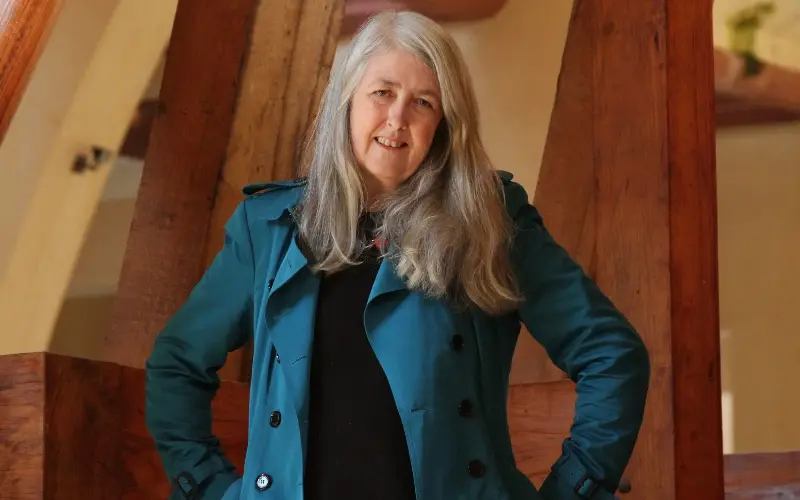
History teaching in schools has a “bloke-ish” fixation on dates and battles that is putting children off the subject, according to Dame Mary Beard.
The Cambridge University academic said children should be taught more engaging stories about how ordinary people lived and that the rote learning should come later.
A connection to history comes from the realisation that we have much in common with people who lived hundreds or thousands of years ago, she said, citing one of her favourite details from the ruins of Pompeii: the discovery of graffiti that reads “Atimetus got me pregnant”.
Asked at the Cheltenham Literature Festival whether schools were failing to engage children with history, Dame Mary replied: “My heart says yes. I think we are terribly fixated on dates and battles, what I would – don’t get upset, gentlemen – call bloke-ish history.
“I’m being a slight hypocrite because the other part of me has spent years examining students’ essays on Roman history and if they said that Caesar was assassinated in 43 BC [it was 44 BC] I would put a red line through it and say, ‘No, one mark off.’
“In the end, to do history well you’ve got to do some of that basic stuff but it is presented to people as if that’s all it is, that once you’ve got all the battles in your head you can then do ‘Atimetus got me pregnant’, whereas I think it [should be] the other way around.”
Visitors should be ‘encouraged to touch artefacts’
Dame Mary also argued that museums should open cases and encourage visitors to touch the exhibits.
In her new book, Talking Classics: The Shock of the Old, she recounts her experience of visiting the British Museum when she was five and seeing a 4,000-year-old piece of bread from Ancient Egypt.
She said a passing curator had seen her struggling to see the bread on its shelf and took it out of the case. “I have to say, it was total magic. Close to time travel is what it felt like,” she recalled.
“What is the job of the museum curator, or the academic, or the teacher? It is to open museum cases for kids. That’s how you make a difference. You get things out for them. You let them get close.”
Dame Mary added: “We will lose the connection to the past if we always put it off limits.”
However, she added that it would be “foolish” to touch some objects. “If you touch leather shoes from the Roman world, there very soon won’t be a leather shoe left. There are certain conservation rules. But quite a lot you can get up close and personal to.”
She said that the “please do not touch” instruction for ancient artefacts was only brought in during the late 19th century. “It probably goes along with the democratisation of the museum. When only the posh were allowed in, they were allowed to touch. When you let the great unwashed in, they weren’t,” she said.
During research for her book she was amazed to discover that visitors to the Tower of London in the early 19th century were able to touch the Crown Jewels.
“Now, they weren’t stupid and they knew you might nick them, so there was a grill and you had to put your hand through the grill in order to touch the Crown Jewels,” she said.
“But they got the point that the museum experience was about touching, the somatic and the sensory, and we’ve tended to lose that.”