



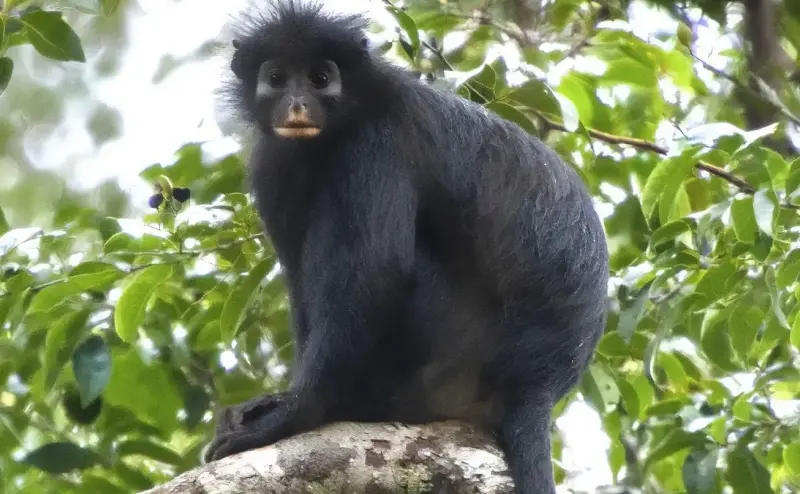
A new monkey species with orange lips and a black face has been discovered.
The black-furred primate, which lives in the Democratic Republic of Congo, can be identified by facial markings and a unique roaring call, scientists have said.
The “Likweli” monkey, as it is referred to locally, or Colobus congoensis, is the fifth new monkey species discovered in Africa in the last 75 years.
It was first sighted in 2008 in a partially obscured photograph, and researchers obtained a clearer image a decade later.
Now, genetic analyses have confirmed that the monkey has a distinct evolutionary lineage, diverging from its closest known relative, the Colobus satanas, between four and five million years ago.
The new species belongs to a larger group of colobus monkeys – a distinct group that does not have thumbs.
Researchers from Florida Atlantic University in the United States and the Lukuru Wildlife Research Foundation in DRC found the animals in a remote zone between the Lomami and Congo rivers in east DRC.
The species was often observed in small groups, living alongside other monkey species.
The Colobus congoensis has glossy black fur akin to that of their closest relatives, a long sweeping tail and a vivid orange patch around the mouth and nose.
Anatomical analysis, as well as cranial and dental studies, confirmed that the primates were a distinct species.
To discover a species means to formally identify and record a previously unknown organism that is genetically distinct.
Dr Julia Arenson, study co-author from the Yale Institute for Biospheric Studies, said: “We compared the skulls and pelts of the colobus congoensis with other species of African colobines, which underscored how unique this new species is.
“At the same time, despite being much smaller in body size, we also demonstrated it shares features of the teeth, skull and face with Colobus to the exclusion of other African colobines.”
Scientists fear monkey may be endangered
But after the research team carried out interviews in 52 villages in the Lomami National Park’s buffer zone, only people from eight of the villages recognised or were able to accurately describe the species, which was considered elusive and was rarely seen.
Locals also called the monkey “kasaba nkoni”, meaning “branch shaker”.
Researchers recorded 114 sightings of the monkey across a 656 sq-mile range between 2018 and 2022.
The animals are hunted for meat, and scientists are already concerned that the species may be endangered.
Junior Amboko, co-author of the study, said: “I was fortunate to be part of this discovery from the very beginning – from recognising in the first photographs that we were looking at something new in the forest, to training field teams to document its behaviour, analysing the data and helping write the scientific paper.
“It makes it even more meaningful that the name I proposed, Colobus congoensis, was chosen. The name honours the Democratic Republic of Congo, a country with extraordinary biodiversity, and reflects the incredible natural heritage that continues to reveal new discoveries.”