



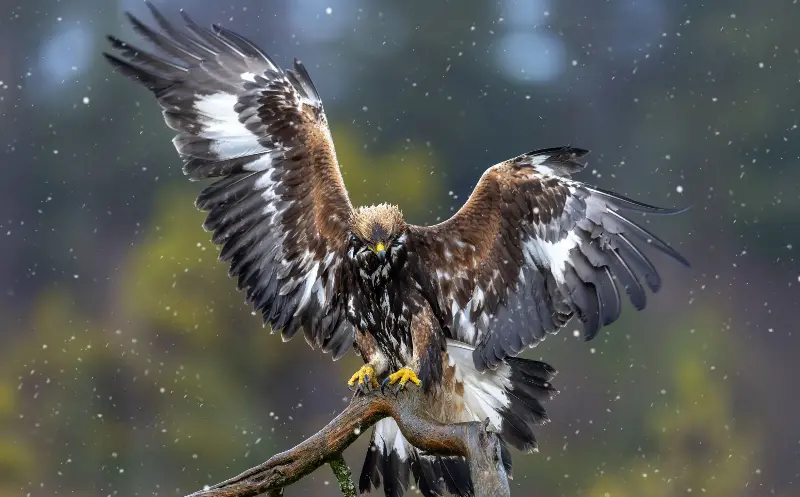
Golden eagles are set to return to the skies above England as part of a Government scheme to reintroduce the bird of prey.
The raptors were once widespread in Britain and mentioned more than 40 times in Shakespeare’s work, but there have been only a handful of pairs in England for the last 150 years.
England’s second-largest bird of prey is now poised to make a return as part of a recovery programme following £1m in funding from the Government.
Golden eagles have a wingspan of up to eight feet and are dwarfed only by the white-tailed eagle in Britain.
A study published by Forestry England has identified eight sites, mostly in the north of the country, that are suitable locations to sustain populations of the birds once more.
The programme could see juvenile golden eagles aged between six and eight weeks released into the wild as early as next year.
Emma Reynolds, the Environment Secretary, said: “This government is committed to protecting and restoring our most threatened native wildlife – and that includes bringing back iconic species like the golden eagle.
“We will work alongside partners and communities to make the golden eagle a feature of English landscapes once again.”
Widespread throughout Eurasia and North America, golden eagles went extinct in England and Wales by 1850 but continued to survive in small numbers in the remote Highlands of Scotland.
They were virtually wiped out in the Victorian era as landowners, shepherds and gamekeepers viewed them as a threat to sheep and grouse.
The apex predators feed on small mammals and birds such as hares or red grouse and are instantly recognisable with their brown plumage that turns golden around their necks.
They are one of two species of eagles native to the UK, alongside the white-tailed sea eagle. Despite their conspicuous appearance, they don’t like to be disturbed, building their nests on cliffs and high in trees in mountainous locations.
They enjoyed a brief resurgence in the 1940s and 1950s, following the two world wars, but numbers gradually declined again.
Only a handful of pairs have been seen in England since, and the last eagle died in the Lake District in 2016.
Plans to reintroduce the birds in Scotland were launched in 2018, when the South of Scotland Golden Eagle Project began relocating birds from the Highlands to a secret location in the Moffat Hills in an effort to reverse their decline.
Since then, the number of golden eagles in southern Scotland has hit its highest recorded level in centuries, with the population reaching nearly 50.
Satellite tracking data show that some of these birds have already begun to fly across the border and explore northern England.
Under the new project led by conservationist charity Restoring Upland Nature (RUN), it is hoped this trend will continue, bolstered by targeted reintroductions of the birds south of the border.
Experts believe Scottish birds could be seen across northern England within 10 years, but that it will take longer for breeding golden eagles to become established in England.
Alan Fielding, a conservation biologist involved in returning the birds to Scotland, said that it was essential that their reintroduction was done hand in hand with farmers to keep the public onside.
He added that their return presented a golden opportunity for tourism after birdwatchers began flocking to Moffat in Scotland to see the birds take flight.
Plans to reintroduce golden eagles are the latest step in the Government’s environmental action plan to halt the decline in species abundance by 2030.
Dr Cat Barlow, the chief executive of RUN, said: “This presents a truly exciting and potentially game-changing moment for the return of golden eagles to Northern England.
“Our priority will be to listen, to work in partnership, and to ensure that golden eagle recovery supports both nature and the people who manage these landscapes, so that everyone can enjoy the thrill of seeing golden eagles flying high once again across the uplands of the UK.”