



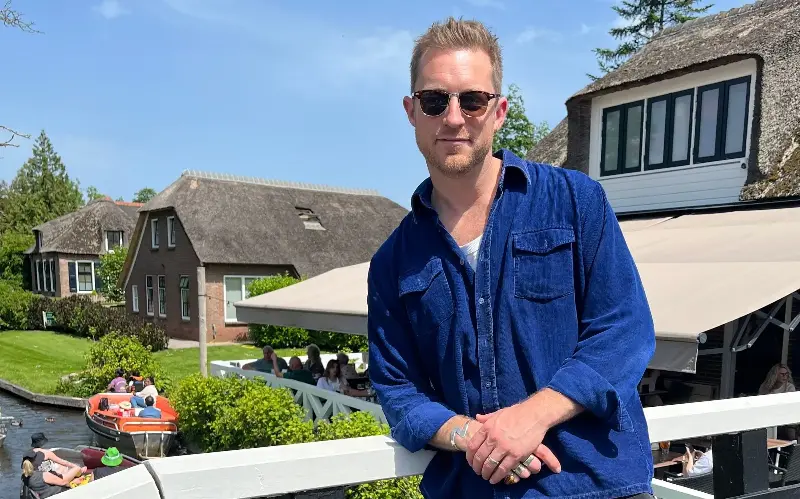
Tourists here walk around with big goofy grins, and I know I’m doing it too. You’d have to have industrial quantities of Botox in your face to not crack a smile at the sight of Giethoorn. This is a village of implausible beauty, the Netherlands’s very own Eden. They should prescribe it for depression.
I sit on a bench along a tree-lined towpath as frogs croak in the reeds and the sky turns orange. A boat glides by with two angelic little girls sleeping peacefully on the bow, while their parents share a bottle of wine at the stern, drinking in the fading light. What a life. Around me the evening chorus nears its crescendo. Boy, do the birds sing here.
I tune in while eyeing up the prim canal-side properties, with their thatched roofs and manicured gardens, private bridges and canals for driveways, little boats bobbing outside front doors. The hedges are uncompromisingly neat, the lawns like putting greens, the floral displays worthy of a gold at the Chelsea Flower Show. This village is a collective labour of love and almost too perfect to be real.
“People think it’s a museum,” says Giethoorn-born Joop Mulder, 51, who chats to me over the fence of his pretty waterside garden, while son Jacco sells fossils to passers-by. “People ask where the reception is, what time it closes.”
The Dutch Venice
Some are so smitten with the place that they buy homes here on a whim, but love is blind. Despite its idyllic aesthetic, life is harder than it looks in car-free Giethoorn.
“It’s a lot of extra effort, living here,” says Mulder, pointing to a house that’s had several owners in as many years. “We have to go by boat just to get our groceries. If you want a new sofa or fridge, it comes by boat. You have to plan. People underestimate it. For me, it never gets tiring.”
Then there are the tourists. More than one million visitors descend on this village of 2,600 residents annually – that’s about 577 for every local. Most, though, are day-trippers and disappear at 5pm. “It’s as though someone shuts a gate,” Mulder says of the sudden exodus.
Newspapers have written paradise-lost tales of overcrowded Giethoorn, the “Dutch Venice”, but Mulder thinks such reports are overblown.
“Word in the media is that Giethoorn has changed massively, but it hasn’t really,” he says. “It used to be a shorter season – that’s the big change. People come here from all over now, not just Europe.”
Indeed, some 350,000 tourists arrive from China alone. Signs in Mandarin hang on people’s gates explaining that their gardens are private property. “If you don’t have a fence, people go in,” says Mulder.
If you want a scapegoat for Giethoorn’s popularity, Dutch artist Willem Tholen is a good place to start. In the late 1800s, he and his fellow Hague School painters put this village on the map.
Prior to that, Giethoorn was a sleepy backwater, its canals shaped not by landscape architects but peat diggers, whose labours transformed the landscape into a patchwork of tiny islands, upon which houses and farms were built.
“The cows and pigs, we transported them by boat,” explains Mulder, a sales manager, whose parents were farmers. “Most farmers quit because they can’t make a living [here],” he adds.
Bedlam on the water
As I walk into the village, I watch sunbeams dance in the trees. Something beautiful happens when you remove cars from the realm: humanity breathes easier, in every sense. Nature, too. Adults linger, little ones run free. Is it any coincidence that Dutch children have once again been declared the happiest in the West by Unicef?
Life in Giethoorn moves to its own gentle rhythm. So much so that the pubs don’t know what time they close: “Whenever,” shrugs the lady collecting glasses at Grand Café Fanfare – a pub that takes its name from the 1958 Dutch film Fanfare, set in Giethoorn.
Over a beer, I watch the evening traffic along the main canal before walking over the bridge for a bowl of tagliatelle at Fratelli, a smart Italian where a cat keeps me company on the veranda.
The peace is broken as a boat passes by with half a dozen lads singing loudly in Dutch, swigging cans of lager as music blasts from a speaker. Someone hushes them from behind a hedge, but they sing on.
Incredibly, I meet someone who came to Giethoorn by accident. Brazilian Melissa Corbett was looking to stay in not-very-nearby Zwolle, but couldn’t find accommodation so booked here on a whim instead.
Keen, like me, to take to the water, we hire an electric boat together the next morning. “I can’t believe I came here accidentally,” she laughs, as we glide under wooden bridges and weeping willows. “It’s incredible.”
The main canal is bedlam. Day-trippers have arrived and it’s total gridlock, the dull thud of boats bouncing off each other ringing out across the town. Despite the water dodgems, locals glide through the slow-mo carnage with cool tempers and cold beers, Dutch flags fluttering proudly from sterns.
Eventually, we get moving and motor along to a nearby lake. Corbett keeps chuckling to herself. Giethoorn has that effect. “It’s just so beautiful,” she says.
The lake is busy with boats and kids splashing in the water, which is shallow enough to stand in – and clean. It wasn’t always that way, though.
“In the 1980s there was a film of oil on the water from all the engines,” says Gea Ardesch, owner of The Black Sheep hostel, as we moor up near her property. “Now we have all these clean, electric boats, which are silent.”
Ardesch acknowledges the tension between tourism and local life. “Some people complain, but most are reliant on tourists in some way,” she says. “Tourism saved the bus route here – I think that’s not appreciated enough.”
There is a less touristy side to Giethoorn, too, which Elbrich Elsenga invites me to explore on a stand-up paddle board. Elsenga lives in Groningen, about an hour north, but works at The Black Sheep part-time.
We paddle south out of the village along a quiet canal. The banks become wilder, more overgrown; the gardens less preened, more real. “Not many tourists make it this far,” she says.
The canal opens up on to another lake, which we have to ourselves. I sit down on the paddle board, listening to birds chirrup in the reeds as planes criss-cross the sky, going nowhere, surely, as perfect as here.
“It’s a utopia,” says Elsenga, seemingly reading my mind. “There’s nowhere else like it.”