



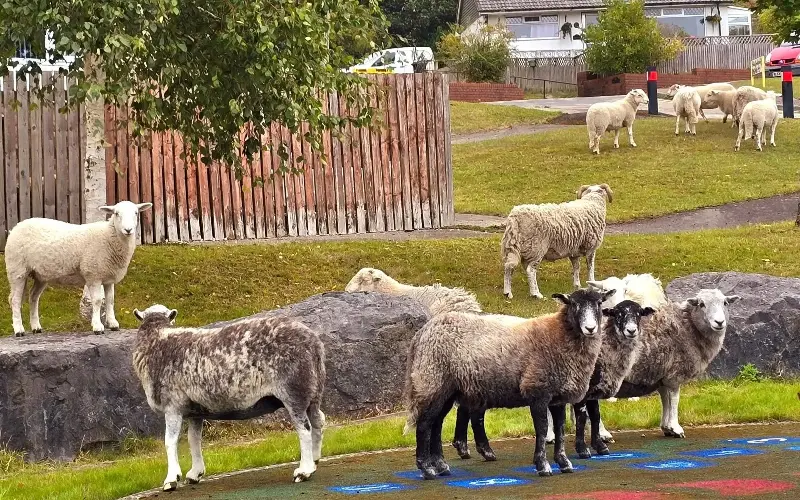
I have some sympathy for folk in that Welsh community which, thanks to vandalised and gap-toothed fencing, now shriek they are at maximum sheep. I once lived in a Hebridean hamlet – a splash of green hemmed in by lugubrious mountains – where most of my neighbours seemed to be called Donald Morrison.
Don, Donny, Dan, Dolly and Domhnull Beag simply adored their sheep. In that era they had sturdy faces, dainty, crag-climbing hooves and black, distrustful eyes. But sheep are, seemingly at least, anything but sturdy. They are prone to innumerable diseases, in many of which the first symptom is death, and therefore need constant medication.
Crofters murmur in low tones of husk, the braxy, joint-ill, hoof-rot, the louping-ill and fly-strike. With one exception, our woolies also have a very strong flocking instinct. In fear, they instinctively bundle together, which is how a skilled stockman and his dog – with cries of “Way to me,” and “Come by!” – can usher them effortlessly into another field, a handy fold, or up the ramp of a mainland grazier’s truck.
The exception is the Soay sheep, a rare Hebridean breed whose spectacular horns put you in mind of a Black Mass. Working Soays is the stuff of Homeric epic. The late Queen kept a flock at Balmoral.
On first acquaintance, sheep can seem remarkably thick too. In the days before miles of rylock fencing became widespread, any drive in the Outer Hebrides called for considerable caution because sheep have no road sense whatsoever. In particular, they have absolutely no directional hearing, and so are as apt to run towards some thundering pantechnicon as away from it.
But they can also endure great hardship, trek for many miles (there are tales of ewes, which, having been sold to someone near Stornoway, were balefully back within 48 hours on their Harris lot), and are capable of astonishing agility.
Around 1992 there was a sensation when a solitary sheep was espied one day atop a towering rock stack by Dalmore beach on the Isle of Lewis. The climb would have made Sherpa Tenzing blench, but this wether – a castrated male – had, incredibly, accomplished it.
Folk flocked to see him, the local paper dubbed him Man Friday and coastguards plotted how he might be rescued – but one morning, all innocence, Man Friday was found back on Planet Earth, plump and unscathed.
Sleep at this time of year in the islands – with the “white nights” bracketing the midsummer solstice – can be elusive. It is especially elusive when the cuckoo yet booms, regardless of the hour, and the only corncrake in the village has laid grating claim to the croft across the road.
But both are capped by a naughty, wandering, lost lamb suddenly in a panic for its Mum. It’s “Meh,” and “Bah,” (and “Bah!” and “Meh!”) at ever-decreasing intervals – until blissful silence falls when Junior is once more plugged into the milk-bar.
In the goofy vulnerability of sheep is their very charm. And yet they have been extraordinarily honoured. Who were the first visitors at the crib of baby Jesus? Humble shepherds. How did John the Baptist first proclaim Him? “Behold the Lamb of God, that taketh away the sins of the world.” And what is the last glimpse in Scripture of the Good Shepherd, the exalted Christ?
It is a Lamb as it had been slain – throat-slashed, yet King of Kings. “We herd sheep,” General George S Patton once thundered. “We drive cattle. We lead people. Lead me, follow me, or get out of my way.”