



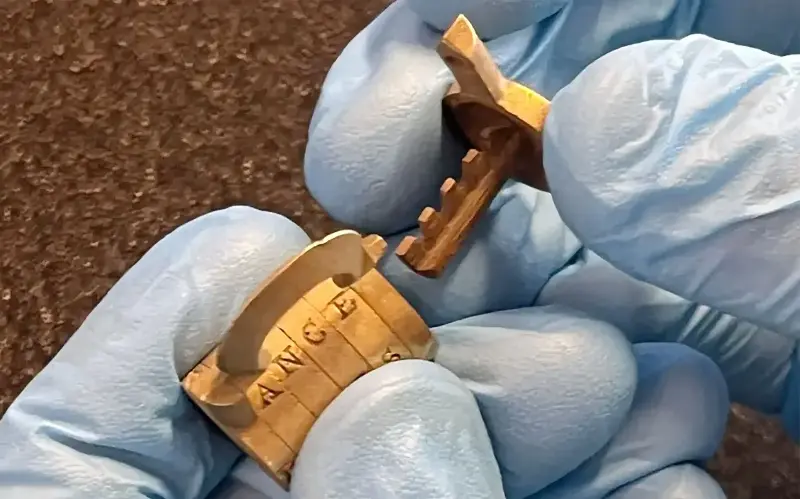
A 16th-century lock found by a detectorist on a beach in Wales has finally been opened after a CT scan revealed the code.
Researchers used the scanning technology to work out the four-letter combination needed to open the brass lock. It had remained a mystery since the lock’s discovery in 1999.
Peter Hughes, a metal detectorist, found the hoard from the Ann Francis merchant ship on Margam Beach near Port Talbot 27 years ago.
He said he was “delighted” the experts had cracked the code – which turned out to be “A-N-C-E” – after he had spent years trying to decipher it himself.
Mr Hughes said: “I tried to unlock it for about 20 years, I tried moving the dials, finding the right combinations, and I failed. But with the aid of modern technology, we’ve been able to crack what’s like the Da Vinci Code, really.
“For me, it’s like opening the Ark of the Covenant, and I’m delighted, truly thrilled.”
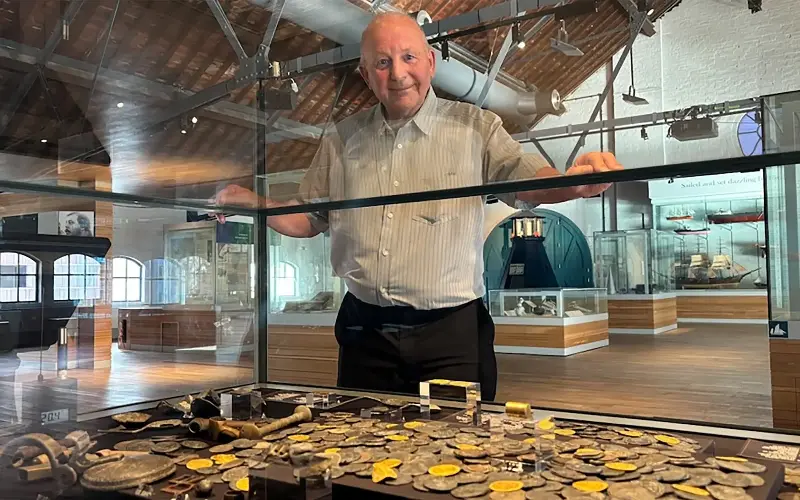
The vessel was shipwrecked in a storm on Dec 28 1583, while returning from Spain, and its valuable cargo remained untouched beneath the sand for centuries.
Experts believe the lock, found near a collection of Spanish silver coins and two coin weights, could have once protected these objects or secured a chest containing valuable items.
The lock has four rotating rings, each bearing six letters, giving 1,296 possible combinations.
Museum Wales and Cardiff University researchers have used CT scanning to reveal the letters needed to be “A-N-C-E”, meaning the lock could be turned for the first time in centuries.
Dr David Williams, a research associate based at the Musculoskeletal Biomechanics Research Facility at Cardiff University’s School of Engineering, said he had been “sceptical” when asked to use a scanning device to find the secret word.
He said: “We did a first scan to see if we could see anything and we were quite surprised that we could see letters. The second scan went terribly, but with the third scan, we tried a different approach, and figured out the code. I was blown away that we actually cracked it.
“Micro-CT scanning allowed us to look inside the lock without damaging it. By creating a detailed 3D image of the internal mechanism, I could see how the notches lined up with the letters and identify the exact combination.”
Mr Williams added: “We normally use this technology to study bones and other biological structures, so investigating a 400-year-old padlock was certainly a first for us.”
Alastair Willis, senior curator at Museum Wales, said the discovery was incredible.
He said: “It’s really complex because there are so many combinations. Also, confusingly, there are other letters on the ends which don’t move, which are unrelated, and it’s like they were to mislead any potential burglar.”
The artefact is among a collection from the wreck on display at the National Waterfront Museum in Swansea. Other highlights include rare gold coins from the reign of Ferdinand and Isabella of Spain, and a boatswain’s whistle.
The exhibition, Tides of Treasure, is on display until June.