



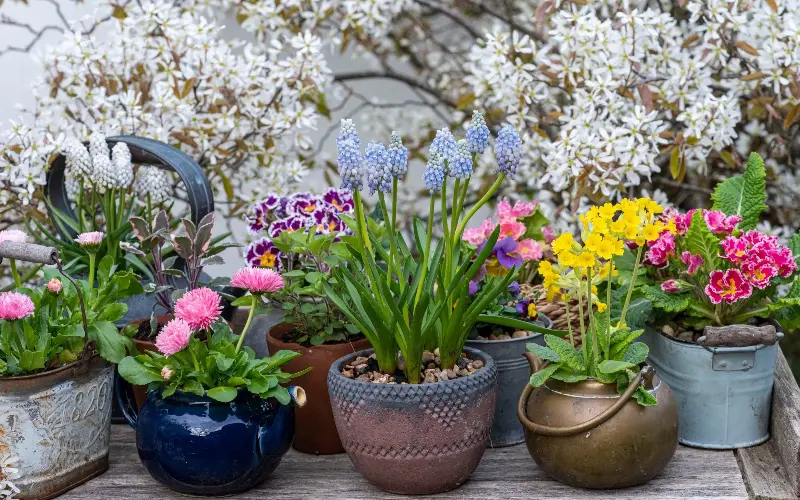
After weeks of gloomy grey skies and rain galore, it’s time to add some spring colour to your garden. We’re about to witness the glorious arrival of spring, and that’s an event not to be missed. Garden-centre and nursery benches are groaning with easy-to-grow perennials and pots of spring bulbs, and they’ll lift your spirits to a new level. Here are my top 10 easy plants for some much-needed spring zing.
Cyclamen coum
These three-inch-high beauties come in every shade of pink, from Barbara Cartland fuchsia to gentle apple-blossom white. Their swept-back petals normally have a darker nose and their kidney-shaped leaves come in shades of green, weathered pewter and silver. Find them a bright, well-drained position, perhaps on the south-facing side of a hedge or on the edge of a sunny path. The brightest pinks show up best and, after the flowers have been pollinated, the ants will roll the seeds around as they lick the sticky coating away so you’ll always get babies close by. Flowering lasts several weeks and cold weather doesn’t deter them: they’ve even survived this year’s heavy rain. The walnut-sized tubers stay small, so segregate them from any autumn-flowering Cyclamen hederifolium in your garden, whose dinner-plate-sized tubers will smother them.
Narcissus ‘Tête Bouclé’
You’ll find lots of miniature daffodils in pots, and this double form of Tête-à-tête is the same warm yellow, but with a tasteful touch of green as well. The fully double flowers are petal-packed, so there’s no pollen and nectar, and the bees can’t pollinate them. As a result, the flowers last far longer and all double flowers share this trait. You might also spot the greenish-yellow double Rip van Winkle. These miniature treasures look best raised up, perhaps on a plant theatre. After flowering has finished, place them somewhere dry and plant the dried-out bulbs in autumn.
Pulmonaria
Make friends with the bees and add some pulmonarias, because the flowers are able to replenish their nectar within moments, so they’re bee magnets. Many have linear leaves splashed in silver spots and their foliage makes a good feature long before the flowers appear. The pink-red ones flower earlier and, after pollination, they change colour, so the flower head glows like a gas-flame as shades of violet appear. Good readily available pink-reds include Raspberry Splash and Shrimps on the Barbie. Trevi Fountain is an excellent cobalt blue and the foliage is evenly spotted in silver. It is sun-tolerant, as is Raspberry Splash, while others prefer a shady woodland edge.
Muscari and Scilla
Both of these miniature bulbs are very bee-friendly, but you have to be selective. Avoid Muscari armeniacum at all costs, unless you want a garden full of it. Seek out Peppermint – a white-rimmed pale blue colour-washed in green. The Ocean Series, selected forms of Muscari aucheri, can also be found now and won’t spread. You may also spot the deep-blue Scilla siberica, a gem that does well in shadier positions. Leave Scilla bifolia though – it’s another over-willing coloniser.
Prunus incisa ‘Kojo-no-mai’
This ubiquitous compact flowering cherry, more shrub than tree, has meandering branches indicating a slow growth habit. It’s smothered in tiny flowers in March and each pale-pink flower is encased in a darker calyx, so it provides horticultural confetti. All flowering cherries need good drainage, because most have been collected from the mountainous slopes of Japan. Many are showy affairs, but this one will flower well even under a lightly wooded canopy. It can be grown in a container.
Primrose belarina series
The garden centres are awash with large-flowered gaudy primroses, but these aren’t hardy. The Belarina Series, bred by Kerley and Company in Cambridgeshire, will last for many a year. The colour range includes strong blues, violet-mauves, reds, vanilla-whites and yellows. They’re all fully double, so they flower on and on, and many of the flowers are encased in a green ruff so they epitomise spring. Belarinas make great garden plants, given good soil and partial shade. They’ll last longer in the ground than in a pot.
Euphorbia
You’ll be spoilt for choice with evergreen euphorbias, many of which are on sale now. They have sumptuous foliage followed by long-lasting flowers with tough colourful bracts. The only maintenance needed is a chop down in late May or June, to encourage new growth at the base. Cuttings can be taken from the offcuts. You’ll find Miner’s Merlot, admired for its sultry velvet-textured foliage and lime-green flower heads. There’s a new one, Walberton’s Little Treasure, with golden-green foliage that colours up to green and warm orange. Deciduous euphorbias include Euphorbia epithymoides, previously Euphorbia polychroma. This one flowers with the bluebells, producing lots of acid-yellow heads above a foot-high cushion of foliage. It brightens up shadier areas and makes the perfect background for blue flowers and bulbs.
Geranium ‘Sabani Blue’
This is the earliest hardy geranium to flower for me, with enormous, long-lasting, violet-veined dusky-blue flowers in March. The lobed green foliage provides a winter feature as well. Plant it on a sunny edge of the border and this sterile hybrid will flower for weeks.
Erysimum
Ignore the fragrant bedding wallflowers in trays, because they are biennial and will fade away after flowering. Seek out some of the potted perennial ones instead, because these will flower for many weeks and come back for two to three years before flowering themselves to death. They lack fragrance, but make up for that with flower power. You’ll find the classic grey-leafed Bowles’s Mauve, which will flower throughout summer, given a sunny position. Constant Cheer is a mixture of mauve and peach, and the more vivid Winter Orchid is tomato-red and purple. The compact and fragrant F1 Sugar Rush Series produce lots of flowers over many weeks, but they aren’t truly perennial. I’m after Red Jep, a dark-leaved wallflower topped by a mixture of hot-pink or warm-red flowers. Perfect for a pot.
Anemone blanda
This sun-loving anemone has upward-facing flowers ringed in ray petals that radiate outwards. The upward-facing stance of the flowers tells you it’s a sun lover. Given full sun and a warm spot, it will self-seed and colonise, but not aggressively. Blue Anemone blanda surrounding the swirling brown Carex testacea is one of my favourite spring combinations, whether in a pot or in the ground. You can also find White Splendour and several pinks – although the blues do it for me. You may see wood Anemones or Anemone nemorosa too, but their pastel-tinted flowers nod their heads, indicating a need for moist woodland shade: don’t confuse the two.