



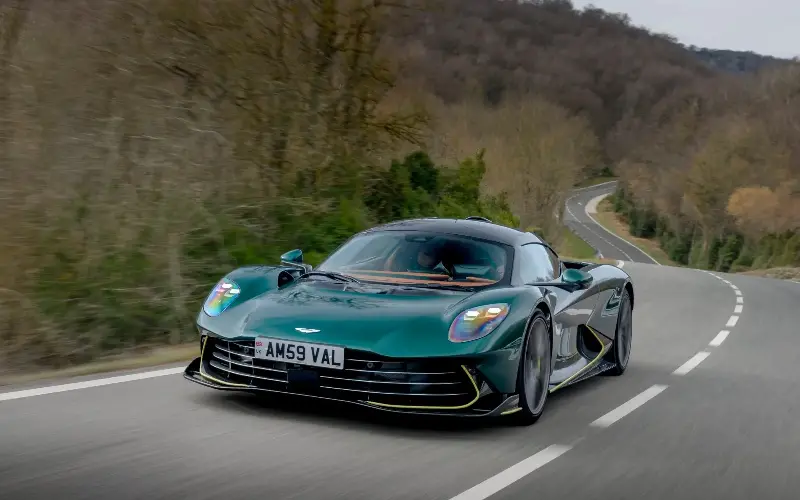
You need to be careful what you wish for in the supercar game. Ask anyone starry-eyed enough to have placed a £50,000 deposit on the V12-engined Jaguar XJ220 concept when it debuted at the 1988 British International Motor Show, but discovered when their production car was delivered more than four years later that it had a turbocharged V6 engine from a Metro 6R4 rally car…
In the case of the Aston Martin Valhalla, however, the cylinder count goes the other way. The concept for this car, Project AM-RB 003, appeared at the 2019 Geneva show with a 3.0-litre, twin-turbocharged V6 engine in the middle. The idea was that it would sit under the £2.5 million, 6.5-litre V12 Valkyrie, both sharing names derived from Norse mythology.
The Valhalla (from Odin’s Hall of Heroes, where slain warriors were laid to rest), billed as “son of Valkyrie”, is Aston’s first series-production mid-engined road car – for the record, the Valkyrie was a very limited edition of 275, the 1979 Bulldog was only a concept and the 1981 Nimrod was a racing car (and not strictly an Aston Martin).
By 2021 it had a cameo role in the Bond film No Time To Die, but with a distinctly different engine note to a V6. In fact, under Aston’s then chief executive, Tobias Moers, formerly of Mercedes-AMG, the V6 had been replaced by a 4.0-litre, AMG-built V8 with its twin turbos between the two banks of cylinders. A plug-in hybrid, the engine’s power was augmented by a 6.1kWh lithium-ion battery and three electric motors – one at the back driving the gearbox and two at the front. As well as increasing the overall power, the motors (along with an electronic rear differential) provided greater stability if, for instance, the driver applied full power midway through a corner.
The total in this instance is 1,064bhp at 6,700rpm, with 811lb ft of torque, the engine providing 818bhp and 632lb ft of this, providing a top speed of 217mph and 0-62mph in 2.5sec. The quoted fuel economy is 20.32mpg and CO2 emissions are 275g/km; you would need to be driving in glass slippers to achieve anywhere near these figures.
Reassuringly expensive
Initially the Valhalla was going to cost more than £1 million, but by 2021 Moers was talking about nearer £900,000.
At this point you might be asking yourself how on earth Aston Martin can justify charging £850,000 for a cut-and-paste version of the £407,617 Ferrari 849 Testarossa or the £259,000 Lamborghini Temerario. I found an example of the pioneer of this three-motor layout, the second-generation Honda NSX, for about £90,000.
The trite answer is that Aston needs the money. It has just fired 20 per cent of its workforce (some 600 people), with the aim of saving £40 million a year; it is on its fifth profit warning since September 1994; and it is making super-serious losses, rumoured to be much larger than the previously forecast £190 million in 2025. New car deliveries in 2025 of 5,448 units were 10 per cent down on 2024 (about half that of Lamborghini), and the company has recently sold its naming rights to its Formula 1 team.
Under the skin
But the Valhalla is different to the Italian pair. First it has a carbon-fibre monocoque central bodyshell (called a tub), which hasn’t been the easiest thing to engineer.
The lower portion is a resin-transfer moulded carbon-fibre item – expensive but strong, good for load-bearing and lending itself to complex shapes. The upper body is pre-impregnated carbon fibre; fabulously expensive but of aerospace quality and very light. It weighs 1,655kg dry, so about 1,755kg with fuel, oil, coolant and screenwash.
The suspension and drivetrain components are mounted on aluminium subframes at each end, while the wings and doors are carbon fibre.
And it looks sensational, as if it had driven straight off the grid of a 1980s Le Mans 24 Hours race. Wings, vents, funnels and venturi draw in the eyes; what do they all do? Spoiler alert: some don’t do anything apart from play a similar role to that of a side split in an evening dress, tantalising but revealing little.
The Valhalla has active aerodynamics. Not only the enormous rear wing, which at times rises as an air brake, but also at the front; under the valance/splitter is a swinging cross-car wing channelling the coming gale under the flat body, helping to deliver downforce of up to 600kg at 150mph.
The springing is passive, but the Bilstein dampers are active, continually changing their resistance to movement. To keep the front low, the springs are laid horizontally (visible below the windscreen) and actuated via bell cranks, like a racing car.
There’s a lot of technology to support the mighty engine, all doing complicated things but with a surprisingly simple set of controls; the driving modes are EV, Sport, Sport+ and Race, while you can also increase the damper force.
Inside job
The large doors lift to reveal a surprisingly large aperture to climb in. It’s best summed up as sparse and workmanlike, but comfortable. Apart from the door pockets, there is no luggage space whatsoever.
The racing-style seats will be tailored to suit each customer. I found them comfortable and as gripping as a squeeze from a giant squid. Aston says the drive sits 15mm lower than in rivals, not that I noticed. The low screen top and bonnet line give a distinct impression that what you should be seeing is a portion of the Le Mans 24 Hours circuit.
Large gear change paddles and a simple engine start/mode selector add to the race-car impression, but the twin oblong screens and row of tricky buttons under the central touchscreen are old-fashioned and unprepossessing; I’d wanted more drama.
That comes when you press the starter and, as long as you haven’t selected EV or Sport modes, the V8 belts into life. The AMG engine (although it is built in Italy for Aston Martin) is ludicrously powerful and delivers an almost flat torque curve, with a coterie of electric helpers to keep the massive turbos on the boil. Its flat-plane crankshaft makes it faster-revving, despite greater vibration and a less charismatic note, than a more traditional cross-plane crank.
On the road – and track
My first drive was at the fast, challenging Circuito de Navarra. My boss usually tells me off for talking about what purports to be a road car is like on a smooth racing circuit, but surely here will be the Valhalla’s hunting ground. And it’s very, very good.
Most of the opposition give you a feeling that the front motors, electronic differential and stability electronics are there like a catcher’s mitt to scoop up the ball if you drop it.
Not the Valhalla. Instead vehicle performance director Simon Newton and his team have wrought something entirely different, where all the systems seem to work to provide pleasure in going faster – and that’s surely the point.
With all that power its pace is a given, but it’s the way the engine bellows – while delivering the same sort of thrust at 4,000rpm as it does at 7,000rpm – which folds time around you. Not needing to rev it hard, you can change up early and savour the torque, the gearbox engaging with a satisfying bump. You are never aware of the electric motor at the other end of the gearbox, driving a separate gear set (the even ratios), simply a seamless swooshing shove which never lets up.
Changeable character
The various driving modes provide two distinct characters: in maximum-downforce Race mode it feels planted, stiff and ultra-responsive to steering inputs; in the more hybrid-involved (therefore faster) but softer Sport+ setting it feels more playful, allowing the tail to drift wide if you gently ease off the accelerator and generally leaving you in awe of what it just allowed you to get away with and how far you can push the grip of the Michelin Pilot Sport tyres. I was out of breath after one five-lap stint, laughing like a fool after another.
And I promise you, at no time do you feel the safety systems policing the fun. Even with the electronic stability program switched on, it would wag its tail like my Labrador, slide like an Olympic skater and effortlessly blast down the straight.
The brakes, meanwhile, are amazing to the extent that stopping distances may increase if you don’t press the pedal with sufficient force.
On the road, its 4,748mm length and 2,014mm width make themselves felt, so caution is a requisite. Carbon-fibre cars I’ve driven previously have felt almost too stiff, with an annoying clackety racket akin to a rally car on gravel as stones are flicked into the wheel arches.
Aston Martin has not reinvented the genre, but there is enough compliance in the damping to provide a firm rather than rock-solid ride quality. And on the odd occasion the road opens up, simply easing on the accelerator pedal allows you to experience the feeling of relentless force that the Valhalla engenders.
The Telegraph verdict
Aston has sold 150 Valhallas so far and has more than 500 to build this year – and since they won’t be for stock, presumably they are sold. Apparently all 150 buyers have extensively customised their cars, so I’d vouchsafe that the final cost of each will be nearer £1 million than the £850,000 list price.
The Valhalla is extremely good, but is it worth that much? As rivals, Aston Martin points not to the cheaper Ferrari Testarossa or to the Lamborghini Temerario but to hypercars such as the £3.1 million Ferrari F80 or the £2 million McLaren W1, even the £3 million Lamborghini Fenomeno. All similar in layout, all capable of retina-melting speeds and acceleration, all limited in production numbers – only 29 of the Fenomeno will be built.
These numbers become meaningless in the end; most customers will have a couple of the above, perhaps all four. Comparisons become absurd, ordinary folk like you and me failing to see the point, but in some ways that is the point. Like supermodels (male and female) they exist simply to remind us of another world of the unobtainable.
As Newton told me: “We were looking for an Aston Martin interpretation of a mid-engined car, with comfort, breathing over bumps, with steering feedback and ride, qualities of reaction that are ours.”
Job done, then. And while they’ll remain a rare sight, you might feel a sense of pride that this company, with its British workforce, can meet – and more than match – the opposition, if it chooses to.
The facts
On test: Aston Martin Valhalla
Body style: Two-seat plug-in hybrid supercar
On sale: Now
How much? From £850,000
How fast? More than 217mph, 0-62mph in 2.5sec
How economical? 20.32mpg
Engine & gearbox: 4.0-litre 818bhp/612lb ft twin-turbo V8 petrol with plug-in-hybrid system of two electric motors at the front and one at the rear plus 6.1kWh lithium-ion battery, eight-speed twin-clutch gearbox, four-wheel drive
Maximum power/torque: 1,064bhp/811lb ft
CO2 emissions: 275g/km (WLTP Combined)
VED: £5,490 first year, £620 next five years, then £195
Warranty: Three years, unlimited mileage
The rivals
Ferrari 849 Testarossa Berlinetta, from £407,617
Based on the previous SF90, this revives a famous old model name with a style straight from the Seventies. Agile and sharp, the powerful Ferrari challenges your driving ability – but best not try that on a wet road.
Lamborghini Temerario, from £267,000
Impressive debut for this Huracán replacement, with a similar drivetrain layout to the Aston and the Ferrari. Good to drive and surprisingly comfortable, but my test car costs well over £400,000 including the optional extras.