



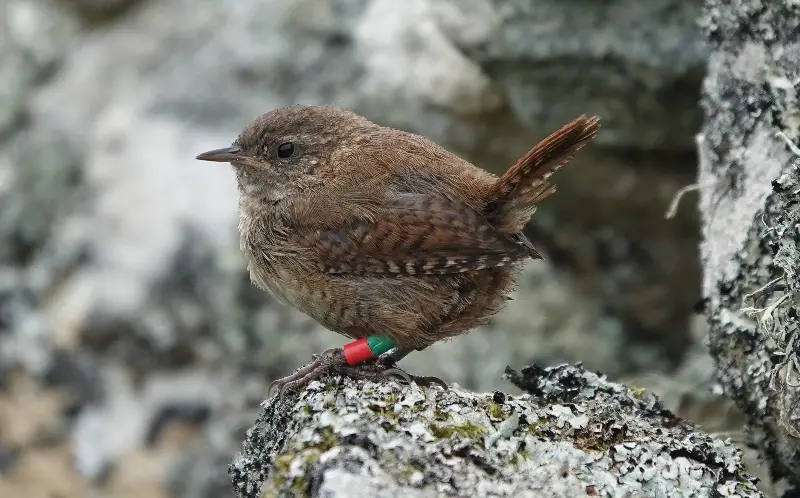
Wrens on Scottish islands are double the size of their mainland counterparts and on their way to becoming a new species.
Birds on Shetland and St Kilda are isolated from other populations and experience “island gigantism”, scientists have found.
While a wren in England will weigh between seven and 10g, they range from 13-16g on St Kilda.
The largest St Kildan wrens are more than twice the size of the smallest on mainland Britain, while those on Shetland are 2.9g heavier than their mainland cousins. Wrens on the Outer Hebrides are also nearly a gram heavier.
Island gigantism occurs in isolated environments where animals are protected from predators and competition, allowing them to thrive.
On the mainland, wrens are threatened by pet cats, foxes, and birds of prey such as hawks and owls, while their nests are threatened by squirrels and rats. There are far fewer predators on the islands.
As well as their “giant” size, the wrens have developed other island traits, including distinctive songs and subtle differences in plumage and body proportions.
Dr Michał Jezierski, a biogeographer from the University of Birmingham, said: “Their island gigantism is a case of ‘parallel evolution’, where a similar original population – probably colonists from the British mainland – made it to each island archipelago, and then independently evolved to become island giants.”
Dr Jezierski continued: “We found that all four Scottish wren subspecies are genetically distinct from the wrens of mainland Britain; with the wrens of Shetland and St Kilda being especially distinct in both appearance and song.
“Their genetic distinctiveness is so high that it is likely they are on their way to becoming a new species.”
Island gigantism occurs across the world, and explains the unusually large size of animals such as the giant tortoises of the Galápagos, the Komodo dragons of Indonesia and the giant weta of New Zealand, the world’s largest cricket.
The effect is reversed in larger animals, which tend to become smaller when they are isolated on islands.
Dwarf elephants existed on Sicily and Malta during the Pleistocene, and there was a species of tiny human – Homo floresiensis – which stood just 3ft 6in tall and lived in Indonesia until around 50,000 years ago.
Island dwellers tend to evolve longer lifespans, slower rates of reproduction and, in birds, less ability to fly.
The extinct dodo of Mauritius was one example of a bird that grew much larger than similar species, and lost its flight.
Researchers examined wrens on Shetland, Fair Isle, the Outer Hebrides, and St Kilda, taking body measurements, song recordings, and sequencing their genomes to look for genetic differences compared with mainland birds.
Fair Isle was the only population that was not significantly different in size from the mainland British wren.
DNA studies showed that each island population was genetically distinct, with Shetland and St Kildan wrens found to have the biggest genetic differences to mainland populations.
The Scottish wrens were also found to have a more languid singing style, with songs that included “buzzes”, unlike birds on the mainland. Songs from St Kildan wrens were found to have a lower bandwidth and were of shorter duration.
Shetland birds had longer and deeper bills, while St Kildan birds had wider bills, and longer tails and wings.
Will Smith, from the University of Nottingham and a co-author of the study, said: “Our research suggests that islands with similar environments can produce similar evolutionary outcomes using different genetic pathways.
“The wrens of Scotland provide us with a powerful case study to understand the mechanisms by which island biodiversity is generated worldwide.”
The research was published in the Evolutionary Journal of the Linnean Society.