



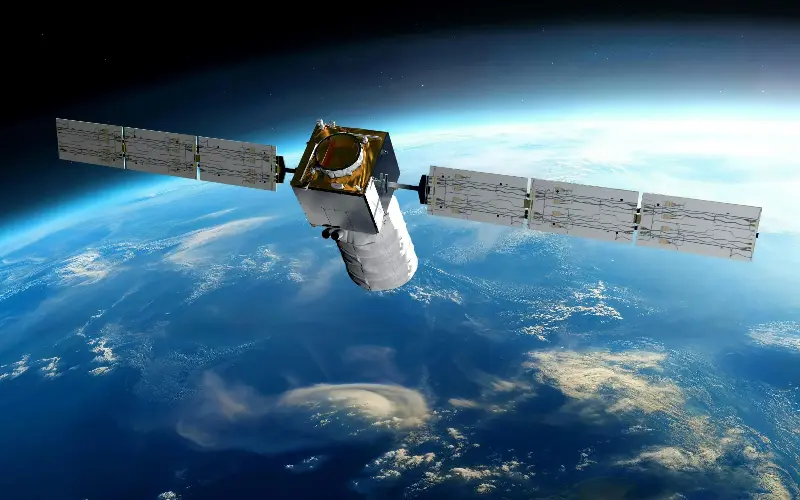
A laser satellite that will forecast heatwaves and hurricanes earlier – and may prevent a future “Michael Fish moment” – is to be built in Britain.
The Aeolus-2 satellite will sweep from pole to pole, shooting ultraviolet lasers into the lowest 18 miles (30 km) of the atmosphere, before analysing the light that bounces back from particles such as aerosols, dust, and cloud droplets.
As the particles move with the wind, the frequency of the returning light is slightly shifted – the Doppler effect – allowing the instrument to see how the wind is behaving.
The satellite, commissioned by the European Space Agency (ESA) and scheduled for launch in 2034, and will significantly improve weather forecasts, predicting wind-driven events such as heatwaves or storms 24 hours earlier than is currently possible.
And it should prevent a repeat of the forecast delivered by Michael Fish when huge storms arrived unexpectedly from the Bay of Biscay in 1987 after the BBC Weather forecaster said they were unlikely.
Martin Davidson, the Aeolus-2 programme lead at Airbus, which is building the satellite at its factory in Stevenage, said: “It will definitely help avoid those Michael Fish embarrassments for future events, which happened because of unpredicted strong winds, and it will increase advanced warning for emergency events and disaster resilience.
“The recent heatwave was an example of a heat dome suddenly landing from north Africa and southern Europe, and it is winds that are driving these up to us, so Aeolus can predict when they will appear.
“It will be able to predict the movement of volcanic plumes of ash that can threaten aviation, as well as storms that can damage infrastructure. So it’s much more than whether we can have a barbecue this weekend, or whether we need to stay indoors.”
He added: “Scientists and forecasters are really crying out for this to be launched to get this wind data, as it is totally missing at the moment.”
‘The forefront of satellite weather forecasting’
Named after the ancient god who was “keeper of the winds” in Greek mythology, Aeolus-2 is the follow-up to the demonstrator satellite Aeolus which was launched in 2018 to see whether the technology would work.
Currently, wind measurements are made by weather balloons, or by pilots passing on readings mid-air.
But during the Covid pandemic, data from Aeolus was used to fill gaps left when planes were grounded, and it was used to track the Hunga Tonga volcanic eruption in 2022.
The pilot satellite was de-orbited in 2023 and there has been nothing giving real-time data on winds around the globe since then.
Aeolus-2 is bigger and more powerful than the original test satellite, and will be able to process 60 times more data during its five-and-a-half-year lifespan, taking measurements every 0.01 seconds, and scanning the planet every seven days.
Ben Boyes, ESA’s Aeolus-2 project manager, said: “Aeolus was a trailblazing mission that demonstrated, for the first time, the immense value of measuring global winds directly from space.
“This next-generation mission will ensure that global wind observations become a permanent component of the weather forecasting infrastructure, helping societies around the world prepare for increasingly complex weather and climate-related challenges.”
The satellite will be launched from the European Spaceport in French Guiana, and there are already plans in place to replace the satellite with updated versions once it reaches the end of its life in 2039.
It will also be one of the first to have the ability to send itself back to Earth at the end of its mission amid concern about the amount of space junk in orbit.
Simonetta Cheli, the European Space Agency’s director of Earth observation programmes, said that Aeolus “exceeded expectations and demonstrated the transformative impact that space-based wind observations can have on weather forecasting”.
“Aeolus-2 represents the natural evolution of that achievement – from pioneering research to an operational service that will benefit citizens and businesses worldwide,” she added.
Liz Lloyd, the UK space minister, said: “The UK has been at the forefront of satellite weather forecasting since the original Aeolus mission.
“Aeolus-2 will deliver real benefits for people across the UK, from more accurate weather forecasts that protect lives and communities, to the highly skilled jobs that come from being a key partner in Europe’s most ambitious space science programmes.”