



When you’ve got a house that doesn’t tick all your boxes, it can be tempting to think that an extension will solve your problems. “People see a house and recognise that it doesn’t work for them,” says interior designer Nicola Harding, “but they imagine that what needs to be done to make it work is much deeper and more wholesale than perhaps it really is.”
The cost of extending is already high, at around £3,000 per sq m in the South East (around half that in the rest of the country), according to a survey by Checkatrade, and is expected to increase due to the war in Iran, according to property experts. But in Harding’s view, extending isn’t always necessary. Instead, reworking floor plans and making clever use of space can save both money and time. “It’s amazing how even the smallest flat can be gently reshuffled to make a momentous difference to how one’s life feels, without costing a fortune,” she says.
She points to a recent project she transformed using all the tricks in her toolbox. A Victorian semi on the banks of the Thames had originally been one large house, but over the years had been carved up into three separate properties. An older couple had lived there for years before the new owners – Harding’s clients – bought it. By the time the family, with two young children, took it on, it had become “a rabbit warren of spaces that didn’t really make sense and weren’t user-friendly,” she says.
Falling in love with the generous proportions of the house, along with the location and river views, the new owners were desperate to make it work for them, and first called in an architect, who drew up plans for a “glass box” extension at the back of the house. But when Harding was brought in, she could see a more sympathetic, easier, cheaper way to achieve what they wanted by reconfiguring the space that was already there. She told them: “There’s a reason you were drawn to that building in the first place. The work should make the most of that, not replace it entirely.”
Reworking the floor plan to create more light
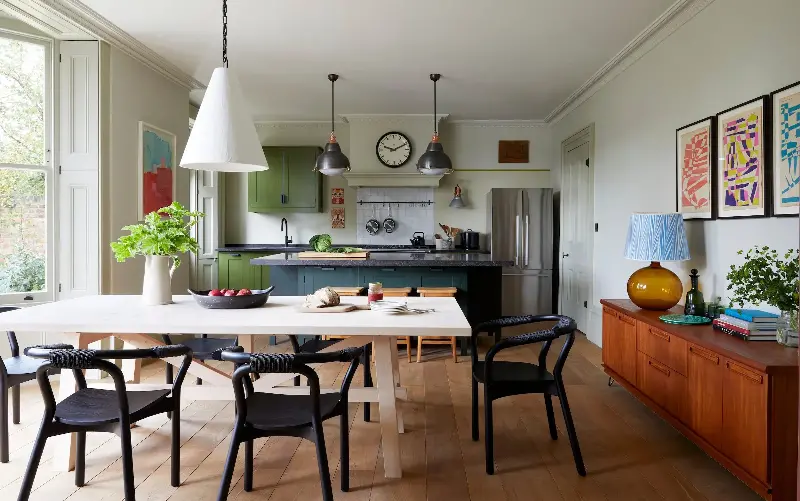
Harding, who is also a mother of two and believes strongly that a house should be practical as well as beautiful, first took a careful look at the floor plan. She says it’s important to think about light. “You really can arrange your house so that you spend most of your time in the places that have the best daylight.” The kitchen was a small, dark room at the front of the house, overlooking the road. She proposed moving it to the back, to make the most of the natural light and replace the noise of the road with tranquil views of the garden and the river beyond.
She says that people are often afraid of moving kitchens. “We think that moving a kitchen is a huge piece of work because it makes such a radical difference to how a house operates and feels,” she says, “but in reality it’s often not that big a deal.” A kitchen, she argues, is essentially a series of fixed pieces of furniture – less structurally complex than a bathroom, which requires a soil pipe to be rerouted. “It’s like a series of bookshelves. You wouldn’t lose sleep over moving a bookshelf,” she points out.
Another piece of the jigsaw is thinking about the time of day you tend to do certain tasks, and how the whole family interacts. For this family, the end of the day is when the children watch television before bed and the mother catches up on final bits of work at her desk. Because the doorways between the kitchen and the living room have now been opened up – making them two separate but connected spaces – “she can be in earshot of the children, but not in the same room, so it’s perfect,” Harding says.
Adding a pantry to increase storage space (and house price)
One way to save money on a kitchen is to install a pantry – what Harding cheerfully describes as “a glamorised cupboard” – rather than expensive fitted cabinets. Not only will this save you money, but, as the popularity of pantries continues to soar, it could potentially make you money, too. “If you can put ‘pantry’ on your floor plan when you’re selling a house, I’m sure it adds thousands,” says Harding.
You don’t even need much space to create one. For this family home, Harding sacrificed a section of corridor to make a small but very hard-working pantry.
How to make every room work harder
With her practical hat on, Harding turned the former kitchen into something arguably more useful to a young family: a large utility and boot room, right where it’s most needed, at the point of entry to the house. “Even persuading someone to take an extra three steps to a coat cupboard can seem like quite a challenging piece of work,” Harding says, so creating a “dump zone”, where prams, scooters, muddy boots, wet coats and bags of shopping can all be put down and stored away, can ease the chaos in the rest of the house.
Making the most of every little bit of space is the key to improving how your home functions, says Harding. In this house, a small corridor linking two rooms has been furnished with a compact sofa and a mid-century drinks cabinet, turning it into a fun spot to pause in.
But even with a large room, it helps to think of it in sections. The newly relocated kitchen in this house, for example, has several seating and dining areas, giving the family different options. “There’s space for everyone to hang out in the kitchen, whether it’s the stools around the island or the seating area in front of the fire,” Harding says.
If you have different purposes within one room, it needs to be zoned. To define the different areas of the kitchen in this house, Harding used rugs, including in the small seating area, which she says, “gives it a bit more presence and gravitas”.
Pendant lights can be used in a similar way to define different areas within a room. “It’s really important to position ceiling lights according to your furniture,” says Harding, “rather than looking at a floor plan and plonking one in the middle of the ceiling.”
While she breaks up spaces with rugs, she unites rooms with colour, which she says “is a wonderful tool for creating atmosphere”. She advises using neutral tones in rooms where you spend the most time. Here, she has stuck to a palette of soft pinks and light greens on the walls of the kitchen and sitting room, while leaning into bolder tones in rooms with more occasional uses, such as the library.
Why bigger isn’t always better
Despite the clever kitchen switch, the owners of this house were still committed to building some form of extra room, but Harding persuaded them to soften the design. Instead of the full glass-box extension they had originally intended to build, she suggested a more traditional orangery-inspired garden room, with three full-length windows offering views of the river and a skylight with electric blinds to protect against harsh summer light.
As with the other rooms in the house, the orangery had to serve more than one purpose, so that it didn’t become, as many conservatories do, a space that “stands empty for the 95 per cent of the year that you’re not celebrating Christmas”, as Harding put it. It is a grown-up zone, where the adults can work from home or relax away from toys and family clutter.
Harding noted that this room was, ironically, the element that held up the whole project most in terms of building work. It is, she reflects, a useful lesson: the structural work that transformed the house most profoundly was the reorganisation of the existing rooms, not the new addition. “It was the work done to the main house that really unlocked the building.”
Nicola Harding & Co: nicolaharding.com