



When The Devil Wears Prada was first published in 2003, the fashion world deemed it an act of high treason. Inspired by author Lauren Weisberger’s 10 months as assistant to US Vogue editor Anna Wintour in 1999, the novel follows aspiring writer Andrea Sachs, who works at the fictional fashion magazine Runway as assistant to “insatiable, impatient, impossible” editor-in-chief Miranda Priestly. The book was optioned for the big screen before it was even finished, and became an instant hit, selling 13 million copies.
But fashion and media’s ranks closed around Wintour immediately, with Vogue’s creative director Grace Coddington decrying Weisberger as “disgracefully disloyal” and The New York Times dismissing the book as “a mean-spirited ‘gotcha’ of a book”; the Wall Street Journal saying it “could have been written by a window washer”.
‘An empty, shallow bitter woman’
In interviews, Weisberger tried to do damage control, claiming the novel was not based on Anna (wise, given Priestly’s character was described as “an empty, shallow bitter woman who has tons and tons of gorgeous clothes and not much else”). Wintour, known to hire up to three assistants at a time and dispose of them regularly, reportedly told Vogue’s managing editor, “I cannot remember who that girl [Weisberger] is.”
When the film – starring Meryl Streep as Miranda and Anne Hathaway as Andrea – went into production three years later, designers were so terrified of Wintour that they refused to lend the film’s costume department clothes, and would only consult on the script under conditions of “absolute secrecy”. Director David Frankel was barred from filming at New York institutions including the Met, Bryant Park and MoMA, leaving only the American Museum of Natural History since it was, as he later put it, “the one place she had no influence”.
No one could have predicted, least of all Wintour herself, that 20 years later, Vogue would not only have chosen the offending book as their April book club pick, but that Wintour would be the star of a surreal, months-long marketing campaign for its sequel. The new film is about the decline of print, which sees Runway decimated by lay-offs and considering selling itself to an oligarch. What sounds like the kind of April Fool’s idea Wintour might once have fired someone for jokingly floating in a meeting is, in fact, the bleak reality of an empire forced to cash in on its own caricature.
In 2025, Vogue announced it would cut its print run to just eight issues a year, and its 153,075 paid US digital subscribers are now roughly an eighth of the 1.2 million print copies the magazine sold per issue in 2006. Last June, Wintour stepped down as editor-in-chief after 37 years, with the title retired entirely – her successor Chloe Malle is simply “head of editorial content”, with Wintour now Vogue’s global editorial director and Condé Nast’s chief content officer. Meanwhile, Condé Nast has sold off several of its titles, suffered hundreds of millions in losses and in 2024 offloaded its famed “Vogue House”, its UK offices for over 60 years, for £75m to a shipping magnate.
In fact, what happens to Runway in the sequel almost exactly mirrors the sea changes at Vogue: from Miranda being hauled before a delegation of budget-slashing McKinsey consultants – the very firm Condé Nast actually hired to “review” its spending – and her editor-in-chief title becoming “global editorial director”, to Runway’s billionaire owner being a clear imitation of Si Newhouse, Condé Nast’s long-time chairman. Meanwhile Emily Blunt’s character is now a thinly veiled Lauren Sánchez – whom Wintour has been quietly courting via a 2025 digital cover and co-chair seat at Monday’s Met Gala – angling to seize Runway via an oligarch husband obsessed with space.
Even the smaller details ring true, with Miranda forced to fly economy to the fashion shows in Milan and her chauffeured round-the-clock town-car service replaced by the odd Uber trip. Condé Nast enthusiastically promoting all of this feels rather like the company that built the Titanic helping market the James Cameron blockbuster about its demise.
A wise economic decision
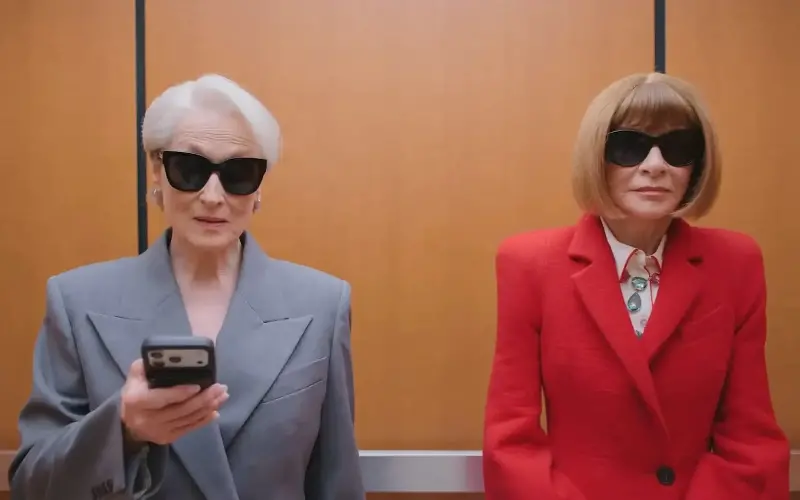
It was likely Malle’s idea to hitch Vogue to one of 2026’s most bankable films – it’s predicted to open with $180m (£140m) at the worldwide box office – is an attempt at the meta-cultural “moment” media brands now need to survive. Wintour, who has always known which way the wind blows, has so far played ball through gritted teeth. In March, she and Hathaway presented Best Costume at the Oscars to a song from The Devil Wears Prada soundtrack; Vogue’s May cover sees Wintour and Streep in cahoots under the cover line “Seeing Double” (styled by Coddington). She even gamely filmed a comic YouTube skit, which sees Wintour and Streep meeting in a lift, greeting each other with glacial condescension.
And yet, for all its grim irony, Vogue’s meta marketing is undeniably smart. Ever since the publication of The Devil Wears Prada, there has been endless fascination over how much Wintour – once dubbed “nuclear Wintour” by employees – actually influenced the franchise.
Aimee Cho, Wintour’s assistant when the book came out, said “everything felt very true to life, but through a negative lens”, while another assistant, Filipa Fino, said it was true Wintour didn’t know anyone’s name (the book and film have her call all of her assistants “Emily”) “but it’s not a demeaning thing, not at all. It’s just too much information”.
How similar is Wintour to Priestly?
Others have spoken about how Wintour would fire off emails through the night, that she expected staff to turn up to meetings an hour early, and that people really did yell “she’s coming!” before she arrived at the office, just like in the opening scenes of the first film. And yet several people who have worked with Wintour describe her as having a surprisingly maternal side, and say that she always kept her side of the deal, allowing assistants to move on to any job they liked after they’d survived two years under her.
In many ways, The Devil Wears Prada has proved useful to Wintour, turning her into a celebrity who, as Amy Odell writes in her 2022 biography of Wintour, titled Anna, “finished the year 2006 as one of Barbara Walters’s Most Fascinating People, and became a mainstream celebrity, like Cher or Madonna, recognisable by her first name alone”. With her trademark bob and sunglasses, Wintour arguably became the first and most successful example of the “personal branding” now vital to both influencer culture and journalism. Odell writes that the film’s impact on her image was “incalculable” and that “with her star power now transcending fashion and media, it would be terribly hard for Condé Nast ever to let her go”.
Arguably, the mythology of Wintour and Vogue’s excess – with astronomical amounts spent on photoshoots, private jets and designer clothes – has worked in Condé Nast’s favour. When the Sunday Telegraph reviewed the book upon release, Jenny McCartney argued Wintour’s perfectionism was a compelling aspect of her brand, and that “had Ms Weisberger really wanted to upset her former employer, she should have depicted poor Miranda Priestly – really rather nice, in a pushover kind of way – working awfully late, her hair going all straggly as she guzzled cheap doughnuts and bit her nails. For that, Ms Wintour, I feel sure, would never have forgiven her.”
The book and film – along with brisk sightings of an unsmiling Wintour at the Wimbledon Village Starbucks during tennis season – certainly fuelled my own intrigue in interning at British Vogue, as I did in the summer of 2015. Unlike with other Condé Nast internships, where staff responded to my application via email (Tatler, GQ), Vogue sent me a luxuriously thick, embossed letter in the post, offering me a three-week, unpaid placement.
Vogue always had three interns at any one time, with each one staggered so that there was a hierarchy of experience and therefore rank. When I arrived, the head intern, who had been there two weeks, explained that she would assign our tasks each morning (a bit like Emily Blunt’s prissy character, Emily, in the film) and would have exclusive sign-off on our shared inbox. As I progressed to second-in-command on week two, I would sometimes rebel and try to put my own name in emails, which would lead the head intern to furiously intercept the draft and delete it.
When I became head intern a week later, I felt dizzy with power. I also finally had my own chair. Absurdly, considering Vogue’s reputation for excess, there were only two desks between three interns, and so for two of the three weeks I found myself sharing a chair, a keyboard, and a mouse. In my exit interview – another plush Vogue formality other internships would never dream of – the managing editor asked me what could be improved for next time. “Well, perhaps a chair and desk for each intern might be handy,” I said. “Oh yes,” came the reply. “We get that feedback quite a lot.”
In other respects, it seemed Vogue staffers liked to play up to The Devil Wears Prada’s image. Fashion editors would arrive mid-morning in stilettos, with one often resting her bejewelled feet on her desk. When a tray of ice-cream pots was once offered around by one of the many brands that would visit Condé Nast offices loaded with freebies, I was mortified to find myself the only person to accept one. A fashion editor then swung her chair around and said, in a non-ironic echo of Kate Moss, “the best snack you can have is a glass of water!” For one bizarre but glorious afternoon I was dispatched to Whole Foods with a shopping list for a dinner party hosted by Sienna Miller, which involved buying an enormous sea bass and various exotic produce. It was all terrifying but intoxicating in equal measure.
Wintour found the first film ‘highly enjoyable’
Ultimately, the drama around The Devil Wears Prada has come from everyone except Wintour. Laurie Jones, former Vogue managing editor, clarified to Odell that Wintour had read the book, but “wasn’t offended”. Last year, when Wintour was interviewed by David Remnick, New Yorker editor, she said she “found [the first film] highly enjoyable”. Though this could be interpreted as pure guff for Vogue’s collaboration on the sequel, it’s notable that Wintour gave both Hathaway and Streep multiple Vogue covers following the film’s release, which wouldn’t indicate a grudge.
During Vogue’s May cover interview, however, there was one rather revealing moment. Streep is explaining to her and Wintour’s interviewer Greta Gerwig why she was interested in reprising the role of Miranda two decades on. “Now that everything’s disintegrating, now that these institutions are being undermined or exploded in a way that who knows what is happening in the world right now,” she says. “I wondered what they were going to do.”
Wintour immediately offers a polite but pointed correction. “I like to think we’re evolving rather than disintegrating. We are still here. We’re all doing our jobs – in different ways and across multiple platforms instead of just one, but how wonderful is that? We’re reaching far more people.” Streep becomes uncharacteristically flustered. “Oh, I didn’t mean disintegrating!” You can almost hear Wintour’s eyebrows arch. Is that so? Or maybe that’s Miranda’s line.