



The crew on board an exploration ship infested with a rat-borne virus initially told passengers the outbreak’s first victim was not infectious.
Three passengers have died and more than 20 British passengers remain trapped on board the MV Hondius, which has been stranded in the Cape Verde Islands since Sunday after an outbreak of hantavirus.
A video shared by a Turkish YouTuber who claims to have been on board the Dutch-flagged ship appears to show a crew member seeking to reassure passengers that there was no danger.
“One of our passengers suddenly passed away last night,” he says, adding: “I am told by the doctor they are not infectious… The ship is safe when it comes to this.”
Hantavirus, a rare virus with a fatality of 1-15 per cent in Asia and up to 50 per cent in the Americas, is typically spread from contaminated urine, droppings and saliva of infected rodents.
The World Health Organisation (WHO) has said the virus could have been brought on board by a Dutch couple who had been travelling in South America.
The couple and a German passenger have died, while a British national has been evacuated from the ship and is in intensive care in South Africa.
Two cases of the virus have been confirmed on the vessel, and five more are suspected.
Ruhi Çenet, the Turkish influencer, criticised the ship’s crew for their response to the first fatality.
In a video posted to social media, he told his 1.3 million Instagram followers: “It turns out the situation was much worse than we were told.
“I got off the ship on day 24 but this vessel called MV Hondius carried on toward its final destination for another 11 days. Just one day after I left the wife of the person who died also passed away.
“After a third person died it became clear there was hantavirus on board.”
He added: “I wish the vessel’s management had taken this problem more seriously from the very first death. They should have thought that it might be a contagious disease.
“People who may have been carrying the virus should have been quarantined but everyone was still together, meals were eaten together and group activities continued.
“Before such a long journey blood tests should have been required from the passengers.”
The first fatality, a 70-year-old Dutchman, occurred on April 11 and his body was removed when the ship arrived at St Helena on April 24.
On the same day, his 69-year-old wife disembarked on the island with gastrointestinal symptoms. Her condition deteriorated during a flight to Johannesburg and she died upon arrival at the emergency department on April 26.
Having left the ship, Mr Çenet said he had travelled to film a documentary on Tristan da Cunha – a British Overseas Territory in the South Atlantic.
“I was lucky but my mind is still with the people on the ship,” he said.
The ship, carrying 148 people, has been anchored off the port of Praia, the capital of Cape Verde, after authorities denied those on board permission to disembark, citing wider health concerns.
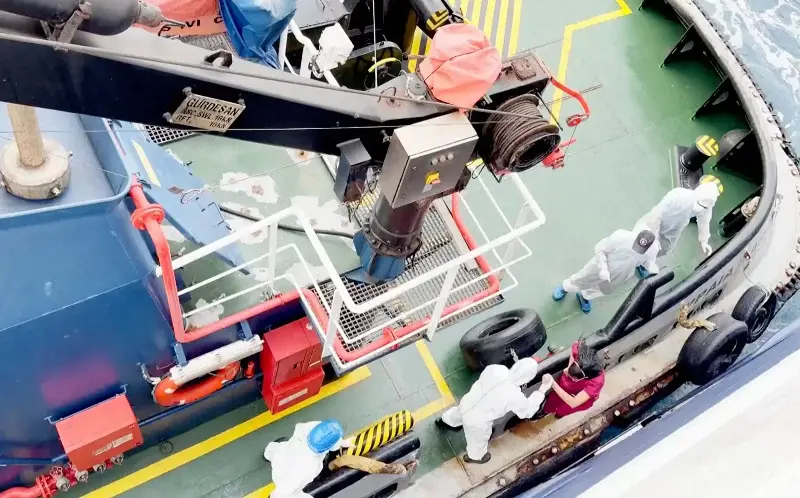
Medical workers wearing white hazmat suits were seen boarding the ship on Tuesday and dropping off supplies of personal protective equipment.
A total of 23 British nationals – 19 passengers and four crew members – are on the ship, which departed Ushuaia, Argentina, on April 1 for an “Atlantic Odyssey” cruise.
No 10 has said it is working to evacuate sick passengers.