



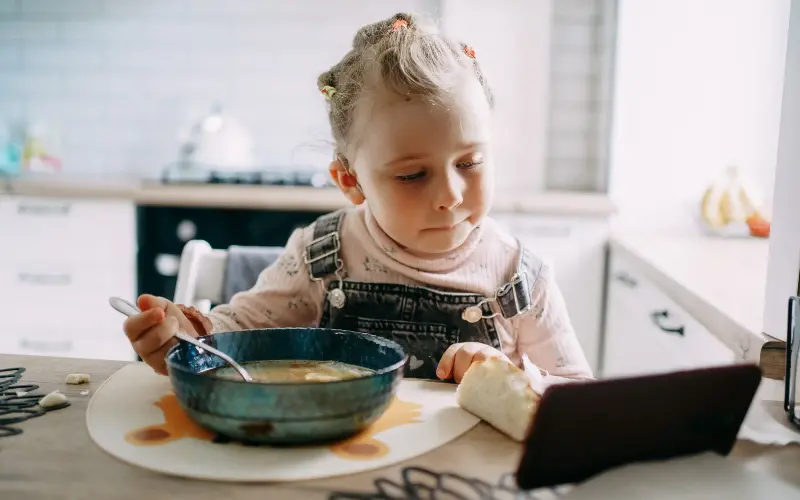
Parents should ban screen time for toddlers during meals, the first national government guidance for families says.
Screen time for children under five should be limited to no more than an hour a day and they should be barred from social media, chatbots and AI toys because they are not “made for young minds”.
Families are also advised that children under two should avoid screen time altogether, except for shared activities that encourage bonding, interaction and conversation. Parents are advised to “lead by example” and limit phone use around their children.
The guidance, published on Thursday, has been drawn up by the Government after research suggested screen time damaged toddlers’ ability to speak.
The average two-year-old in Britain watches more than two hours of television, video and digital content a day, twice as much as recommended by the World Health Organisation.
Surveys by Ofcom, the communications regulator, found that 37 per cent of children aged three to five – up to 800,000 toddlers in the UK – used social media apps or sites in 2024, an increase from 29 per cent in 2023.
The guidance recommends parents impose screen-free zones. It says: “Keep bedrooms and mealtimes free from screens. This can protect valuable family time and interaction.”
During meals, it suggests parents should try swapping screens for background music, simple conversation, table games, colouring or playing I Spy with colours or letters. At bedtime, it recommends reading stories together and no screens for toddlers an hour before bed to avoid disrupting sleep. Parents themselves are told to “lead by example”.
The guidance says: “Children’s brains are like sponges – they’ll copy your screen use habits. Be mindful of how often you use your phone around your child.
“Spending long periods on your phone can make it harder to notice what your child is doing or feeling. Young children need attention, interaction and shared moments with their parents and carers to feel secure and supported.”
‘Parents should lead by example’
Parents should try to keep screen time for children aged from two to five to “one hour a day. Less if possible”.
Toddlers should watch “slow-paced, predictable” content because it is “better for young brains” than “fast-paced, over-stimulating social media-style videos”.
AI toys, tools or chatbots should be banned, and the guidance warns: “Social media isn’t made for young brains, so it should be avoided.” Harmful content should be blocked through parental controls.
Watching screens with children, and talking and asking questions about the content is better for a child’s cognitive development than letting them use them alone, the guidance says. Shared screen activities could include video calling friends and family or looking through photos together.
Starmer: ‘We need to do more’
Sir Keir Starmer said on Thursday that the status quo “isn’t good enough” and that “we need to do more to protect children”. He admitted some would “oppose” Labour providing guidance, but said: “My government will not leave parents to face this battle alone.”
Research commissioned by the Government concluded that two-year-olds who spent five hours a day in front of screens knew significantly fewer words than those who watched for less than an hour. It also found that 86 minutes per day was the turning point at which “the link between prolonged screen use and lower vocabulary became particularly marked”.
The guidance was developed by a panel led by Dame Rachel de Souza, the Children’s Commissioner, and Prof Russell Viner, a children’s health expert.
It comes a day after the House of Lords voted for a full social media ban for under-16s in defiance of Sir Keir, who favours a public consultation before deciding whether to follow Australia in introducing such a measure.
Writing for The Telegraph (below), Lord Nash, the former schools minister, urged MPs to back his amendment, passed by the Lords on Wednesday, introducing the ban. He said Sir Keir’s consultation amounted to no more than “hollow promises” and “half-measures” that would not address the damage social media firms were doing to children.
The Government’s approach to the wellbeing of children is not good enough
By Lord Nash
On Wednesday night, by rejecting the Government’s consultation and voting for an amendment in my name to the Children’s Wellbeing and Schools Bill, the House of Lords sent – for the second time – an unambiguous message to the Government: we need to raise the age limit on the most harmful social media platforms for children, and we need to do it now.
That this achieved an even bigger majority – including an increase in support from Labour peers – than when my amendment was previously passed sends a clear message that hollow promises and half measures are not enough.
The bill is returning to the Commons with a clear message that peers do not think the Government’s approach to the wellbeing of children is good enough.
How can it be, when their own consultation asks children as young as 10 to assess whether platform features – such as the ability for children to send nude images or videos – should be blocked?
This consultation is a shocker. It does not begin to pass muster for a balanced consultation. It was rushed out in a blind panic to try and convince peers to vote against my first amendment. That failed, they voted for it.
‘A huge increase in self-harm’
Since then, our elected colleagues in the Commons have decided to take a gamble on this consultation. They decided that the Government’s words were enough to take a chance on. What does the Government have to say for itself?
The Government believes – in the words of Liz Kendall – that there is still a question of “is it causation or correlation?”
The consultation tells us we must weigh the so-called benefits of social media against its horrific harms. That young children being able to share dancing videos of themselves is somehow enough to counterbalance the harms that we see daily such as the explosion of “sextortion” of young boys, a huge increase in self-harm, and worse.
The Government believes we need time to wait and take time to conduct some extremely limited trials. What can these tell us when the overwhelming body of evidence is that there is a clear link between social media use and harm to our children – with whistleblowers from the social media companies themselves telling us that their own internal research shows that?
Compare the Government’s statements to what we hear every day. The daily publication of even more academic research into harms ranging from depression to radicalisation. The daily pleas of parents, teachers, clinicians and the police who are united behind the need for decisive action.
On Wednesday, in a landmark judgment, a Los Angeles court ruled that Meta and YouTube were social media platforms addictive by design – not by some accident of tech bros creating “cool” platforms, but intentionally designed to lure people in and keep them there. This follows a court in New Mexico fining Meta $375m (£280m) for misleading consumers about the safety of its platform and enabling harm, including child sexual exploitation.
Taken together, this shows that the tide is turning fast. The era of allowing big tech to conduct its experiment on young people is coming to an end globally. But the only people who haven’t noticed are the Government. They remain stuck in the middle with fingers in their ears, talking about needing to see the evidence and a two-sided argument.
‘Listen to what is going on around you’
I ask them: please listen to what is going on around you. Lenin apparently said that there are decades where nothing happens, and there are weeks where decades happen. This is one of those moments. The world is shifting. If the Government wants an off-ramp, it has one. It can come out now and say the facts have changed and so we must show leadership and change course.
I did not get into this to make this the Nash amendment. If putting our children first becomes a crowning achievement of this Labour government and this Prime Minister, I will be cheering them on from the sidelines. And I will do all I can to work with them to make this happen.
That is my message to MPs. Tragically, some in this debate do not get second chances – as we saw from the incredibly brave bereaved parents in the gallery. But MPs will, when this bill returns. It is in their power to act and I urge them, please, to do so.
Lord Nash is a former schools minister