



The year is 2050. You arrive at the Next Nest hotel in Neo Tokyo welcomed by a holographic concierge who instantly recognises you and greets you by name. The lobby walls are decorated with ever-changing art created by AI artists.
A fragrance fills the air, tailored to each guest, whose preferences are detected by biometric scanners as they walk in. Upstairs, your room has been tailored automatically too – from temperature and lighting to the music playing in the background. Beds adjust to the perfect firmness based on body type and sleeping habits.
Smart-glass windows switch from transparent to opaque on voice command. The walls are interactive displays projecting whatever scene you like. The hotel’s AI is always at your service and can arrange for anything from a meal prepared by robotic chefs to a VR tour of ancient Rome. The spa uses nanotechnology to provide personalised treatments at cellular level.
This is just one sci-fi vision laid out in a new book, The Future of Hotels: Creating What’s Next, co-edited by Dr Ian Yeoman, professor of disruption, innovation and new phenomena at the Netherlands’ prestigious Hotel Management School Leeuwarden. “The book is about speculation, but I’m always interested in scepticism,” he says. “If someone says it’s not going to happen, to me it will happen.”
It wouldn’t be the first time Yeoman has described a seemingly unthinkable future and got it right. In 2006, he modelled a scenario where a global virus shut borders and tourism collapsed. So what does he think the next pandemic-level disruptor is for hotels? “The AI algorithm replacing the hotel manager with a computer. That’s the big thing I talk about.”
Other futuristic projections in the book – which brings together academics from around the world to gaze into their crystal balls – include wellness programmes monitored by brain-computer interfaces, 3D printers used to produce anything guests forget to pack, hotel rooms that dynamically transform based on guest preferences using claytronics (an emerging field of engineering that focuses on creating programmable matter), a hotel on Mars in 2049 and – that science fiction staple – humanoid robot staff.
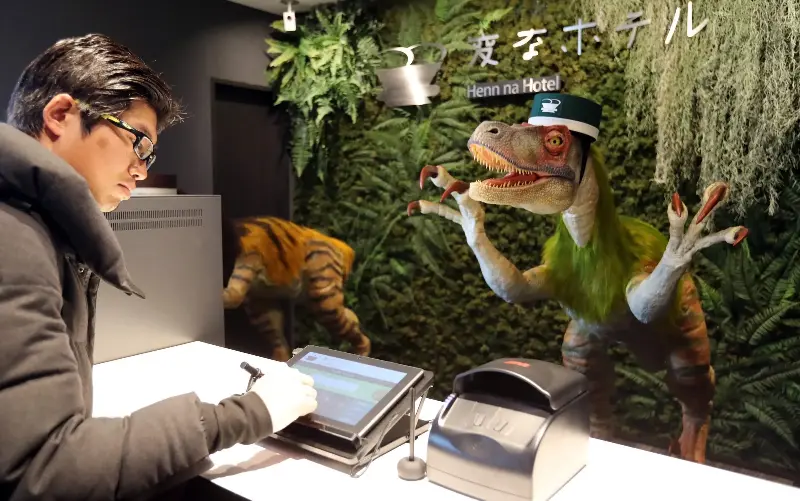
“Elon Musk has already discontinued two models of his Tesla cars to turn over factory space to build his humanoid robot Optimus,” explains Yeoman. “He thinks that in five years time we’ll be in that high-robot environment.” For now at least, hotel robots are more gimmick than game changer. Last year, for example, Yeoman stayed in the Henn na Hotel in Tokyo, which was the world’s first robot-staffed hotel when it opened back in 2015. In front of him at the automated check-in were six Portuguese guests. “But the robots hadn’t been programmed to speak Portuguese – so a real person had to come out and help.”
“There’s a long way to go,” he adds. “Robots can now clean a bathroom, but they can’t make a bed. They will get there. If you speak to companies such as Amadeus or Dyson they have some really advanced robotics.” Yeoman and his fellow researchers look to patents in the public domain to see what cutting-edge technologies companies are working on and then extrapolate how they might apply to hospitality.
But what are hotels without people? Of course, the book’s ideas aren’t all like something out of Black Mirror or I, Robot. Others focus on how sustainability will no longer be a choice but a necessity, thanks to water scarcity, climate change and increasing natural disasters. Or maybe there will be such a kickback against big tech’s pervasiveness that hotels will market themselves as places to disconnect and digitally detox.
New hotel models are already starting to appear. Hybrid concepts that morph from long-stay Aparthotel to co-working space, reflecting our increasingly blurred work-from-anywhere lifestyles (Locke Living, The July). Slick wellness-centric brands that tap into the obsession with self-improvement and longevity (try SIRO or Six Senses’ growing number of city outposts).
Hotels that double as brand sales funnels (see Soho House/Soho Home or the recently opened Fortingall from the British interiors brand Anbôise) where you can click to buy the lamp beside your bed or the chair you are sitting on as easily as ordering room service.
Yeoman is already working on a follow-up edition looking at the design of the hotel bedroom in 2075. “The most under-researched area in hospitality is actually sleep,” he says. “But if I walk into a hotel bedroom in the future, what I’m still looking for is a good night’s rest – a nice big, soft, comfortable bed. To many people, a hotel bedroom is a sanctuary.”
As anyone with an Oura Ring knows, data is power when it comes to getting a good night’s kip. So check into the hotel of the future and expect intelligent bedding with sensors to adjust temperature and purify the air, music-playing pillows to lull you off to sleep and mattresses that gently shake you awake, circadian lighting systems programmed to your ideal bedtime routine and gamified sleep-optimisation apps.
For all the talk of technological singularity and virtual reality advancements, however, Yeoman doesn’t imagine a future where the hotel – in the real world – simply ceases to exist. “People used to say when we invented the cinema that it was the end of theatre. When we invented the TV that was the end of cinema. All these were just new technologies, for new leisure activities,” he says. “After all, nobody wants to go on holiday in Second Life.”
The Future of Hotels: Creating What’s Next, edited by Ian Yeoman, Hanneke Assen, Elena Cavagnaro and Erwin Losekoot, is out now; £43, Channel View Publications