



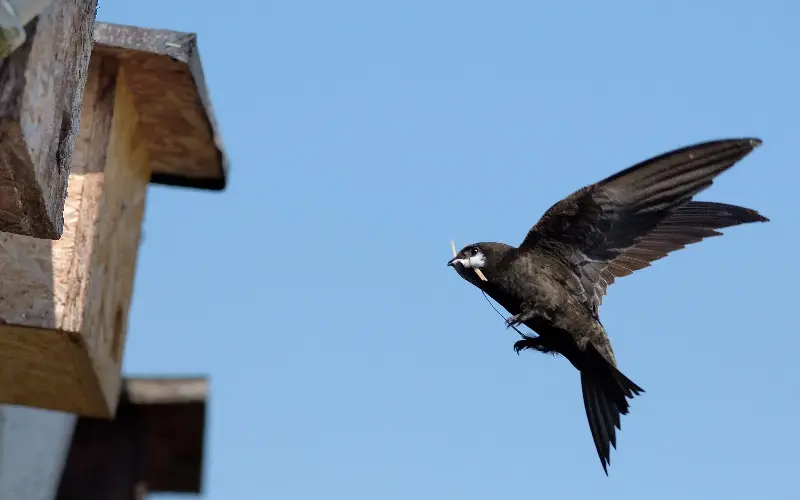
Swifts returning to a house to nest are probably the same ones as last year – and the year before that, scientists have found.
The Royal Society for the Protection of Birds (RSPB) has spent 15 years tracking 190 swifts in the village of Belstone on Dartmoor, West Devon. It discovered that 94 per cent reused the same nesting site as the previous spring, with many pairing up with previous partners.
Malcolm Burgess, the RSPB’s principal conservation scientist, said: “We’ve thought for a long time that swifts are loyal, returning to the same nesting sites and partners each spring.
“But for the first time we’ve documented just how strongly faithful they are to their nest sites, which highlights just how important it is to protect their nesting sites in our neighbourhoods.”
Heralded as providing the “sound of the summer”, swifts are a familiar sight in Britain’s villages, towns and cities, returning from Africa in the spring to breed, and identifiable by their darting motion and high-pitched calls.
Historically, they have made use of the small cracks and crannies in buildings to raise their chicks, but new buildings and techniques have led to fewer flaws making it harder for the birds to find shelter.
The RSPB said the study had shown that many swifts return from their 3,400-mile migration to find their traditional nest site blocked or gone entirely, forcing these birds to expend extra energy and time searching for an alternative.
The lack of nesting sites, as well as the continuing decline in insect populations, mean swifts have fallen in number by 70 per cent since 1995.
More protection for buildings
The charity said that there should be more protection for buildings where swifts nested and that more should be done to encourage builders to include swift boxes and bricks in new sites.
Carl Bunnage, head of nature policy at RSPB England, said: “Recent changes to planning policy made by the Government to more strongly encourage developers to fit ‘swift bricks’ to new buildings are a small step in the right direction.
“However, they fall far short of what is needed if we are to halt and reverse the decline in our swifts. The fitting of swift bricks in accordance with the relevant British standard wherever possible should be a legal requirement.
“Tighter controls are also needed on the demolition of buildings where swifts are, or may be, nesting, alongside more resources for the stronger enforcement of the Wildlife and Countryside Act 1981 where nests are illegally disturbed or destroyed. Swifts need us to act, and now.”
In 2026 Scotland became the first UK country to make installation of swift bricks – designed to provide an ideal space for the birds to nest in – a legal requirement for new buildings.
But the rest of the UK still fell short, the RSPB warned.
“The decline in swift numbers is a great cause for concern and without increasing the availability of nest sites, and replacing those that are being lost, we will see further declines of this extraordinary bird in our towns and cities,” said Mr Burgess.