



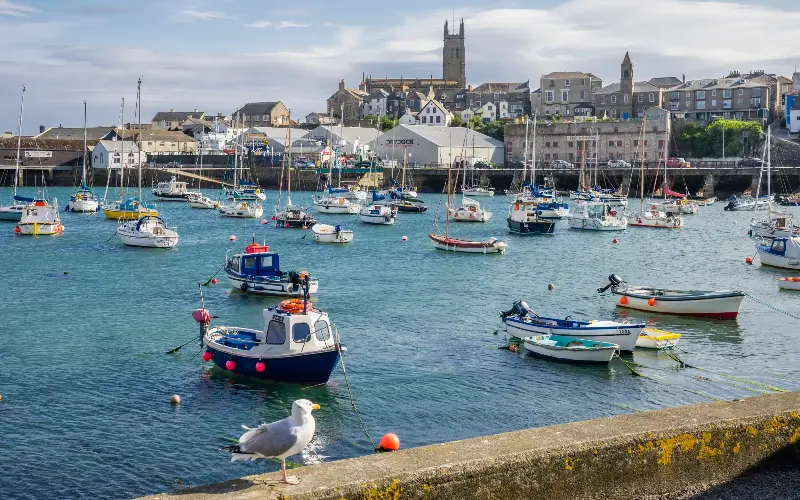
All summer, Telegraph Travel will be taking the pulse of Britain’s seaside towns, examining the efforts being made to regenerate them, and reflecting on whether they are still worth visiting. This week: William Cook visits Penzance.
Strolling along the Penzance promenade, looking out across Mount’s Bay, I wonder why my favourite seaside town doesn’t attract more visitors. It’s on a spectacular stretch of coast, but it’s never overrun – unlike bigger Cornish resorts such as Newquay and St Ives.
I first came here as a toddler, brandishing my brand-new bucket and spade. It was the first place where I went paddling, the first place I saw the sea. Since then, I’ve returned here more times than I can count, but I always feared for its future. As British holidaymakers departed, lured away by budget flights to Spanish beaches, the town became a shadow of its old self.
Yet lately something’s changed: Market Jew Street, the historic high street, is bustling again; Chapel Street was always charming, but now it’s a lot smarter; Causewayhead is filling up with trendy cafés and quirky thrift shops. Artists priced out of St Ives have come here for cheaper studio space, and lots of independent shopkeepers have followed in their wake. After decades in the doldrums, unfashionable Penzance has finally become chic.
What’s Penzance really like?
Penzance is in a super spot, surrounded by a ring of rolling hills and overlooking Mount’s Bay – one of the loveliest views in Britain. It’s full of robust old buildings – relics of its Georgian heyday, when this was an important port, Cornwall’s gateway to the world.
The climate is exceptionally mild, which makes a big difference if you’re here out of season. Sunshine is never guaranteed, but even winters are clement. Morrab Gardens, the municipal park, is ablaze with exotic flowers you see only indoors elsewhere in the UK.
Here, tourism is just one part of life, not its raison d’être. You’ll find lots of local schoolchildren on the beach. You’ll hear plenty of Cornish accents in the pubs and bars. Penzance has a grungy, vaguely hippy vibe – which makes it a gritty alternative to posher holiday spots like Rock. “Scruffy but interesting” is how one local describes it.
It’s a great place to hunt for old vinyl, secondhand books and vintage clothes. If you’re tired of overpriced, overcrowded beach resorts, if you’re looking for a working town with lots of history (and hipsters), this is the place to come.
What’s not to like?
Despite its antique architecture and striking location, Penzance is a bit too rough around the edges to be truly picturesque. The town has improved a lot in recent years, but it’s still a work in progress, with a fair few modern eyesores and derelict older buildings. Building sites bode well for the future, but they’re hardly ideal if you’re holidaying here today.
Do this
Penzance is on the doorstep of one of Britain’s most dramatic landmarks: St Michael’s Mount, a castle on a craggy island that rises out of the water like a scene from the legend of King Arthur.
Fortified since the Middle Ages, it’s been the home of the St Aubyn family since the mid-1600s. Most of the castle is open to the public (the views from the summit are breathtaking), and the cluster of houses around the harbour are also full of interest, with a fine art gallery and a stylish restaurant. The terraced gardens are stunning, and the journey to the island is enchanting: a walk across the causeway (if the tide is out) or a ride on the ferry (if it’s in).
The Jubilee Pool is an art-deco masterpiece: Britain’s largest saltwater pool, built in 1935 to mark King George V’s Silver Jubilee. An outdoor dip in this sleek seafront lido is an invigorating start to any day (if you don’t feel quite that brave, the adjoining geothermal pool is heated to a balmy 30C).
Penzance has been an art hub since the 1880s, when Stanhope Forbes and Walter Langley and a host of other painters came to the nearby fishing village of Newlyn (still home to one of Britain’s biggest fleets) to paint the hardy men and women who made their living from the sea. Newlyn has hardly changed since then, and much of the best work by Forbes, Langley and their pals now hangs in Penlee House, a grand old villa in leafy grounds.
The art school that Forbes founded is still here. Nowadays it’s a gallery, with a sister gallery in Penzance, housed in the old telephone exchange (for details of both galleries. click here). If you’re keen to buy, Penzance also has numerous commercial galleries, most notably Cornwall Contemporary.
The most remarkable gallery (and garden) is Tremenheere Sculpture Gardens, a lush valley full of subtropical plants and striking modern sculpture created by Neil Armstrong, a local GP. “I enjoy the plants, I enjoy the artworks and I enjoy meeting people,” he tells me, as we look out across his little Eden, “so it’s been a huge joy for me.”
But don’t do this
Don’t come to Penzance expecting a classic seaside holiday. It’s more a port and market town than a kiss-me-quick beach resort.
Eat this
The best meal I ate was at Argoe in Newlyn harbour. Proprietor Rich Adams grew up here. His father is in the fishing trade. He’s worked in fishing from an early age, and his deep understanding of the sea is reflected in his maritime menu.
Orto in Penzance comes a close second. Enterprising young chef Fred Goodrich serves fine Italian food. I adored his rich venison ragù, his rainbow chard and his salty chocolate mousse.
The Hoxton Special brews fabulous coffee in a funky surf shack on Marazion beach. For the best pasties check out The Cornish Hen on Market Place. For ice cream go to Jelbert’s, a family business that’s been serving one flavour only – vanilla – in Newlyn for five generations.
From a local
“It used to be really run-down,” says Kate Jmo, the manager of Chapel House (see below), who was born and raised in Penzance. During the past few years she’s seen a real revival in her hometown, driven by local people. “It’s become less about the big chain shops and more about independent businesses.” She loves the sense of space, and the rugged landscapes all around. “The light is beautiful. You get some amazing sunrises and sunsets.”
“It’s a very special place,” concurs Armstrong, who founded Tremenheere Sculpture Gardens and has lived here since 1987. “This is an ancient land: Everywhere you see historical monuments. There’s a huge cultural energy in the area – lots of artists and musicians.” He especially enjoys the majestic coastal walks. “I wouldn’t live anywhere else.”
From a visitor
“It’s got a bit of everything,” says Hannah Hayman, on holiday but looking to move down here from London with her sons, Theo and Riley. “There’s the beach, there’s the boats, there’s enough to entertain the kids. I also swim a lot, so the lido’s great for me.”
Stay here
A handsome Georgian townhouse a short walk from the seafront, Chapel House is a tranquil hideaway in the heart of old Penzance. It’s elegant yet understated, and the style is intimate – more like staying with old friends than checking into a hotel. Doubles from £192, including breakfast (the kippers are divine).
Getting there
The most romantic way to travel to Penzance is on the Night Riviera from London Paddington: Nod off in the Big Smoke and wake up to the sound of seagulls. GWR’s daytime service is just as good, with direct services to Bristol and Cardiff as well as London. For details visit www.gwr.com.