



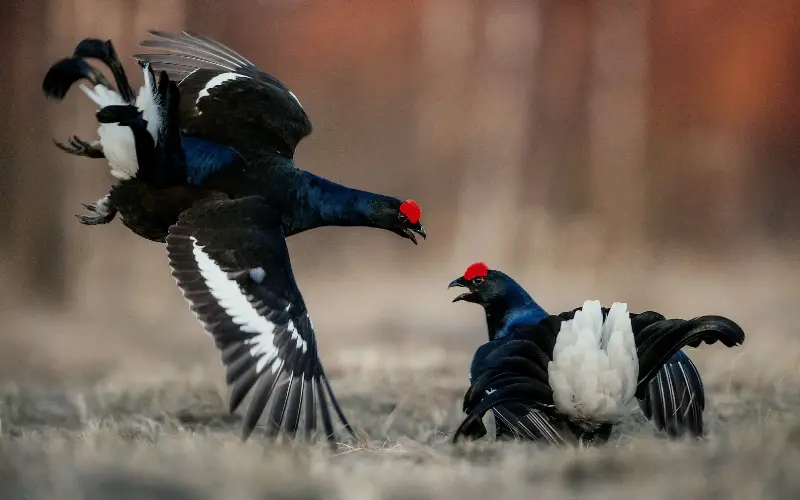
Conservationists are racing to save the black grouse from extinction after a sharp drop in the bird’s numbers.
A nationwide survey of the species is to be launched by the Game and Wildlife Conservation Trust (GWCT) in an attempt to work out how few are left and how best to protect them.
Black grouse, a plump game bird with large white feathery tails, were present in every British county until the mid-Victorian period, but can now only be found in small numbers in Scotland and northern England.
It is thought that there are now fewer than 5,000 male black grouse in total across the UK, down from an estimated 6,500 in 1995.
The causes of their decline are predation by creatures such as badgers and foxes, as well as the loss of their pine forest habitat. Large swathes of areas where they were previously numerous, such as Dumfries and Galloway, have been turned over to commercial forestry plantations, which do not suit the birds.
Nick Von Westenholt, the chief executive of the GWCT, said: “Black grouse are an iconic British species. We have worked for decades with land managers to restore their numbers and any initiative that takes that work forward should be welcomed with open arms.”
The nationwide survey, which is being funded by the Government, is designed to assess recent population changes and look at how best to boost numbers.
As part of the work, GPS trackers will be attached to black grouse to better understand their movements. The female black grouse can fly as far as 20 miles in search of a mate.
Data from the survey will be combined with studies on habitat suitability to identify areas that may suit reintroductions. This would see a small number of birds taken from areas where they are numerous, such as parts of the north Pennines.
The study will also explore how cattle grazing can be used to create better black grouse habitat on woodland fringes. The dung of the cattle attracts flies and grubs, which the black grouse eat. Hardy native cattle also create short areas of vegetation for the black grouse to nest in.
The black grouse “lek”, which sees male birds battling it out in spring to win female mates, is credited with being one of the most beautiful sights in the British countryside.
Viscount Ridley has tripled the number of black grouse on his estate in Cumbria in recent years by creating the best habitat, such as scrub and young trees, as well as carrying out systematic predator control. This ranges from trapping stoats to fox shooting.
He said: “The black grouse is Britain’s bird of paradise. Preserving this species is really important.
“Our black grouse have started to recover, particularly in and around the north Pennines, thanks to the work of gamekeepers and other land managers.”
‘Habitats must be managed’
Tarquin Millington-Drake, a wildlife photographer and conservationist, said predator control was crucial to protecting the black grouse, even if people find it challenging.
He said: “Humane cable restraints, which catch foxes, are crucial, as is the balanced legal predator control of corvids. Habitat must also be managed to provide winter and summer food.”
Black grouse were traditionally shot from Aug 20 onwards. In some parts of the country, they are still shot in very small numbers where there is a sustainable harvest. They are prized for their rarely eaten meat, which is both dark and pale.
Emma Reynolds, the Environment Secretary, said: “This Government is committed to protecting and restoring our most threatened wildlife – including cherished native birds like the black grouse and merlin.
“With decisive action through our Wild Again initiative, we can reverse the decline in nature.
“We are now going even further, with record investment to protect more species across the country. Successfully reintroducing black grouse on the North Yorks Moors is proof of the impact support for species recovery can have.”