



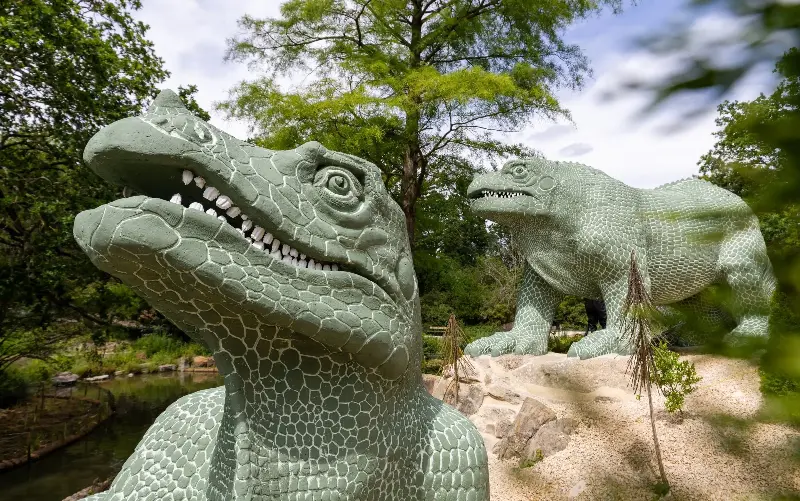
When some 30 life-size dinosaur sculptures were revealed to Victorian visitors in London’s Crystal Palace Park in 1854 - and which this month, July, have been restored - they were greeted with gasps of awe and wonder. Probably the same shock and intrigue with which we would greet today creatures emerging from an alien spaceship.
Dinosaur fossils were a recent discovery and these first attempts at full-size reconstructions were both a major scientific leap forward as well as a fascinating public spectacle. But despite our vastly superior 21st-century scientific knowledge, and sophisticated entertainments – immersive virtual-reality exhibitions, for example – we are still drawn to the weird, wonderful and – frankly – eccentric.
Gnome Reserve
Bideford, North Devon
Often viewed with a degree of dismissive snobbery, these gnomes in the colourful surrounds of a garden centre in Devon are likely to change your mind. Started as a private collection in the 1970s by Ann Atkin, an artist, in a large woodland garden in West Putford, North Devon, the 2,000-plus jolly little figures moved to their new garden-centre home in Bideford, 12 miles away, a few years ago.
Cheeky, adventurous, preposterous – gnomes scuba-diving, playing cricket, climbing trees, playing dominoes, riding tractors – they’re spread around the garden beside the restaurant, and will lead children (and plenty of adults, too) on little journeys of discovery. Come the winter, however, they go into hibernation. Admission free
British Lawnmower Museum
Southport, Merseyside
Who knew there could be such fascination in that stalwart of suburban garden weekend activities – the lawnmower? Horse-drawn, Flymo, a vicious-looking reciprocating knife blade scythe (not to be trifled with), and a 1921 Atco Standard 9-blade – one of the first mass-produced lawnmowers, a-gleam with brass gauges, fittings and tool-rack – are just a few of the more than 200 exhibits in this museum.
Invented in 1830 by Edwin Beard Budding, a textile machinery mechanic of Stroud, Gloucester, that first patented lawnmower (a push-me, pull-you type) is in the collection together with Lord’s Cricket Ground’s original lawnmower – a veritable Rolls-Royce of a machine – plus a few oddballs, such as Alan Titchmarsh’s weeding tools. Admission £3
Smallest House in Great Britain
Conwy, Wales
You’ll certainly have to stoop, but it also helps to breathe in a little when visiting this pillar-box red house at the end of Lower Gate Street in Conwy. Measuring just six feet wide, 10ft deep and barely 10ft high, it nevertheless manages to accommodate a living area with a basic kitchen downstairs, bedroom upstairs, plus two windows and one door.
Built in the 16th century to fill the gap on the quayside between two rows of cottages, and with the town wall as its rear wall, it was rented out – sometimes to couples – until 1900, when it was deemed unfit for human habitation. Saved from demolition because of its unique “smallest house in Great Britain” status, it’s still owned by descendants of the last landlord. Admission £1.50
Laurel & Hardy Museum
Ulverston, Cumbria
Sink into a vintage velvet cinema seat and watch a classic Laurel and Hardy film. It doesn’t matter what time you turn up; the films play throughout the day at this extraordinary museum – appropriately in an art deco cinema – in Ulverston, where Stan Laurel was born in 1890.
The museum began as one man’s passion; Bill Cubin collected every bit of memorabilia of the comedy duo that he could lay his hands on (photographs, film posters, bowler hats, souvenir mugs, cine reels, dolls), displaying them, higgledy-piggledy, in the back room of the family café in Ulverston. The collection eventually moved to the cinema where his grandson, Mark Greehow, now oversees things with the same passion and gentle insight – and slightly more structure. Admission £7.50
Thursford Steam Engine Museum
Thursford, near Fakenham, Norfolk
To see a steam traction engine on display at an agricultural show, colossal and shiny, is one thing. To see several dozen, lined up, gleaming with pent-up power, is quite another. This collection was started in 1947 by Norfolk farmer and road-building George Cushing, a Norfolk farmer and road-building contractor, when he realised steam-power was redundant in an age of the internal combustion engine.
Today, it spreads around an enormous brick barn in the tiny village of Thursford, now run by second- and third-generation Cushings. It includes a fantastically painted travelling showman’s engine, fairground organs and rides, as well as steam-rollers and steam-powered tractors. At Christmas, a West End-style “Christmas Spectacular” variety performance is staged amongst them. But that’s another (bizarre) story. Admission £8-£12
Fairy Bridge
near Newtown, Isle of Man
Yes, technically, the Isle of Man is not in Britain, it’s a Crown Dependency – but let’s not be too pedantic. To Manx inhabitants, crossing the Fairy Bridge in the correct manner is entirely normal behaviour. To visitors, it can seem fascinating, and more than a little strange. The small, stone-arched bridge sits on the A5, about half-way between Castletown and the airport, and the capital, Douglas.
Underneath the bridge, apparently, lives a colony of fairies (one of several on the island) and as you cross it, it is considered expedient to greet them. Failure to do so is inviting misfortune – not wise, especially if you’re heading to the airport. There are tales of mysteriously lost passports, sudden flight cancellations, car breakdowns… If you’re on a bus, do not be surprised to hear a murmur of “Hello!” ripple through your fellow passengers as you cross. Admission free
The Museum of Classic Sci-Fi
Allendale, Northumberland
Picture the scene: there you are, happily strolling around a village high in the North Pennines, when all of a sudden, you are confronted by a Dalek on the pavement. You enter the basement of the narrow Georgian house behind it, and discover a spectacular (or terrifying, depending on your feelings about sci-fi) hoard of monsters, costumes, props and scripts from classic sci-fi TV and film productions – including, of course, Dr Who.
Painstakingly collected and restored by Neil Cole, a former art teacher, the fulsomely labelled displays include Third Doctor Jon Pertwee’s frilly white shirt, an original Dalek head (complete with sink plunger antenna), and a blobby Plasmaton costume, as well as other sci-fi treats such as Darth Vader’s helmet and a Star Trek Xyrillian’s costume. Admission £7.50
Electric Brae or Croy Brae
near Dunure, South Ayrshire
How can a stationary car, with its engine switched off, move uphill when its brake is released? Follow the coastal A719 south from Ayr for eight miles, until you reach a point at which the road turns sharply inland at the northern end of Culzean Bay, and slopes gently downhill – or so it seems. Stop in the layby on this “downhill” stretch and – provided the road is clear – release the handbrake.
The car will start to roll backwards – apparently uphill. In truth, the inland section of this stretch of road is 5m higher than the bend at the coastal end; it just looks lower, the optical illusion caused because the slopes of the surrounding landscape encourage you to think the road is descending. At one time, it was thought an electric or magnetic force was the cause, hence the name. Admission free
Cerne Abbas Giant
Cerne Abbas, Dorset
It’s huge, it’s male and doesn’t wear a stitch of clothing; it just lies on its back bold as brass and wielding a club. No one knows what the Cerne Abbas Giant, a figure carved out of the chalk grassland hills of Dorset, is all about. At 180ft tall, the Giant is Britain’s largest chalk hill sculpture and can be viewed from a lay-by on the A352, although the surrounding hills provide a better perspective.
Archaeological work suggests it was carved between AD 700 and AD 1100, yet there’s no documented record of him until 1694. Even weirder, why would the nearby 10th-century Cerne Abbey be happy with a naked man – possibly with pagan connections – as their neighbour? Maybe he was carved in Saxon times, then abandoned and hidden by the grass? Is he a fertility symbol, a depiction of demi-god Hercules – or the outline of a real giant killed by the locals after he terrorised them..? Whatever the answer, he still attracts plenty of visitors. Admission free
Broadway Tower
Middle Hill, Broadway, Worcestershire
Britain has many follies, fabulously futile constructions that serve no other purpose than to amuse the (usually wealthy) landowner. At their peak in the 18th and 19th centuries, towers, temples, “ruined” castles and archways were popular fantasies. Broadway Tower, which stands on the second-highest point of the Cotswolds, is one that’s easily reached and allows you inside.
An eccentric construction that combines three corner towers, hexagonal rooms, balconies, gargoyles and a rooftop viewing platform, it was designed by Capability Brown and James Wyatt in 1794 for the 6th Earl of Coventry. Lord Coventry, apparently, wanted something to “animate the horizon” from his home, Croome Court, near Worcester, 15 miles away. Stand on the roof viewing platform and you’re at the Cotswolds’ highest point, with views across 16 counties. Admission £14