



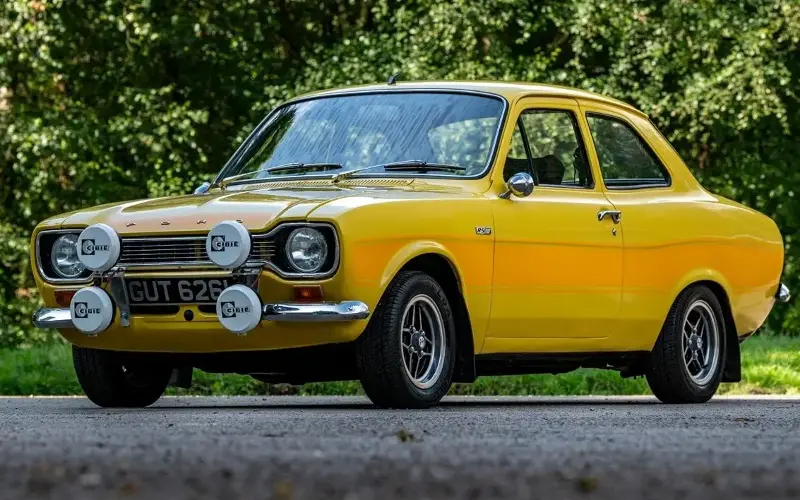
Revered hot hatchbacks such as the Volkswagen Golf GTI, Peugeot 205 GTi and a bevy of Ford Fiesta XR2, Escort XR3 and Focus RS models from the 1980s to early 2000s are very much in demand – but with that desirability comes the risk of buyers being taken for a ride. Exotic fakes with other-worldly values exist, but those most often caught unawares are enthusiasts of high-performance versions of mass-market cars who simply do not realise what they are buying.
I know of one such car that stops aficionados in their tracks, drawing as much attention as a supercar. But while within a geeky collector community this machine is upheld as a highly desirable example of its kind, it will never be for sale: it is not a genuine original. And only a handful of sympathetic senior members of the marque’s owners’ club know its secret background. The owner simply didn’t realise it was not the real thing when he acquired it, a fact that instantly halved its value.
High-performance classic cars fall into one of three distinct categories: genuine original, “tribute” (or replica, or recreation, or evocation) or fake. For some of the real horror stories of deception, look to sought-after Porsches. More on that later; first, here is how to avoid your classic car dream turning into a nightmare.
Trust the experts
With any car, it pays to join an owners’ club, get to know its members, go to events, pick up knowledge and, before committing to buying what is (or at least appears to be) a classic, profit from the extensive expertise of the club’s myriad experts.
There are a lot of “tribute” cars out there, 1960s to 1980s fast Fords such as Escorts and Sierras featuring highly. Cheap base models were plentiful, and their simple engineering meant overt (or covert) upgrade parts were plentiful and inexpensive, encouraging conversions.
Genuine Escort RS2000s, for instance, whether original or restored, Mk1 or Mk2, fetch upwards of £50,000 in what Iconic Auctioneers says is a market that has adjusted back from Covid-era classic-car demand and its consequent wild pricing.
Iconic currently has a genuine 1975 RS2000 listed for its February 21 auction at the Race Retro show. Its guide price is £46,000 to £54,000 – a 1972 RS2000 “recreation” recently sold by the same auctioneer made £25,875, indicating the relative values of the real thing and a later replica.
Focus on Ford
A spokesman for the Ford RS Owners’ Club, founded 1980, says that 1970s and 1980s performance models are now valuable assets. Buyers are usually savvy, and genuine cars well-documented. “Our Registrars [specialists in specific models] can help with pre-sale queries. They have access to records, have intimate knowledge and know the tell-tale signs of it being a genuine RS,” he says.
“A previously unknown RS from the 1970s-1980s is quite a rare event. However, our Registrar team exists to help determine authenticity.”
But potential buyers who might allow the cars’ raw appeal to cloud their judgment risk not doing due diligence, perhaps even bypassing the marque experts altogether.
In terms of spotting fakes, the club says an extreme example would be the Mk2 Escort RS1800. Only 109 were built. “A low mileage, low owner, original, well-documented car would likely sell for in the region of £200,000. A dedicated ‘replica’, not purporting to be genuine, would likely be worth £20,000. Trying to pass a replica or fake as original would make the car virtually worthless,” says the spokesman.
The Lotus lesson
While fast Fords enjoy a mainstream following, the limited-production Talbot Sunbeam Lotus is a relatively under-the-radar classic. It was developed in the late 1970s to compete in international rallying against the benchmark family-two-door-turned-racer Ford Escort.
Perry Antoniou is chairman of the Sunbeam Lotus Owners’ Club. Those of us of a certain age get all goose-pimply when such cars come into conversation. With a lightweight two-door shell cloaking a Lotus 2.2-litre twin-cam engine developing 150bhp, the whole thing weighing only 960kg, it was fast in its day; homologated for competition, it won the World Rally Championship in 1981.
Only 2,300 were produced (1,184 for the UK). “But there are now only 277 real ones – originals – left. And at least 150 fakes we know of,” says Antoniou.
They were thrashed and crashed competing in rallies, while the road-going cars produced to satisfy homologation rules fell easy victim to rust. Engines (tunable to almost 300bhp), gearboxes and axles found their way into a variety of period tuned or competition cars: gearboxes (made by German specialist ZF) easily slotted into high-performance rear-wheel-drive Escorts, for example.
“A good original car will fetch £70,000 or £80,000 and values are holding firm, but I know of cars built from scratch [as genuine efforts to openly create replicas] at a cost of £100,000 which have sold at auction for less than half of that,” says Antoniou.
The Owners’ Club is expert at spotting fakes, citing two highly visible features, but maintaining secrecy on several others.
“If its speedometer goes to 120mph rather than 140mph and the battery tray is either on the right or there’s evidence it has been moved to the left, then it’s fake. But there are several other things we keep to ourselves which distinguish fake from original,” says Antoniou.
Pretend Porsches publicised
Those Porsche horror stories? Anthony Shearer of Porsche Inspections audibly shudders when I ask for anecdotes about his fake-finding experience. He is a Porsche super-geek.
“Pre-2000 cars are easiest to fake; the majority are imports, so it takes nothing more than MOT-ing them and paying road tax to make them [legitimately UK road-registered],” he says.
“I know what to look for; [same-model] cars will change spec slightly year to year. For instance, early 1980s 911s have a sticker detailing the car’s paint colour, but the sticker has changed in design and position four times.
“One customer came to me with a 1989 911 Turbo, 930-series. That’s about as desirable a classic Porsche as it gets. It was the only year that model was fitted with a five-speed gearbox. Genuine cars, maybe £150,000.
“It was right-hand drive, but had been cut up and converted from left-hand drive. He had no idea. He had bought it innocently. There was no way to know its real identity, but if the real owner surfaced, they would have the right to claim it back. The buyer would lose both the car and the money paid for it.
“I know of a [modern classic] 911 currently for sale which had no chassis number, but suddenly acquired one. Its background is a mystery. But international car registration authorities don’t talk to each other, so its real identity may never be known.”
The ultimate deception?
But taking the biscuit is a 1992 911 964-series RS, one of the most sought-after among Porsche collectors. Genuine cars make £200,000. “A UK car was crashed and the bodyshell deemed beyond repair. But [specialist] mechanics replaced the shell, maintaining the RS as a bona fide UK car,” says Shearer.
“But the original shell turned up overseas, was repaired, built into a left-hand-drive 964 RS, then registered. There are now two 911 964 RSs with the same chassis number.”
If they ever end up in the same country, ownership mayhem will break out. Shearer knows exactly where the cloned car is.
It all alerts enthusiasts to the perils of buying blinkered. As ever, the best investment could be a £50 owners’ club membership. It could save a buyer tens of thousands and avoid them being stuck with a car they would find difficult, even impossible, to sell on – assuming it’s not confiscated, meaning loss of both car and cash paid for it.