



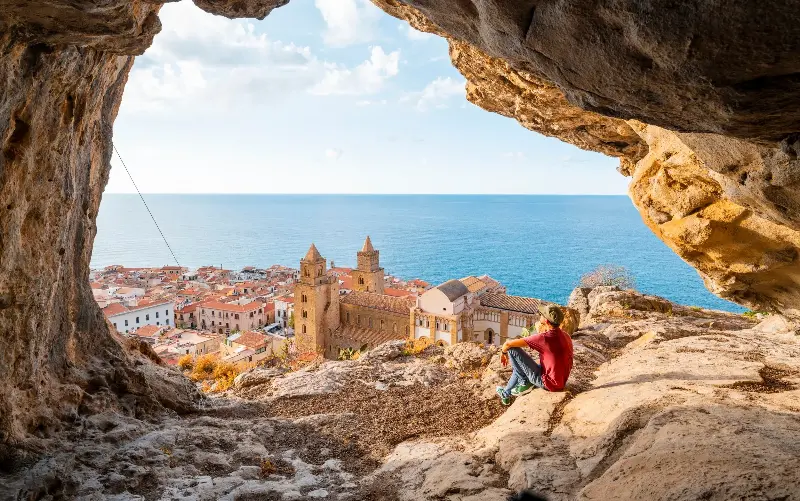
The greatest island in the Med? According to Telegraph Travel’s extensive study, comparing 50 islands across more than 30 different metrics, it is Sicily that reigns supreme.
With everything from sandy beaches and ancient ruins to Michelin-starred restaurants and first-rate hotels, it appeals to the classicist and the hedonist alike (as well as A-listers like Dua Lipa and Callum Turner, who this weekend celebrated their wedding there).
Covering 9,927 square miles, the island is home to three active volcanoes and seven Unesco World Heritage Sites, but to those who call it home, Sicily’s soul resonates far deeper than mere data points.
‘Slow living is a state of mind’
For Alessandra Cicero, that reality began in the port town of Pozzallo, in the province of Ragusa. Her childhood and teenage years were defined by the outdoors; free time spent on the beach or at the nearby park playing hopscotch, or a version of hide-and-seek called “quattro cantoni”.
After moving abroad to study, Cicero maintains a special relationship with the island of her youth. “Whenever I leave, it feels like leaving behind a big piece of myself,” she says, “but deep down I know that I’ll find everything as I left it next time I come back.”
This continuity is anchored by the Italian philosophy of il dolce far niente (the sweetness of doing nothing). Whether marvelling at the Duomo di Siracusa, or basking in the honey-hued glow of Noto’s opulent palaces and churches, there is a relaxed, carefree attitude here that proves elusive elsewhere.
“Nowadays, the concept of slow living is sought and desired by many, but in Sicily it is always a state of mind,” Cicero says. “Take life easy, worry less, and enjoy the little pleasures, like an espresso at the counter while catching up with people.”
Beyond cherished childhood memories is Cicero treasures the deeply ingrained spirit of hospitality and a strong sense of belonging. A distinct identity is fostered by residents who often identify more as Sicilian than Italian, a legacy of a time when Italian was not the island’s mother tongue.
‘Once you are in, you are one of them’
This unique connection is echoed by local wedding planner, Adriana Smentek, who emphasises that Sicilian people do not like being called Italians and always correct you by saying “sono Siciliano”, meaning “I am Sicilian”.
Smentek lived in London before moving back to the historic port city of Catania in 2016, and maintains that Sicily is, without a doubt, defined by its people.
“They aren’t always the easiest to communicate with or the most flexible, but generally, they are good people with open hearts who will help you when you are in need, welcome you, and make you feel like you’ve been part of this community forever,” she says. “Once you are in, you are one of them. I think that many expats find this very attractive.”
The people are just one of the aspects British expats find appealing about the island. Sicily also offers a lower cost of living compared to the rest of the country, roughly 18 per cent lower than the national average.
To put this into perspective, since 2018 more than 80 British buyers have purchased properties in Mussomeli, a hilltop town which gained considerable attention for its €1 home scheme aimed at tackling population decline by encouraging foreign buyers.
Aside from the cheaper costs, the omnipresence of history is hard to ignore. “Greek and Roman ruins are literally scattered everywhere, and it is not uncommon for people to find mysterious objects when they renovate Palazzos,” Smentek remarks.
“Sicily is an open-air museum. The only place that beats it is Rome.” For her, living on an island where so many civilisations have left their mark is truly special.
‘What always strikes me is the beauty’
This sense of history is a sentiment shared by Antonio Alonge, who was born near Agrigento, close to some of the best-preserved Greek temples in the world.
He left Sicily in his twenties after meeting his wife, who is from Tuscany, and has since built a life there. However, like Smentek, the island remains a strong presence in his life. “I go back whenever I can, for family holidays, or simply because I feel the need to return,” he says.
“What always strikes me is the beauty. The light, the landscapes, the sea – it is difficult to compare it to any other place in the world,” he reflects.
“Even something simple, like buying oranges in season, becomes a memory. Those oranges, so sweet and full of sun, are for me one of the symbols of Sicily.”
Ultimately, Sicily’s enduring status has little to do with rankings and everything to do with its refusal to change for anyone else. The island is a convergence of food, architecture and culture rooted in the unhurried pace of its lifestyle.