



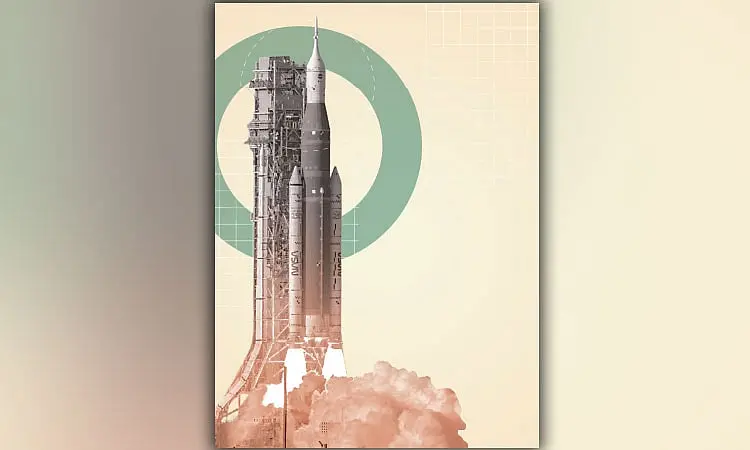
“We realized the gravity of the mission.” That’s how astronaut Reid Wiseman described Artemis II, a journey that will take humans farther from Earth than anyone has ever gone before.
It has been more than 50 years since humans last traveled to the moon. In that time, space has remained both familiar and unknowable — a place we have studied endlessly, yet barely touched again.
There is something deeply human about wanting to leave Earth. And perhaps nothing more inhumanly human than space exploration itself.
Set for a 10-day mission, Artemis II will carry astronauts as far as 252,799 miles (406,840 kilometers) from Earth, surpassing the record set by Apollo 13 in 1970. A billion-dollar program led by Nasa, Artemis also reflects a new era of collaboration, where discoveries in space ripple back to industries and technologies on Earth.
With growing global attention, more people are beginning to pick up the language of space. Here is a guide to key terms from Nasa’s glossary to help make sense of the mission.
Key terms
Translunar injection burn – A critical maneuver in which a spacecraft fires its engines to leave Earth’s orbit and head toward the moon.
Lunar flyby – When a spacecraft travels around the moon without landing, using gravity to guide its path.
Space Launch System – Nasa’s most powerful rocket, designed to carry astronauts deeper into space for missions such as Artemis II.
Light-year – A unit of length equal to the distance light travels in a year. In a vacuum, light travels about 671 million mph (1.1 billion kph), so one light-year equals roughly 5.8 trillion miles (9.5 trillion kilometers).
Speed of light – The fastest known speed in the universe, at 299,792,458 meters per second. It defines how distance and time are measured in space.
Artificial gravity – A concept used in spacecraft design to simulate gravity, helping astronauts function during long-duration missions.
Observable universe – The portion of the universe that can be seen from Earth.
Aurora – Natural light displays caused by solar particles interacting with a planet’s magnetic field.
Fluorescence – When a substance absorbs energy and re-emits it as light, often observed in space environments such as comet tails.
Lunar craters – Depressions formed when asteroids, meteoroids or comets strike the moon. The moon’s lack of atmosphere and erosion keeps these craters well-preserved.
Orientale Basin – A massive multi-ring impact crater on the moon’s far side, previously seen only through robotic spacecraft images.
Copernicus – A relatively young lunar crater, about 800 million years old, with pale ejecta still visible and well-defined features.
Tycho – One of the most prominent craters on the moon, appearing as a bright spot in the southern highlands with radiating streaks.
Reiner Gamma – A mysterious bright swirl pattern on the moon’s surface that scientists are still trying to fully explain.
Impact flashes – Brief bursts of light caused when meteoroids strike the moon’s surface.