



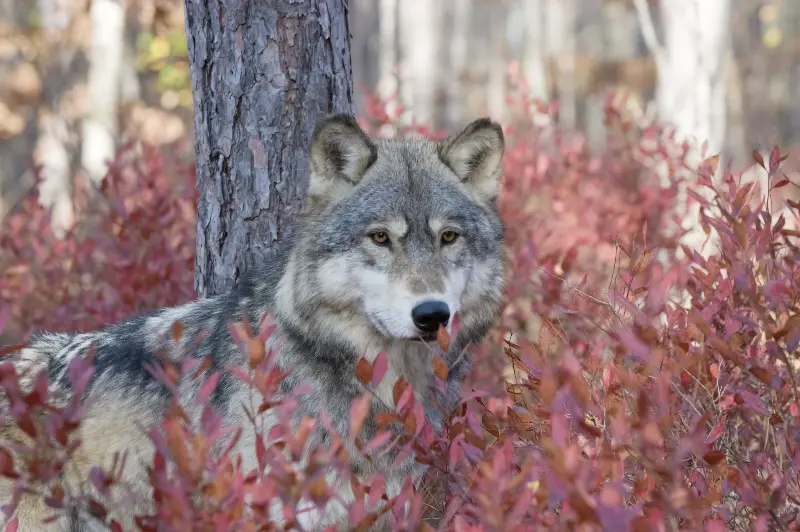
MINNEAPOLIS — The meat-loving apex predator of the great North Woods may play a surprising and out-sized role in the proliferation of an unlikely source of food: wild blueberries.
Gray wolves gorge on blueberries in the late summer, when their usual prey — whitetail deer — are hardest to catch. And then, like fierce furry Johnny Appleseeds, the wolves carry the blueberry seeds in their stomachs, spreading them around the forest through their scat. New research from the Voyageurs Wolf Project out of the University of Minnesota found that blueberry seeds thrive after a stint inside a wolf’s stomach, showing that the carnivores likely play a previously unknown role in fruit propagation.
The seeds collected from wolf scat grew faster and were far more likely to successfully germinate than seeds collected from the same woods and planted by hand, researchers found.
“This shows that there is a benefit to blueberry seeds in getting eaten by a wolf,” said Tom Gable, one of the authors and the project lead of the Voyageurs Wolf Project. “And that’s important because wolves travel such far distances that they have the ability to disperse these seeds pretty far away.”
The findings shed new light on how a vital food source for many species takes root and spreads in a boreal forest. And it suggests that wolves, which live almost entirely off deer, beaver and fish, may play at least some role in nurturing plant life.
Blueberries are found just about everywhere wolves live.
In northern Minnesota, the plants start bearing fruit in mid-July and remain available until around mid-August. That happens to be a particularly lean time for wolves.
Deer fawns are old and fast enough by late summer to be difficult to catch. Wolf pups have grown large by that time of year and are more difficult for parents to feed. Even beavers, an important prey, tend to stay more in the water in the late summer and aren’t as easy for wolves to find as they are in the fall, said Alex Gross, the lead author of the study.
So, wolves eat all the blueberries they can get. During that month or so when blueberries are ripe, the fruit can make up more than 80% of their diet, Gable said.
It’s not a particularly good food for wolves. They’re stomachs aren’t adapted to gain much nutrition from the fruit, Gable said.
But the berries can help the animals feel full and may provide a quick burst of energy. By feasting on blueberries in late summer, wolves essentially starve more slowly, trying to buy time until they can get their next kill, Gross said.
Research on the benefits to fruit seeds from being digested by other canines is mixed. Some studies have shown that red foxes are also beneficial to the seeds when they eat blueberries. But coyotes seem to have no effect on the fruit.
Black bears are highly beneficial to the fruit seeds and blueberry patches that they eat. A 2018 study out of Oregon State University found that bears, not birds as previously thought, were by far the most prolific fruit seed spreaders in southwestern Alaska, profoundly affecting what grows there.
But here in northern Minnesota, black bears are not nearly as mobile as wolves. A bear may travel about a half-mile with blueberry seeds in its stomach. A wolf would be expected to travel about ten times that distance in an hour or two, according to the study.
“Wolves have the capacity to spread these seeds way farther than red foxes, coyotes, bears,” Gross said.
The Wolf Project, which is funded with state lottery proceeds that go to Minnesota’s Environment and Natural Resources Trust Fund, has been collaring wolves and studying their behavior near Voyageurs National Park for years. Researchers collected the seeds from fresh wolf scat produced by a handful of collared wolves.
The seeds didn’t spend enough time in the scat for the wolf poop to act as any sort of fertilizer, Gable said.
Something seems to happen during digestion that helps the seeds. Researchers suspect the seed coat is scraped in a way that essentially unlocks it, helping the seed take up water and respond to germination cues once it is back on the ground.
Seeds from wolf scat were 27% more likely to germinate in a lab setting than seeds that were collected by hand from the same blueberry patches where the wolves were eating, the study found.
The wolf seeds also started growing about a week earlier than handpicked seeds.
“This shows another way that wolves are connected to these forests,” Gross said. “We think of them as just carnivores, but this highlights an underappreciated role.”