



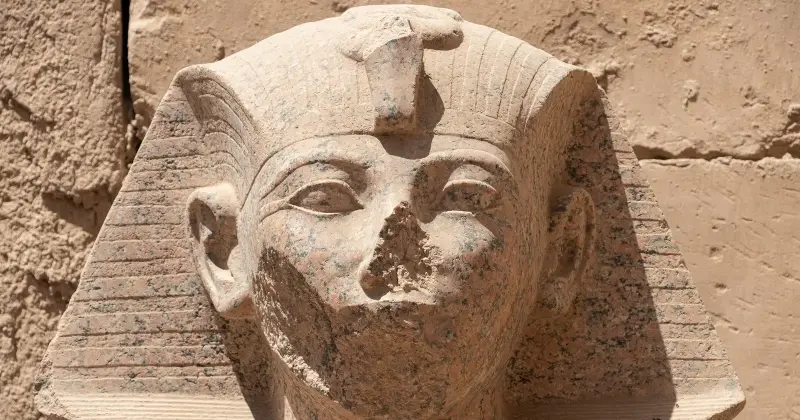
The Eighteenth Dynasty of Ancient Egypt ruled the country between approximately 1550 and 1292 BCE, a period during which Egypt reached the greatest territorial extent, wealth, and cultural influence in its recorded history. The dynasty produced some of the most famous names in ancient history: Hatshepsut, the female pharaoh who ruled as king; Thutmose III, whose military campaigns extended Egyptian power across the Levant; Akhenaten, who briefly attempted to convert the country to monotheism; his wife Nefertiti; and Tutankhamun, the child pharaoh whose mostly intact tomb was discovered by Howard Carter in November 1922 and remains the most famous archaeological find of the twentieth century.
The dynasty is well documented in the surviving Egyptian record. Its pharaohs are known by name, by regnal length, by the temples and monuments they built, and by the tombs into which they were interred. All of them, that is, except one.
Thutmose II, the fourth pharaoh of the Eighteenth Dynasty, ruled Egypt for approximately fourteen years between 1493 and 1479 BCE. He was the husband and half-brother of Hatshepsut, the father of Thutmose III, and one of the least documented pharaohs of the dynasty. His mummy had been recovered in 1881 from a cache of relocated royal remains at Deir el-Bahari. His tomb had never been found.
For over a century after the discovery of Tutankhamun’s tomb, the search for the burial site of Thutmose II remained one of the more conspicuous unsolved problems in Egyptian archaeology. Multiple expeditions had searched the Valley of the Kings and its surrounding wadis without success. The location of the tomb, on the standard scholarly consensus, was unknown, and by the early twenty-first century increasingly presumed to be permanently lost.
The softness in the sand
On 31 October 2022, a joint archaeological mission of the Egyptian Supreme Council of Antiquities and the New Kingdom Research Foundation, based at the McDonald Institute for Archaeological Research at the University of Cambridge, was conducting clearance work at a site in the Western Wadis, approximately 2.4 kilometres west of the Valley of the Kings and near the tombs of several wives of Thutmose III. The team, led by the Scottish archaeologist Dr Piers Litherland and the Egyptian archaeologist Professor Mohamed Abdel-Badi, was searching for foundation deposits associated with the known royal wife burials in the area.
Two members of the team, Ashraf Omar Ali and Heraji Sayed Ahmed, noticed a softness in the surface of the sand at a location that had not been previously identified as archaeologically significant. The team began to dig downward. What emerged, over the following days, was the entrance to a substantial rock-cut staircase leading into a corridor descending into the bedrock beneath the Theban Mountain.
The discovery was designated Tomb C4. The team’s initial working hypothesis was that the tomb belonged to one of the royal wives of the Eighteenth Dynasty, given its proximity to the known wives’ tombs and its location closer to the Valley of the Queens than to the Valley of the Kings. This hypothesis was consistent with the standard interpretation of the surrounding archaeological landscape and was, in the initial phase of the excavation, the most parsimonious explanation for what had been found.
It was also, on what the team would eventually determine, wrong.
The three-year excavation
The tomb’s interior, when it began to be accessible in late 2022 and through 2023, was in substantially poorer condition than any previously excavated pharaonic burial. Shortly after the original occupant’s death, on the physical evidence of water damage throughout the structure, the tomb had been flooded by a substantial water event. The plastered walls had partially collapsed. The corridor and burial chamber had filled with debris. The original grave goods and the mummy had, at some point in antiquity, been removed and relocated, presumably by priests attempting to preserve the burial from further water damage.
The excavation that followed took nearly three years. The team documented and removed the debris layer by layer, recovered fragments of the original tomb decoration, and gradually reconstructed what the burial site had originally contained. The work was meticulous and unspectacular by the standards of popular archaeology. There was no intact burial. There was no undisturbed treasure. There was, for a substantial period, no definitive evidence of who the tomb had originally belonged to.
What eventually emerged from the debris was three specific categories of evidence that identified the tomb’s original occupant.
The first was the wall decoration. Fragments of the original plastered walls contained hieroglyphic passages from the Amduat, a funerary text used almost exclusively in royal burials of the Eighteenth Dynasty and later. The Amduat was not a text applied to the tombs of royal wives, and its presence at Tomb C4 was the first strong indication that the original hypothesis about the tomb’s occupant was incorrect.
The second was the ceiling decoration. Additional plaster fragments preserved a blue ceiling painted with yellow stars, a representation of the night sky. The blue-and-yellow starred ceiling was, on the available comparative evidence, a specific stylistic feature of Eighteenth Dynasty pharaonic tombs. It did not appear in the tombs of royal wives.
The third was the alabaster vessels. Fragments of small alabaster jars, shaped like ducks and used in ancient Egyptian burials to hold cosmetics, perfumes, and ointments, were recovered from the debris. The inscriptions on the alabaster jars bore the name of Thutmose II, identified in the inscriptions as the “deceased king,” along with inscriptions bearing the name of his chief royal consort, Queen Hatshepsut. The combination of evidence was, in the team’s assessment, definitive. Tomb C4 was the burial site of Thutmose II.
The announcement
The Egyptian Ministry of Tourism and Antiquities announced the identification of the tomb on 18 February 2025. The Minister of Tourism and Antiquities, Sherif Fathy, described the discovery as “the first royal tomb to be discovered since the groundbreaking find of King Tutankhamun’s burial chamber in 1922,” and characterised it as “an extraordinary moment for Egyptology and a profound step in our understanding of humanity’s shared past.”
Litherland, speaking to BBC Newshour after the announcement, described his reaction to the confirmation. “When I came out, my wife was waiting outside, and the only thing I could do was burst into tears. When you come across something that you’re not expecting to find, it’s emotionally extremely turbulent, really.” The Litherland team’s work had begun in the Western Wadis over a decade before the identification, in a project that had previously excavated over fifty other tombs in the Theban Mountain and had identified more than thirty royal wives and court women of the Eighteenth Dynasty. The Thutmose II identification represented the accumulated result of that longer excavation programme rather than a single dramatic find.
The second tomb
The most substantial complication of the Thutmose II identification is that the tomb, on the physical evidence, does not appear to have been the pharaoh’s final resting place. The flooding that damaged the tomb occurred within a few years of Thutmose II’s death in approximately 1479 BCE. The mummy and grave goods were relocated at that time, presumably to a second, drier location that could preserve the burial from further water damage.
Litherland has publicly stated that he believes he has identified a candidate location for the second, undiscovered tomb of Thutmose II, in an area of the Western Wadis where his team has found what appears to be an artificial deposit of approximately 23 metres of layered material concealing a structure below. If the second tomb exists and contains the original relocated burial, it would represent a substantially more dramatic archaeological find than the first tomb, potentially including intact grave goods that had been protected in antiquity from the water damage that destroyed the original.
The mummy that has been identified as Thutmose II since its recovery from the Deir el-Bahari cache in 1881 may or may not actually be him. The identification of that mummy was made on the basis of an inscribed label and physical measurements that are consistent with a pharaoh of his approximate age at death, but the identification has been contested in the peer-reviewed literature and Litherland has indicated that the mummy in his hypothesised second tomb, if it exists, may be the actual Thutmose II.
Whether the second tomb exists, whether it contains the original burial, and whether the currently identified mummy is genuinely Thutmose II are questions that the available evidence does not yet resolve.
What it means
The February 2025 announcement is the first identification of a pharaoh’s tomb near the Valley of the Kings since Howard Carter’s 1922 discovery of Tutankhamun’s burial. Several other royal burials have been found in the intervening century in other parts of Egypt, including the Silver Pharaohs of Tanis and various royal family members at Dahshur and other sites. None of these was a ruling pharaoh, and none was located near the Valley of the Kings itself. The Thutmose II identification closes the last major gap in the roster of known Eighteenth Dynasty royal tombs.
The tomb is in substantially worse condition than Tutankhamun’s, contains substantially fewer grave goods, and produced substantially less dramatic material than the 1922 discovery. Its archaeological significance is not comparable to Tutankhamun’s in terms of surviving contents. It is comparable, however, in terms of what the identification adds to the historical record. Thutmose II is one of the least documented pharaohs of the Eighteenth Dynasty, and the recovery of the tomb architecture, the wall decoration, and the inscribed grave goods provides substantially more direct evidence about his reign than had previously existed.
The possibility of a second, intact tomb remains open. Litherland’s team continues to work in the Western Wadis.
The last missing pharaoh of the Eighteenth Dynasty has been found.
The pharaoh himself, on the strongest current reading of the evidence, may still be waiting somewhere else.
The post The last missing royal tomb of Ancient Egypt’s Eighteenth Dynasty, belonging to a pharaoh named Thutmose II who ruled approximately 3,500 years ago, was announced by a joint British-Egyptian archaeological team in February 2025, in the first discovery of a pharaonic tomb near the Valley of the Kings since Tutankhamun’s was found by Howard Carter in November 1922. appeared first on Space Daily.