



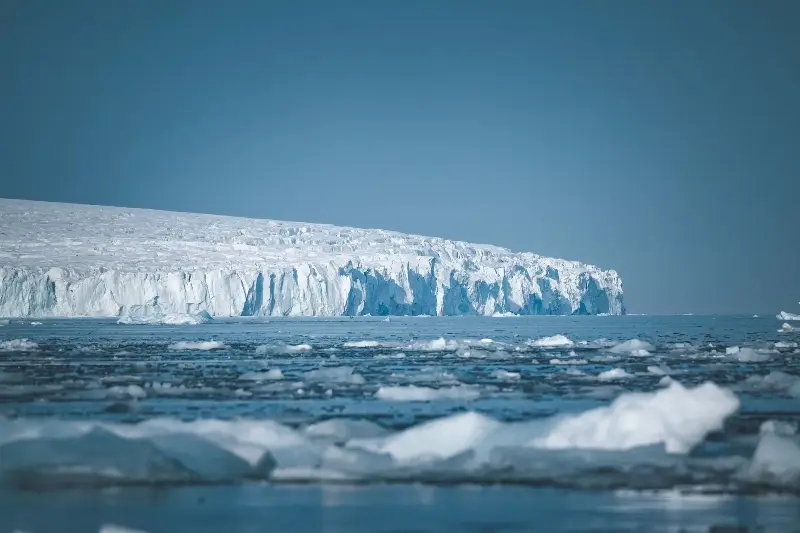
East Antarctica can look, from above, like the quiet half of the frozen continent: old, thick, cold and buried under kilometres of ice. But beneath that ice, new mapping suggests the bedrock may carry the shape of a much more violent past.
In a Nature Geoscience study published in June 2026, researchers described a giant fan-shaped geological province hidden beneath the East Antarctic Ice Sheet. The feature links several huge subglacial basins that had previously been treated more like separate buried depressions. Together, the team argues, they may form a coherent tectonic structure radiating from a focal region near the South Pole.
The authors call it the East Antarctic Fan-Shaped Basin Province. If their interpretation is right, the structure is not just a strange pattern in buried topography. It may be a continent-scale scar from the long tectonic stretching that helped prepare Antarctica and Australia to separate during the breakup of Gondwana.
A map drawn through ice
The feature was not discovered by drilling through the ice and finding a single exposed rock face. Almost all of East Antarctica’s bedrock is hidden. Instead, researchers pieced together the shape of the land below the ice using sub-ice topography, gravity, magnetic and seismic data.
The key observation is geometric. Several low-elevation, V-shaped basins beneath East Antarctica appear to spread outward in a fan-like pattern. These include major buried regions associated with the Wilkes and Aurora basins and the basin that contains Lake Vostok, the largest known subglacial lake on Earth.
Those basins were already known. The new claim is that they may not be unrelated holes in the landscape. They may be parts of one wider system produced by a tectonic process called distributed rotational extension.
In plain language, that means the crust did not simply split along one neat crack. It stretched and rotated across a broad region, opening a set of basins like the ribs of a fan. In the Nature Geoscience abstract, the authors describe the province as a semi-continental-sized physiographic unit that radiates from a focal point near the South Pole.
The Gondwana connection
The proposed timing matters because Antarctica was once part of Gondwana, the southern supercontinent that also included Australia, India, Africa, South America and other landmasses. Gondwana began fragmenting in stages, and the final separation between Antarctica and Australia unfolded much later in that long breakup history.
The study proposes that the fan-shaped basin province formed before the breakup of Gondwana through intraplate rotational extension. The authors argue that the northern edge of the fan may have created a lithospheric weakness that helped guide the propagation of Antarctica-Australia separation and shape the resulting continental margins.
That does not mean the buried fan alone tore the continents apart. Plate breakup is a long, multi-cause process involving mantle dynamics, inherited weaknesses, rifting and seafloor spreading. The claim is more specific: the fan-shaped deformation may have weakened and organized part of East Antarctica in a way that influenced where and how the later separation progressed.
That is why the discovery matters. A continent that looks geologically stable under the ice may preserve hidden evidence of stretching, rotation and reorganization linked to one of Earth’s major rearrangements.
Mountains, basins and hidden structure
The model does more than connect Antarctica to Australia. It also tries to explain several major features inside Antarctica itself.
To the west of the proposed fan, the authors argue, the same deformation could have caused compression and contributed to the uplift of the Gamburtsev Mountains. These mountains are often compared in scale to the European Alps, but they are buried beneath the East Antarctic Ice Sheet rather than standing exposed to the sky.
To the east, the model suggests that a northern segment of the Transantarctic Mountains rotated clockwise by about 20 degrees, contributing to segmentation of the mountain chain and differential uplift. The Transantarctic Mountains divide East and West Antarctica, so any process that affected their geometry also matters for the continent’s broader tectonic architecture.
These are not small claims. They turn the fan-shaped basins from passive depressions into pieces of a larger tectonic machine. They also imply that the shape of the subglacial bed, the routes taken by glaciers, and the long-term evolution of the ice sheet may be tied to ancient bedrock deformation.
Why it matters for the ice sheet
Bedrock controls ice in practical ways. Glaciers and ice streams follow slopes, troughs, basins and ridges. A deep buried basin can steer ice flow. A high ridge can slow it, redirect it or help stabilize part of the ice sheet.
That means Antarctic geology is not just a deep-time curiosity. It is part of the boundary condition for ice-sheet models. If scientists misunderstand the shape and origin of the bed below East Antarctica, they may miss why some sectors of the ice sheet flow where they do, or how they could respond as climate and ocean conditions change.
The new study does not predict an immediate ice loss event. It is not that kind of paper. Its importance is structural: it argues that a large part of East Antarctica’s hidden landscape may have a shared tectonic origin, and that this origin influenced the development of glacial troughs and outlet glaciers.
A hypothesis under kilometres of ice
The authors are careful that the fan-shaped province is a model, not a final verdict. The pattern is persuasive enough to name and test, but the timing of deformation remains a key uncertainty. The structure may have developed in more than one phase, and better constraints will be needed to separate what happened before Gondwana breakup from what may have continued afterward.
That caution is important because Antarctica makes geology unusually hard. On most continents, scientists can walk across faults, sample rocks, date minerals and map structures directly. In East Antarctica, the crucial evidence is often buried under more than 3 kilometres of ice.
For now, the fan-shaped basin province is best understood as a new way to organize scattered clues beneath the ice. It links known basins, buried mountains, continental margins and the Australia-Antarctica breakup into one testable tectonic story.
If that story holds, East Antarctica is not simply an old frozen block with an ice sheet on top. It is a continent whose hidden bedrock still records the stresses that helped pull the southern world apart.
Sources
- Armadillo et al., “A fan-shaped subglacial basin province in East Antarctica formed by rotational extension,” Nature Geoscience, 2026
- Live Science report on the East Antarctic Fan-Shaped Basin Province
- Fremand et al., “Antarctic Bedmap data: FAIR sharing of 60 years of ice bed, surface and thickness data,” Earth System Science Data, 2023
The post Scientists have detected a giant fan-shaped structure buried beneath the East Antarctic Ice Sheet, suggesting the frozen continent may be hiding the geological scars of the breakup that helped separate Antarctica from Australia appeared first on Space Daily.