



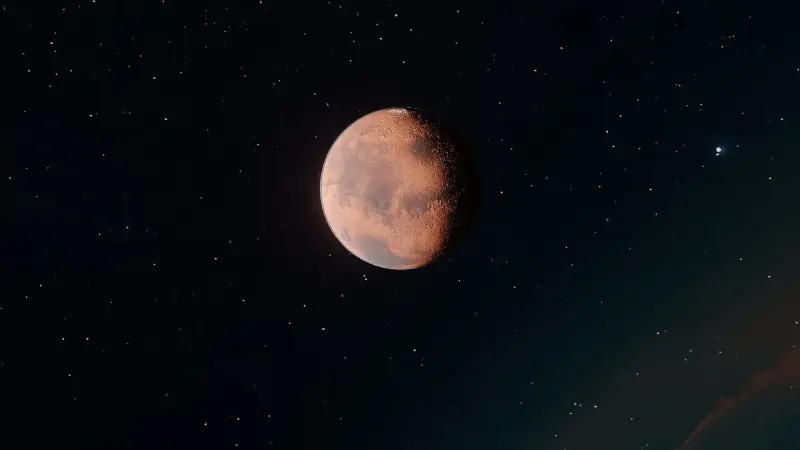
Mars once had a global magnetic field, generated deep inside the planet, strong enough to deflect the solar wind much as Earth’s does today. When that field faded, Mars lost its thick atmosphere and its surface water, and over time it changed from a world that may once have been habitable into the frozen desert we see now. The broad story is well supported, though, as we will see, the pace of that transformation is where the popular version tends to overreach.
A planet that once had a shield
The evidence that Mars had a magnetic field is written into its oldest rocks. In the ancient southern highlands, the crust is strongly magnetised, a fossil imprint left behind when molten rock cooled in the presence of a global field. That tells us early Mars ran an internal dynamo, a churning, electrically conducting core that generated a magnetic field wrapped around the whole planet, in its first few hundred million years.
Such a field would have created a magnetosphere, a protective bubble that turns aside the solar wind before it can reach the air below. By studying which ancient impact basins are magnetised and which are not, researchers have dated the dynamo’s death to roughly four billion years ago. After that, the shield was gone.
Losing the shield
The dynamo faded because the small planet’s interior cooled and the churning that sustained the field wound down. Once the global field was gone, nothing stood between the atmosphere and the solar wind, the ceaseless stream of charged particles flowing out from the Sun.
With the shield down, that wind could strike the upper atmosphere directly and carry it off into space, molecule by molecule. Earth, by contrast, still runs an active core and keeps its magnetic shield, which is part of why it has held onto its air. Mars lost that protection early in its life.
How we know the solar wind is doing this
This is not just a plausible story; the process has been caught in the act. NASA’s MAVEN orbiter was built specifically to measure how Mars loses its atmosphere, and it found the planet is still bleeding air into space today, at a rate of roughly 100 grams every second. Crucially, MAVEN’s data also imply that the loss rate would have been far higher long ago, perhaps hundreds of times higher, when the young Sun was more violent. The mechanism the headline describes is real and observed.
The important caveat: it was slow
Here is where care is needed. The idea of the atmosphere and oceans vanishing in a geologically brief period can leave the impression of a sudden catastrophe, and that is misleading. The loss played out over hundreds of millions to billions of years. It was a long, slow bleed, not a collapse. “Brief” applies only in the sense that geologists count time in billions of years; in any human sense it was unimaginably gradual.
The magnetic field is also not the whole explanation. Mars is a small world with weaker gravity, which by itself makes it easier for gas to escape. A great deal of the planet’s water was not lost to space at all but locked away underground and bound into minerals in the crust, where signs of it are still being found. Much of the carbon dioxide was sequestered into rock. The death of the dynamo was a major trigger and a genuine turning point, but it acted alongside several other processes rather than as a single switch that drained the planet.
From possibly habitable to frozen
What makes the change so poignant is what Mars seems to have been before it happened. In its warm, wet youth it had a thicker atmosphere, and rivers, lakes and perhaps standing seas on its surface, the kind of environment that could in principle have supported life.
Whether it ever actually did is unknown. Rovers have found ancient habitable settings and complex organic molecules in old Martian rocks, but no confirmed trace of life itself. As the atmosphere thinned and the planet cooled, liquid water could no longer survive on the surface, and Mars settled into the cold, dry, largely airless state it holds today.
Why it matters
Mars is both a cautionary tale and a natural experiment. It shows how tightly a planet’s habitability can be bound up with its interior, because a cooling core and a lost magnetic field appear to be part of why a once-watery world became a desert. That link matters as astronomers weigh the prospects of planets around other stars, where a magnetic shield, or its absence, could help decide whether an atmosphere endures.
The things to watch are the efforts to read Mars’s early, wetter chapter more clearly: the plan to bring Martian rock samples back to Earth for detailed study, and continued work tracing where the planet’s water went, both the portion lost to space and the portion still hidden in the crust. The magnetic field that once guarded Mars is long gone, but the record of what its loss set in motion is still there in the rocks, waiting to be read.
The post Mars once had a magnetic field strong enough to deflect solar wind, just as Earth’s does now — when it collapsed, the planet lost its atmosphere and its oceans within a geologically brief period, transforming from a world that may have held life into the frozen desert it is today appeared first on Space Daily.