



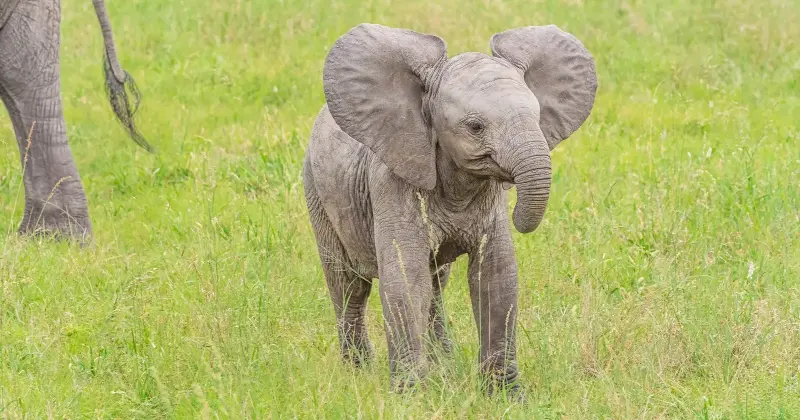
Of all the things a body weighing several tonnes might struggle to do, getting airborne sounds like it should be near the top of the list.
Yet the surprise runs the other way. Elephants are capable athletes by almost any measure, and they fail at only one common animal feat: lifting all four feet off the ground at once.
Let’s start with what elephants can do, because it is more than the lumbering stereotype suggests. They are strong swimmers, using the trunk as a built-in snorkel, and can stay afloat over long distances. They rear up on their hind legs to forage, extending the trunk to reach vegetation several metres up a tree. A committed charge is no bluff, either: an elephant can accelerate hard enough to outrun a sprinting human.
The inability to jump is not about weakness or timidity. An animal that swims long distances, balances its full weight on two legs to browse, and accelerates hard when provoked clearly has power and coordination to spare.
What it lacks is the one mechanical trick that even a house cat has: the crouch-and-spring.
The clearest reason sits in the leg bones. Most mammals carry their limbs in a zig-zag, with joints that flex and angles that let the leg fold and then snap straight. That folding is what stores energy for a leap. Elephants are built differently. A 2023 study describes their limbs as “columnar”, a near-vertical, pillar-like stack that the authors identify as unique among living mammals.
That design is superb for one job: holding up a multi-tonne body all day without the muscles having to fight gravity at every joint. The legs work like the columns of a building, passing load straight down to the ground. The bones point downward because that is the most efficient way to bear weight in a straight line. The trade-off is that a column cannot coil. There is no bent-knee, bent-ankle geometry waiting to release, because the geometry is already extended.
The skeleton is only part of the picture, though. A jump requires pushing the whole body upward fast enough to beat gravity, and the heavier the body, the more force that takes. Elephant mass scales against them here, while the parts that would generate explosive lift are comparatively underbuilt: the lower-leg muscles are relatively weak, the ankles are inflexible, and the elastic tendon recoil that lets a deer or a kangaroo store and return energy is limited. Work by Ren, Miller, Lair and Hutchinson in PNAS found that elephant limb leverage is only one-third as good as biomechanical models predict.
There is a neat way to see all of this in motion, and it comes from how elephants run. Work led by John Hutchinson and colleagues in 2003, who filmed Asian elephants across a range of speeds, found that the animals always kept at least one foot in contact with the ground. Even at a record top speed of 6.8 metres per second, the front and back legs never left the ground at the same instant, meaning no full suspension phase and no moment of flight.
That finding is the argument in miniature. A jump is, mechanically, an aerial phase you choose to enter, and an elephant’s gait never has one — even flat out. The science of what counts as running has shifted around this. Some researchers now hold that “the modern definition of running doesn’t require an ‘aerial phase'”, as University of Manchester biomechanics researcher Bill Sellers put it, which is partly why elephants can be said to run at all despite never leaving the ground.
That same post noted that elephants begin their running-style gait at about 8 kilometres an hour, with the fastest animal in that experiment clocking a still-gentle 12.6 km/h. It is a single study of a handful of animals rather than a universal law, but it fits the wider picture: the elephant’s body is tuned for steady contact with the ground, not departure from it.
Being built to carry enormous weight across long distances, day after day, is a different engineering solution from being built for an explosive push off the ground. An animal that does the first extremely well has little reason to do the second at all, and the columnar geometry that makes the first possible is precisely what rules the second out.
The post Elephants can swim, charge and rear up, yet they cannot jump — the bones in their legs all point downward, and their sheer mass leaves no spring to lift four feet at once appeared first on Space Daily.