



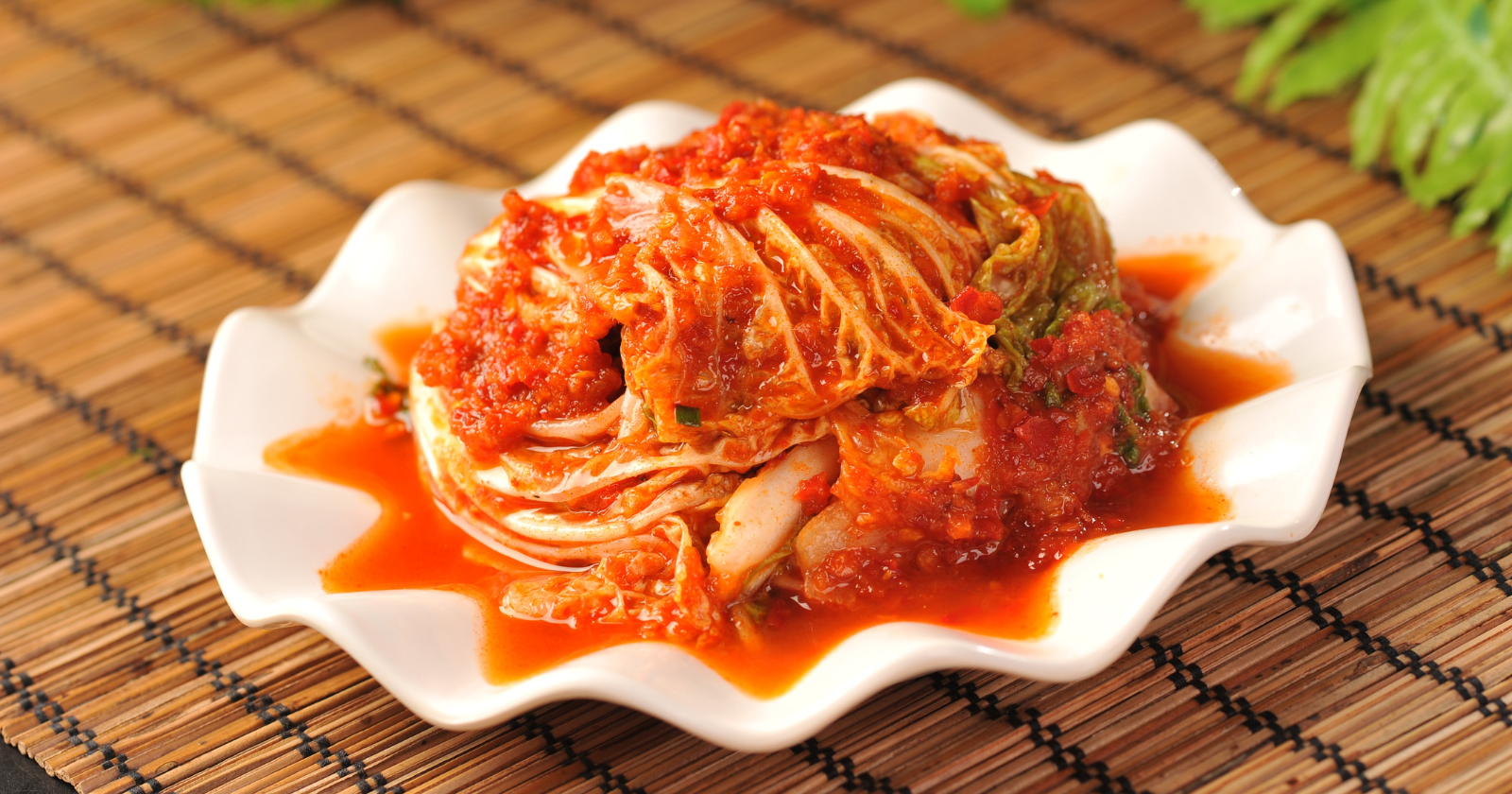
Fermented cabbage and a bottle of olive oil do not obviously share a shelf. In 2006, the American magazine Health put them on one anyway, naming five foods it called among the world’s five healthiest: olive oil, soy, lentils, yogurt, and Korean kimchi.
The list has had a long afterlife, especially in Korea, where it is often cited as proof that kimchi is officially one of the planet’s best foods. The framing deserves some care. What Health published was a magazine feature, not a ranking from a nutrition body or a peer-reviewed panel. We are a publication, not nutritionists, and what follows is a reading of the food science rather than dietary advice.
The choice was not random, though. The reason kimchi could sit beside yogurt comes down to one shared process.
What the list actually named
The five foods were framed by country rather than by food group. Olive oil was tied to Spain, soy or bean products to Japan, lentils to India, yogurt to Greece, and kimchi to Korea. That national framing has drifted in the years since, and it was always a little loose. Olive oil is no more Spanish than it is Greek, Italian, or Turkish. Yogurt is eaten across a wide arc from the Balkans to Central Asia. Soy sits far closer to East Asian cooking than to anything Mediterranean.
The through-line the list gestured at had less to do with geography than with pattern. Four of the five entries were plants: vegetables, legumes, and beans, with olive oil the single added fat and yogurt the single dairy item. Three of them also carried a feature the list never spelled out.
The fermentation thread
Kimchi, yogurt, and a large share of the world’s soy intake in the form of miso, natto, and tempeh are fermented. Fermentation is old, and it started as a way to keep food from spoiling rather than as nutrition. Kimchi began exactly there, as vegetables salted to last through Korean winters, with the chilli and seasoning arriving centuries later.
In lactic-acid fermentation, bacteria break down the sugars in a food and produce acids that preserve it and give it a sour edge. Those bacteria, mostly Lactobacillus and related strains, are why kimchi and yogurt keep turning up in the same breath. Kun-Young Park, a professor of food science and nutrition at Pusan National University, argued in a 2014 review in the Journal of Medicinal Food that kimchi can be treated as a vegetable probiotic food with benefits comparable to yogurt, the dairy version of the same idea.
What the research supports, and what it does not
Here the distinctions matter. A 2021 study by Anna Korus, Emilia Bernaś, and Jarosław Korus at the University of Agriculture in Krakow, published in the International Journal of Food Science, measured the composition of kimchi made from Chinese cabbage, kohlrabi, white radish, and cucumbers. It found the products to be a good source of dietary fibre, vitamin C, B-group vitamins, minerals, and polyphenols, with the exact profile shifting depending on the vegetables used. That describes what is in the food. It is far more modest than the disease-fighting powers kimchi often gets credited with.
The bigger assertions, that kimchi lowers cholesterol or reshapes metabolic health, rest on a research base that is real but genuinely mixed. A 2013 randomised trial by In-Hwa Choi and colleagues, in the Journal of Medicinal Food, reported improved serum lipid profiles in healthy young adults who ate fermented kimchi. A 2024 analysis of the Korean Genome and Epidemiology Study cohort, led by Seok-Jae Oh in the European Journal of Nutrition, found associations between higher cabbage-kimchi intake and changes in cholesterol measures across roughly sixty thousand participants. Encouraging, but observational, and the authors of a later Mendelian randomisation paper noted that earlier findings in this area had been inconsistent enough to warrant testing whether the link was causal at all.
So the honest summary is narrow. Fermented foods deliver live bacteria and the by-products of fermentation to the gut, and there is reasonable evidence they can support digestion. Whether any single fermented food meaningfully prevents disease is a much larger question, and the current research does not settle it.
Why the list endured anyway
Part of the answer is national pride. Korea took the mention and ran with it, and kimchi’s climb into global supermarkets since 2006 has only reinforced the story. Part of it is timing. The feature landed just as Western interest in gut bacteria and fermented food was building, and it gave that interest a tidy, memorable shape.
What the 2006 list got right was modest and durable. It noticed that several traditional foods, arrived at independently across very different cultures, lean on plants, legumes, and fermentation. That is a genuine observation, and it does not need a “world’s healthiest” badge to be worth making.
The ranking was the marketing. The pattern underneath it was the part worth keeping.