



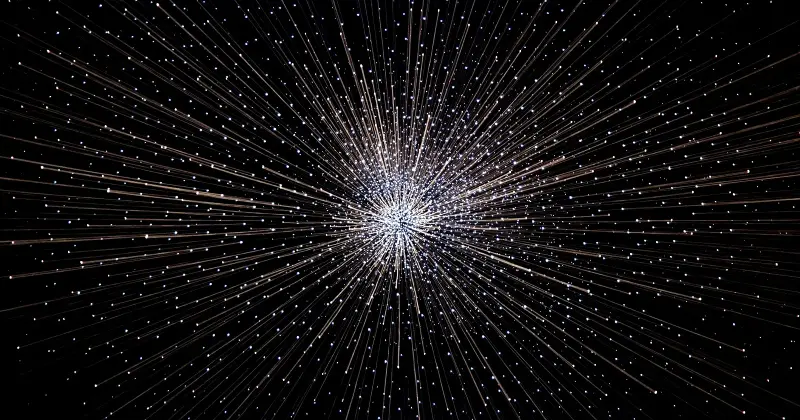
Ask where the Big Bang happened and most people will gesture at some distant point in the sky, the spot where it all went off. The picture behind that gesture, a bomb detonating in a pre-existing void with debris flying outward, is the most common mental model of the event. It is also wrong, and the way in which it is wrong turns out to be the most interesting thing about modern cosmology.
The Big Bang was not an explosion in space. On the standard account, it was the expansion of space itself, happening at every point at once. There was no surrounding emptiness to expand into and no central point of origin. The early universe was hot and dense everywhere, and every region of it, including the region that would eventually contain your chair, has been stretching away from every other region ever since.
Why the explosion picture fails
An explosion has a centre, an edge, and a medium. Shrapnel moves through air, away from a detonation point, toward observers standing at a distance. Every one of those features is missing from the cosmological case.
The mathematics underpinning the standard model of cosmology, the framework developed in the 1920s by Alexander Friedmann and Georges Lemaître and built on Einstein’s general relativity, describes a universe in which distances between points grow over time. Nothing in that description moves through space the way shrapnel does. The points stay where they are, in a local sense, while the space between them stretches.
This is a genuinely different claim, and it has a consequence that sounds like a riddle but is plain physics: if expansion happens everywhere, no location is privileged. There is no centre because every point can equally claim to be one.
What Hubble actually observed
The observational anchor goes back to Edwin Hubble’s measurements in the 1920s showing that distant galaxies recede from us, and that the farther away a galaxy sits, the faster it recedes. Lemaître had reached the same relationship from theory two years before Hubble’s 1929 paper, which is why the International Astronomical Union formally recommended in 2018 that the relation be known as the Hubble-Lemaître law.
Read naively, Hubble’s result seems to put us at the middle of things. Everything is running away from us, so surely we are the point everything is running from.
The expansion model dissolves that reading. If the space between galaxies is stretching uniformly on the largest scales, then an observer in any galaxy sees exactly the same pattern: everything receding, with speed proportional to distance. The qualifier matters. Bound structures, galaxies, solar systems, atoms, your chair, are held together by gravity and other local forces that dominate at small scales, so they are not themselves being stretched. The expansion shows up in the distances between galaxies and galaxy clusters, not within them. Astronomers in a galaxy ten billion light years away would measure the Milky Way rushing away from them and could draw the same self-centred conclusion. Everyone appears to be at the centre precisely because no one is.
The raisin bread analogy, and where it breaks
The standard teaching image is a loaf of raisin bread rising in the oven. Every raisin moves away from every other raisin, not because the raisins are travelling through the dough, but because the dough between them is growing. A raisin twice as far away recedes twice as fast, which is the Hubble-Lemaître law in baked form.
The analogy has a known failure point, and it is worth naming because it tends to smuggle the explosion picture back in. A loaf has a crust and sits in an oven. The universe, as far as the evidence shows, has neither. The observable universe has a boundary, set by how far light has been able to travel since the beginning, but that is a horizon of visibility, not a wall or an edge. In standard cosmology, the observable universe is only the region whose light has had time to reach us. Beyond that horizon there may be vastly more universe, possibly even infinitely more, but we cannot directly observe it, and careful accounts stop at saying so.
The afterglow comes from every direction
One of the strongest pieces of evidence for the everywhere-at-once picture is the cosmic microwave background, the faint radiation detected by Arno Penzias and Robert Wilson in 1964 and reported the following year, work that later earned them the Nobel Prize in Physics. It is the cooled light from the period, roughly 380,000 years after the beginning, when the universe first became transparent.
If the Big Bang had happened at a point, that afterglow would come from one direction in the sky, the direction of the blast. It does not. It arrives with near-perfect uniformity from every direction, varying by only about one part in 100,000, as mapped in detail by the COBE and WMAP missions and, most precisely, by ESA’s Planck space telescope. The whole sky glows because the whole universe was once the hot, dense place the glow came from.
The same logic answers the title question. The hot early universe was not somewhere else. It was here, and everywhere else, simultaneously. The matter that became the Earth, and you, was part of it.
What the model does and does not claim
Two clarifications keep the claim honest. The first concerns the word “beginning.” The standard model describes the universe evolving from an extremely hot, dense early state. Whether there was a true initial singularity, and what physics applies at the earliest fraction of a second, remains open territory where general relativity and quantum mechanics have not been reconciled. Cosmologists can speak with confidence about the universe from a tiny fraction of a second onward. The moment zero itself is not settled science, and careful accounts do not pretend it is.
The second concerns size. None of this says the universe is infinite, or finite. The observable universe spans about 93 billion light years, but the question of what the whole is, and whether “the whole” is even a well-posed idea, stays open. The everywhere-at-once description holds either way.
What the model does claim is narrower and stranger than the explosion picture: that expansion is not a journey outward from a point, but a stretching of the distances between all points. The question “where did it happen?” assumes a map with an X on it. The honest answer is that the X covers the entire map, and the spot you occupy right now sits inside it as legitimately as any other.