



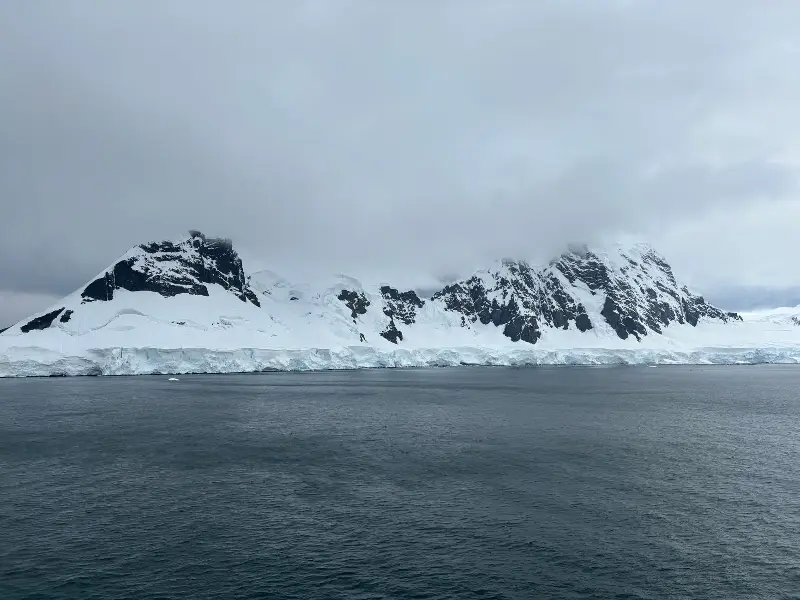
The South Pole gets less snow in a year than Phoenix gets rain. At the Amundsen-Scott South Pole Station, where the United States has kept people alive continuously since 1957, the annual precipitation averages under 80 millimetres of water equivalent — thinner than the drizzle that falls on the Sonoran Desert. That is the paradox at the bottom of the world: Antarctica is a desert by every meteorological definition, and yet it holds roughly 70 per cent of the fresh water on Earth, pressed into an ice sheet that averages more than two kilometres thick across the entire continent.
The ice is old, and it is dry, and it is deep. Those three facts, held together, explain almost everything strange about the place.
What makes a desert a desert
The definition has nothing to do with heat or sand. A desert is a region that receives less than 250 millimetres of precipitation a year, and by that measure the Antarctic interior is the driest continent on Earth. The high plateau around Vostok and the South Pole receives closer to 50 millimetres a year of snow-water equivalent. The Sahara, by comparison, averages around 100 millimetres, and parts of the Sahel push past 200.
The reason is atmospheric. Cold air holds almost no moisture. When temperatures at the pole drop past minus 60 Celsius in winter, the water vapour content of the air collapses toward zero, and there is simply nothing left to fall. What snow does arrive often comes as diamond dust — needle-thin ice crystals precipitating out of a nominally clear sky, catching sunlight in tiny prismatic flashes.
Fieldworkers describe the sensation as walking through a place that has forgotten how to be wet. Skin cracks. Nostrils sting. Exposed food freeze-dries within hours. Rain, when it happens at all, happens at the coast, and even there it is rare enough that scientists dress for cold and glare, not wet weather.
How a desert holds most of the world’s fresh water
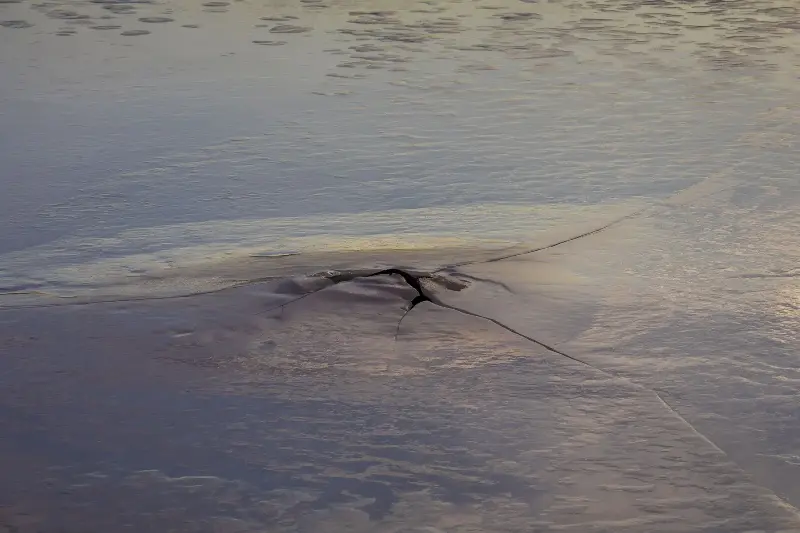
The trick is time. Snow that falls on the East Antarctic Plateau does not melt. It compresses. Each year’s dusting — a few centimetres of powder — is buried by the next, and the next, and the next, until the crystals below sinter into firn and then into solid glacial ice. At the base of the ice sheet, some of that ice was laid down more than 800,000 years ago. The oldest layers Vostok ice cores have reached extend past 420,000 years, and newer drilling projects are chasing samples closer to a million and a half.
The ice sheet averages more than two kilometres thick across the continent, and in places it reaches nearly five kilometres — deeper than the Grand Canyon is wide. Under the weight, the bedrock itself has been pressed down below sea level. Recent radar and gravity surveys have revealed massive buried geological structures beneath the East Antarctic Ice Sheet that had been hidden by the sheer bulk of the ice above them.
Roll all of that water back into liquid form and you get an estimated 26.5 million cubic kilometres — about 70 per cent of the fresh water on the planet, and about 90 per cent of the ice. Greenland is a distant second. Every lake, river, aquifer, and cloud on Earth combined is a rounding error next to it.
The plateau is a cold high desert
Most people picture Antarctica as flat. It is not. The interior of East Antarctica is a plateau averaging over 3,000 metres in elevation — higher than most of the Rockies. The air is thin. Helicopter pilots flying to the South Pole plan for altitude sickness as much as cold, because the effective altitude at the pole, accounting for the low polar atmosphere, can feel closer to 3,700 metres.
Cold, dry, and high is the exact recipe for a desert. It is why the Atacama, the Gobi, and the Tibetan Plateau all qualify alongside the Sahara. Antarctica is simply the most extreme version — colder, drier, and higher across a landmass larger than the contiguous United States and Mexico combined.
The lowest reliably measured air temperature on Earth, minus 89.2 Celsius, was recorded at the Soviet Vostok Station in July 1983. Satellite readings of the ice surface itself have gone lower — past minus 98 Celsius on the ridge between Dome Argus and Dome Fuji. At those temperatures, a deep breath can freeze the moisture in a person’s lungs.
Dry valleys and the closest thing to Mars
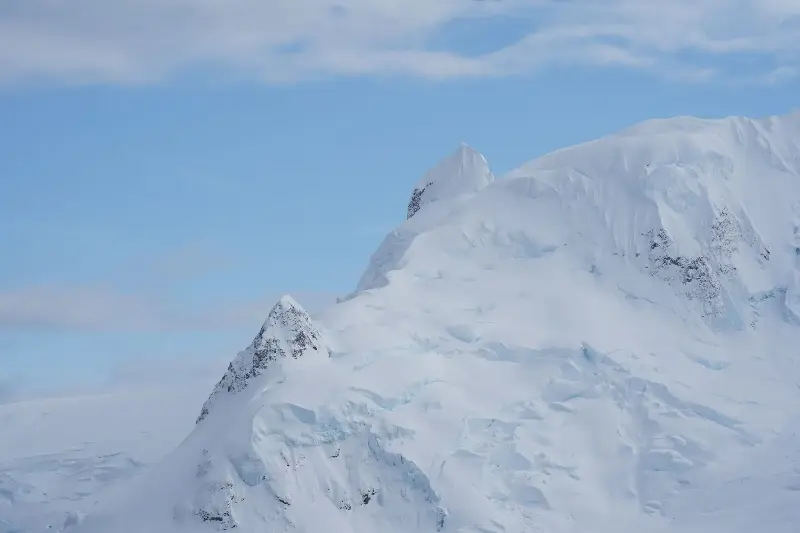
Not all of the continent is buried. The McMurdo Dry Valleys, a set of ice-free basins near the Ross Sea, have been shielded from glacial flow by the Transantarctic Mountains for millions of years. Some patches have not seen rain or snow in an estimated two million years. NASA has run Mars-analogue experiments there since the 1970s, testing landers and life-detection instruments in what is, hydrologically, the closest terrestrial approximation to the Martian surface.
Mummified seal carcasses lie scattered across the valley floors, freeze-dried and wind-polished, some of them thousands of years old. Nothing decays because nothing lives in the soil to decay it — no bacteria of the kind that break down tissue elsewhere, at least not in numbers that matter. The valleys are as close to sterile as any large landscape on Earth.
What the ice remembers
Because Antarctic ice does not melt, it keeps records. Each snowfall traps a tiny sample of the atmosphere that produced it: bubbles of ancient air, isotopes that encode temperature, dust from distant volcanic eruptions, traces of sea salt, pollen, and — for the last two centuries — industrial lead, radioactive fallout, and combustion soot.
The Vostok and EPICA ice cores gave climate scientists their first continuous, direct measurements of atmospheric carbon dioxide going back hundreds of thousands of years. The graph that emerged — CO₂ and temperature rising and falling in near-lockstep across eight glacial cycles — is one of the foundational data sets of modern climate science, and it exists because a desert refused to melt.
Other cores have picked up the signature of the 1815 Tambora eruption, the 1257 Samalas event, the Roman lead smelters of the first century, and the atomic tests of the 1950s and 1960s. The ice is a library with a two-kilometre spine.
What happens when a desert starts to melt
The paradox is unstable. Warmer air holds more moisture, which means a warming Antarctic will actually see more snowfall in the interior, even as its coasts lose ice faster than the interior can gain it. The West Antarctic Ice Sheet, the smaller and more vulnerable of the two, is grounded below sea level and exposed to warming ocean water that eats at it from underneath. Thwaites Glacier alone — the so-called Doomsday Glacier — drains an area the size of Britain, and its collapse would raise global sea level by more than half a metre on its own.
The total sea-level rise locked in the Antarctic ice sheet, if all of it went, is around 58 metres. Nobody expects that to happen on any human timescale. A few metres, though, is enough to redraw every coastline on Earth, and the current trajectory of loss has accelerated markedly since the 1990s.
There is a longer view, and it is not entirely bleak. Studies of past interglacial periods suggest that East Antarctic ice losses have, in the deep past, been followed by recovery once conditions cooled again. The recovery took thousands of years. Coastal cities do not have thousands of years.
A continent held together by cold
The astonishing part is how thin the margin is. The ice sheet exists because the continent is cold enough to freeze what little precipitation reaches it, and because the ice that has already accumulated reflects roughly 80 per cent of incoming sunlight back to space. Melt enough of it, expose enough dark rock or ocean, and the feedback runs the other way — more absorption, more warming, more melt.
For now, the plateau stays quiet. Snow crystals drift down through minus-60 air at the South Pole, adding another submillimetre to a stack that has been building since before humans left Africa. A researcher at Concordia Station, one of the highest and coldest research bases in the world, will watch the diamond dust catch the low sun and know that the flake landing on a mitten is, by mass, part of the largest freshwater reservoir in the solar system’s rocky planets.
It is a desert. It is also almost every glass of fresh water on Earth, waiting.
The post Antarctica is classified as a desert because it receives less precipitation than the Sahara, yet it holds about 70 per cent of the planet’s fresh water, locked in an ice sheet averaging over two kilometres thick across the continent appeared first on Space Daily.