



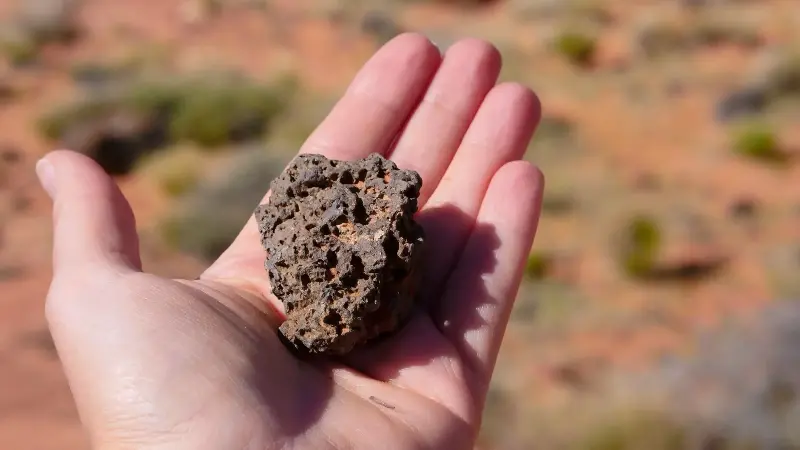
A rock about the size of a fist, found lying in the Sahara, may be a surviving shard of a lost world nearly as large as the Moon. According to a new study, it formed beside the young Sun out of ingredients different from those that built Earth and Mars, and it was destroyed while the planets were still coming together.
It is worth separating what is measured from what is inferred. The rock is real and genuinely ancient, and those are solid facts. The giant parent world is a new interpretation drawn from the rock’s chemistry, and its destruction is the best available explanation rather than something anyone watched happen.
A rare rock with the wrong chemistry
The meteorite is called Northwest Africa 12774, a piece weighing a little under half a kilogram that was recovered from the Sahara in 2019. It belongs to a rare class known as angrites, of which only a few dozen are known among the more than eighty thousand meteorites catalogued on Earth.
Angrites matter because they are among the oldest volcanic rocks in existence. The radioactive clocks locked inside them show that they crystallised within a few million years of the solar system’s birth, more than 4.5 billion years ago. They are, in effect, samples of the first generation of worlds.
They are also chemically odd. Angrites are poor in silica, the silicon-and-oxygen compound that makes up ordinary sand and forms the bulk of the crusts of Earth, Mars and most other rocky bodies. Because of that, researchers had long assumed angrites came from a small asteroid, perhaps no more than a couple of hundred kilometres across.
The clue was in the pressure
The new work, led by Aaron Bell and colleagues at the University of Colorado Boulder and published in the journal Earth and Planetary Science Letters, challenges that assumption. Looking closely at NWA 12774, the team found crystals of a mineral called clinopyroxene that were unusually rich in aluminium, a tell-tale sign that the rock had formed under great pressure.
To read that pressure, they built a new measuring tool, a barometer based on how the mineral’s chemistry shifts as the surrounding pressure changes. It told them the rock crystallised at pressures of roughly 17.5 kilobars, more than seventeen times the pressure at the bottom of the deepest ocean trench on Earth. A small asteroid simply cannot squeeze its interior that hard. To generate such pressures, the parent body had to be large.
How big the lost world was
Turning pressure into size involves an assumption about how deep inside the body the crystals grew. Taken at face value, the pressures imply a parent body with a radius of at least about 1,000 kilometres. Other features of the crystals, such as sharp edges that would have been smoothed away had they sat for ages deep in a hot interior, suggest they formed at relatively shallow depths instead.
If that is right, the body had to be larger still to reach the same pressure nearer its surface, with a radius beyond 1,800 kilometres, comparable to the Moon and edging toward the size of a small planet. The Moon-scale figure is the upper end of the range, not a single settled number, but even the lower estimate points to a world far bigger than any asteroid previously tied to these meteorites. “It’s incredible to think there was once a world this large,” Bell said. “We only know it existed because a few fragments of it happened to land on Earth.”
A different kind of world
The chemistry says more than just size. The materials that built this body were, in the team’s words, fundamentally different from the ingredients of Earth and Mars, silica-poor throughout rather than silica-rich. They read that as evidence of a separate developmental pathway among the earliest planets, one built from an unusual mixture of the first solids to condense out of the disc around the young Sun.
This is where care is needed about the idea of a different path. What the rock records is a distinct chemistry and a distinct way of forming, not a mapped orbit. We cannot trace where this world circled the Sun. What we can say is that it grew from different raw material and followed a different course of development than the planets that survived.
How it ended
Whatever this world was, it is not here now. The favoured explanation is that it was broken apart in one of the violent collisions that were common while the planets were still assembling, with some of its debris later swept up into growing worlds, including Earth, and a few pieces left over as the angrites we find today. That destruction is inferred rather than observed. We hold the fragments, and no such body remains, and the simplest account of both facts is that it was smashed early and never rebuilt.
What to watch
The result rests on a single meteorite analysed with a newly built tool, so the obvious next steps are independent checks and applying the same barometer to other angrites to see whether they point to the same large parent. Bell has noted that many meteorites sit barely studied in collection drawers, which hints that more of these lost worlds may be waiting to be recognised.
What to watch, then, is whether the giant-parent-body picture holds up as others test it, whether the size estimate can be pinned down more tightly, and whether other odd meteorites turn out to be shards of still more vanished protoplanets. For now, a fragment in a drawer is the only trace of a world that formed alongside the Sun, took its own chemical path, and was gone before Earth had finished growing.
The post A rare meteorite found in the Sahara may be a surviving shard of a lost Moon-sized world — one that formed beside the young Sun, followed a path unlike Earth or Mars, and was smashed apart while the planets were still being built. appeared first on Space Daily.