



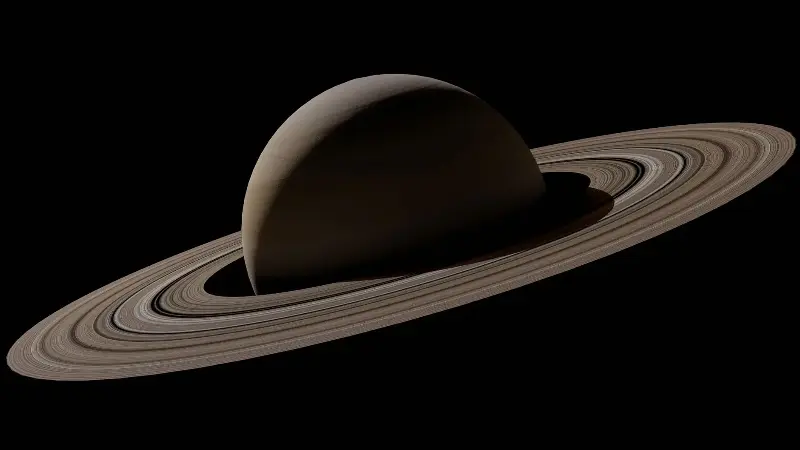
For thirteen years, a spacecraft called Cassini circled Saturn. It flew straight through the icy plumes erupting from the little moon Enceladus, tasted water and organic molecules in the spray, and then, in September 2017, was deliberately steered into Saturn’s atmosphere to burn up. It was destroyed on purpose, so that it could never contaminate what might be a living ocean.
It is one of the more remarkable endings in the history of space exploration: a mission that helped reveal a possible home for life, and then sacrificed itself to protect it.
Thirteen years at Saturn
Cassini reached Saturn in 2004, after a seven-year journey from Earth, and spent the next thirteen years orbiting the planet. It was one of the most productive planetary missions ever flown. It mapped Saturn’s rings and atmosphere in detail, discovered new moons, and carried a European lander called Huygens that touched down on the giant moon Titan in 2005, the most distant landing ever made.
But among all its discoveries, one small moon came to stand out above the rest.
The plumes of Enceladus
Early in the mission, Cassini found something startling at Enceladus, an icy moon only about 500 kilometres across. From cracks near its south pole, giant jets of water were erupting into space, feeding a faint plume above the moon. Those geysers, it turned out, were venting material from a salty ocean hidden beneath the moon’s frozen crust.
That opened an extraordinary opportunity. Rather than land and drill through kilometres of ice to reach the ocean, a spacecraft could simply fly through the spray and sample it in flight. Cassini did exactly that, making repeated passes directly through the plume, some of them low and fast, catching the ejected material on its instruments.
What it tasted
The spray turned out to be mostly water, along with salts and a range of organic, carbon-based molecules, including large, complex ones. Most tantalising of all, Cassini detected molecular hydrogen in the plume.
That hydrogen matters because, on Earth, it is produced when hot water reacts with rock, at the hydrothermal vents on the ocean floor, and such vents are among the places life may first have taken hold here. Its presence at Enceladus points to warm water meeting rock at the bottom of that hidden ocean, which would provide a potential source of chemical energy. Between the water, the organic chemistry and that energy, Enceladus appears to have the basic ingredients thought necessary for life. It is important to be clear, though, that Cassini found the conditions for life, not life itself. Whether anything actually lives in that ocean is unknown.
Why crash it on purpose
By 2017, Cassini was almost out of the propellant it used to steer. Once the fuel ran dry, controllers would lose the ability to point and guide it, and over the long run an uncontrolled spacecraft might one day drift into Enceladus or Titan and crash. If it did, it could carry hardy microbes from Earth, stowed away since launch, into an environment that might be capable of supporting them.
To rule that out, NASA chose to end the mission deliberately. On 15 September 2017, it flew Cassini into Saturn itself, where the spacecraft burned up and disintegrated high in the planet’s atmosphere. This is the principle of planetary protection: keeping possibly habitable worlds pristine, uncontaminated by our own hardware and its passengers, for honest future study.
Science to the last second
The ending was not only a disposal, it was an experiment. In its final months Cassini flew a series of daring orbits that threaded the narrow gap between Saturn and its rings, a region no craft had ever visited. And on the final plunge it kept its instruments running and its antenna pointed at Earth, sampling Saturn’s atmosphere directly and radioing the measurements home until the friction tore it apart and the signal stopped.
Why it matters
Cassini transformed Enceladus from an obscure speck of ice into one of the most promising places in the solar system to search for life beyond Earth. It also proved a powerful idea: that you can taste an alien ocean without ever landing on it, simply by flying through what it throws into space.
Its deliberate destruction is a quiet lesson in scientific responsibility. A mission that had spent thirteen years uncovering a possible cradle for life chose to burn rather than risk spoiling it. The work of following up now falls to future missions, with proposals to return to Enceladus and sample its plume in far greater detail, and a mission already on the way to fly across Titan. Cassini is gone, scattered into Saturn’s clouds, but it left behind an ocean that everyone now wants to go back and read more closely.
The post A probe called Cassini spent thirteen years orbiting Saturn, flew through the plumes of its moon Enceladus, tasted water and organic molecules in the spray, and then was deliberately crashed into Saturn’s atmosphere in 2017 so it could not contaminate what might be a living ocean appeared first on Space Daily.