



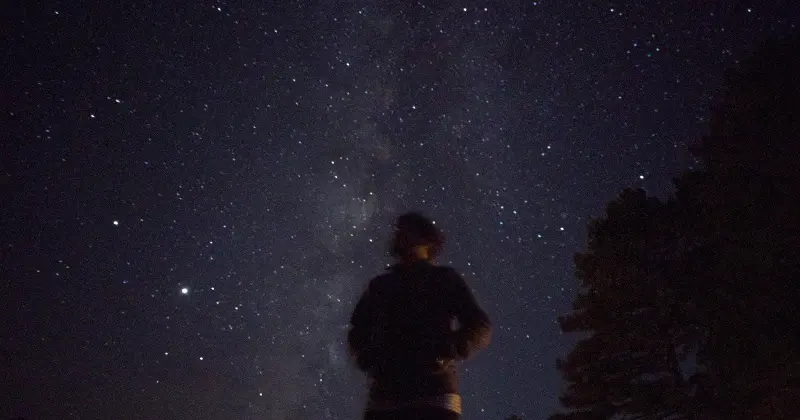
Encounter something that evokes enough awe and, on average, you may come away a little more generous, a little more patient, a little more willing to give up your time for someone else. It sounds like something a wellness brochure would say but psychologists have measured related effects across surveys, field studies and controlled experiments.
A quick note before I go further: I’m not a psychologist or a clinician, and this is reading and reflection on the research, not advice. These studies look at groups of people, and patterns across a group are not promises about how any one reader will respond on any given night.
Dacher Keltner, founding director of UC Berkeley’s Greater Good Science Center, defines awe as “the emotion we experience when we encounter vast mysteries that we don’t understand.” A huge night sky is about as close to a textbook trigger as you can get.
One idea keeps coming up in this work, under an odd name: the “small self.” The thinking is that awe shrinks your sense of your own importance, and that this shrinking may nudge you toward other people.
The foundational modern work is a series of studies by Paul Piff and colleagues, including Keltner. Across five studies, they linked awe with a diminishment of the individual self and greater generosity, ethical decision-making, prosocial values or helping.
The study I keep coming back to is their fifth, because it’s the closest to actually standing outside. Participants stood in a grove of towering eucalyptus trees before an experimenter “accidentally” dropped a box of pens. The people who had just been looking up picked up more pens, and felt less entitled, than a comparison group who had looked at a building. A small gesture, but a measured one, and it followed straight from a brief dose of awe.
A separate line of work by Yang Bai and colleagues put numbers on the smallness itself. In a daily-diary study, Chinese and U.S. university students reported feeling smaller on days they felt awe than on days they felt joy. It held in both groups, which suggests it isn’t just a quirk of one culture, and the effect tended to be larger for the Chinese students.
The patience piece comes from somewhere else again. Melanie Rudd, Kathleen Vohs and Jennifer Aaker found that people feeling awe felt they had more time available, were less impatient, and were more willing to volunteer their time to help others. The generosity here is a specific kind. In that same experiment, awe made people more willing to give time but, as the authors note, it had no measurable effect on willingness to give money. It’s the patient, hand-lending kind of generosity, tied to time.
Perhaps surprisingly, awe is not rare, which is part of what makes this interesting. Keltner’s research suggests people feel everyday awe two to three times a week, and he estimates that about three-quarters of experiences are positive. He also lists a run of benefits, saying awe “reduces stress” and helps your immune system.
What I find genuinely odd is the direction of the whole thing. A wellness tip promises to make you feel good, and feeling good is usually about getting bigger: more energy, more confidence, more you. Awe seems to work the opposite way. It makes you feel smaller, and that smallness may be part of what does the work. The sky doesn’t puff you up into generosity. It quietly shrinks the self that was in the way, and the helping may follow from the gap that leaves behind.
The post Standing under a huge night sky does something measurable to us, beyond a simple sense of wonder: studies find that awe shrinks the sense of self and leaves people noticeably more generous, patient and willing to help others appeared first on Space Daily.