



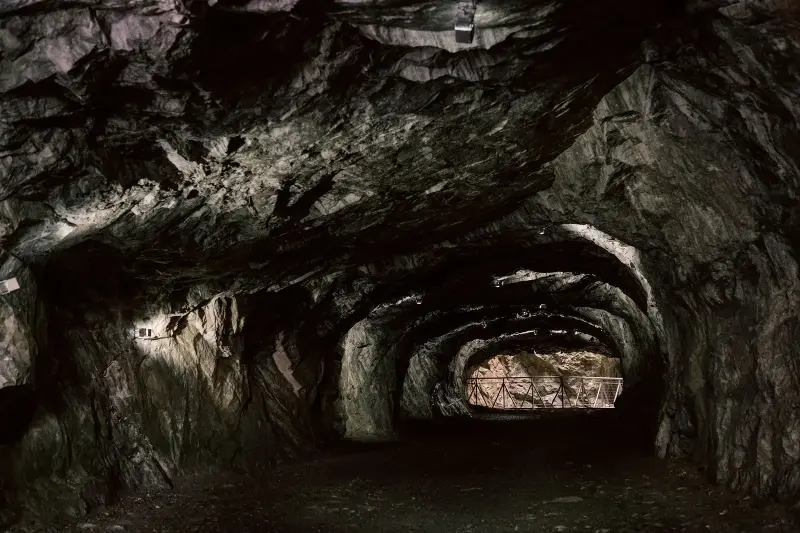
Eighteen metres beneath a dusty patch of scrubland near the Romanian port city of Mangalia, there is a cave whose air would kill you in minutes. The oxygen concentration hovers at roughly half of what your lungs expect. Carbon dioxide runs about 100 times higher than the atmosphere at the surface. Hydrogen sulphide — the gas that gives rotten eggs their smell — hangs in the still air and dissolves into warm, milky pools. And in those pools live spiders with no eyes, leeches that have never touched a ray of sunlight, and a centipede with serrated back legs that scientists nicknamed the king of the cave.
Forty-eight species. Thirty-three of them found nowhere else on Earth. All of them descended from ancestors that were sealed underground somewhere around 5.5 million years ago, when the Messinian salinity crisis was drying out the Mediterranean, not long after the human and chimpanzee lineages had gone their separate ways.
The place is called Movile Cave, and Romanian workers found it in 1986 by accident, while drilling exploratory boreholes to see whether the ground could hold a power plant.
An accidental doorway into deep time
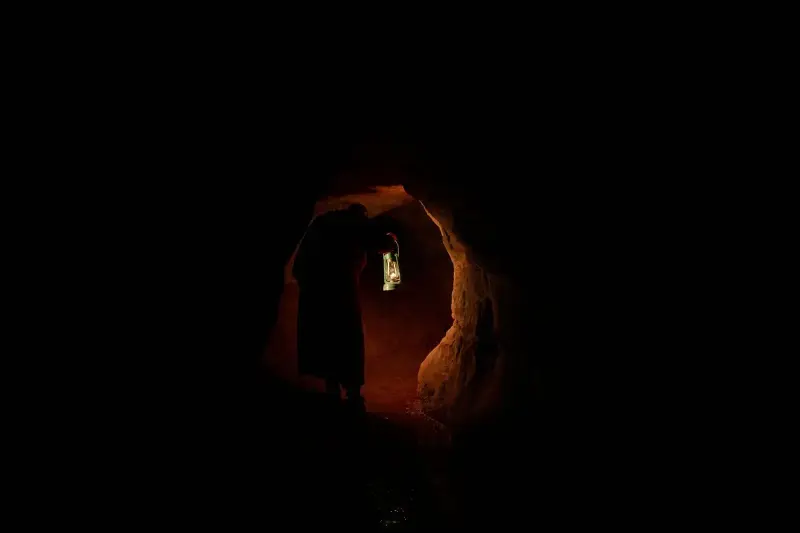
The workers were not looking for biology. They were looking for bedrock. The borehole punched through 18 metres of clay and limestone and broke into a void that had been holding its breath since the late Miocene. When Romanian biologist Cristian Lascu descended into that void in 1986, he became the first vertebrate in about 5.5 million years to see the inside of the chamber.
The cave sprawls over roughly 240 metres of narrow passageways. At the far end sits a small lake, its surface coated in a pale, gelatinous scum of bacteria. Air pockets above the water — known as the bell chambers — are the strangest rooms of all. To reach them, a diver has to submerge, swim under a partition of rock, and surface into a pocket of gas that has been isolated from the atmosphere for the duration of primate evolution.
That gas is deadly. Ammonia. Methane. Hydrogen sulphide at concentrations that would drop an unprotected human within a few breaths. And yet the water underneath is thick with animals.
Life without the Sun
Almost every ecosystem on Earth’s surface runs, at its base, on photosynthesis. A plant catches a photon, splits a water molecule, fixes carbon, and hands the resulting sugar up the food chain to a beetle or a deer or a person. Take away the Sun and, in a matter of years, most terrestrial ecosystems collapse.
Movile does not need the Sun. The food chain there begins with chemosynthetic bacteria — microbes that draw their energy from oxidising hydrogen sulphide, methane, and ammonia rather than from sunlight. They form a floating mat on the lake’s surface and a slick film on the cave walls. Snails and nematode worms graze the mat. Water scorpions, leeches, centipedes, and eyeless spiders eat the grazers.
The 48 species catalogued in Movile include 33 that live only in the cave. Nearly all of them have lost their pigment. Most have lost their eyes. In exchange, evolution has given them absurdly long antennae and legs, sensory tools for a world in which vision is useless and touch is everything.
The king of the cave, a centipede described in a 2020 paper, has saw-like ridges on its rearmost pair of legs. Biologists think it uses them to grip prey the way a fisherman grips a struggling fish.
Why 5.5 million years matters
Isolation is what makes Movile scientifically precious. Caves are not rare. Caves with unique fauna are not especially rare either. But a cave whose atmosphere and biota have been sealed away for 5.5 million years is a natural experiment nobody could have designed on purpose.
Five and a half million years is enough time for entire lineages to diverge. It is roughly the interval since the last common ancestor of humans and chimpanzees. During that same stretch, the animals of Movile were sitting in the dark, eating bacteria, and slowly editing their genomes to match a world in which the Sun did not exist.
A 2023 paper in Scientific Reports described a new ostracod crustacean, Pseudocandona movilaensis, from Movile’s sulfidic ecosystem — a tiny, shelled animal whose ancestors evidently arrived before the cave sealed and never left.
How the ecosystem eats its own house
The bacteria at the base of the food web do not just feed the animals. They also excavate the cave. When they oxidise hydrogen sulphide, one of the by-products is sulphuric acid. That acid dribbles down the limestone walls and slowly dissolves them, opening the cave chamber by chamber and releasing carbon dioxide from the rock in the process.
This is why the air inside Movile carries about 100 times the carbon dioxide of the outside atmosphere. The cave is quite literally being widened by the metabolism of its own inhabitants. The animals live inside a room that their food is slowly enlarging.
That process — sulphidic cave formation — is now understood to have shaped a number of significant cave systems around the world, including parts of the Frasassi complex in Italy and Lechuguilla in New Mexico. Movile was the first one where biologists caught the process in action with an intact, endemic ecosystem still running on top of it.
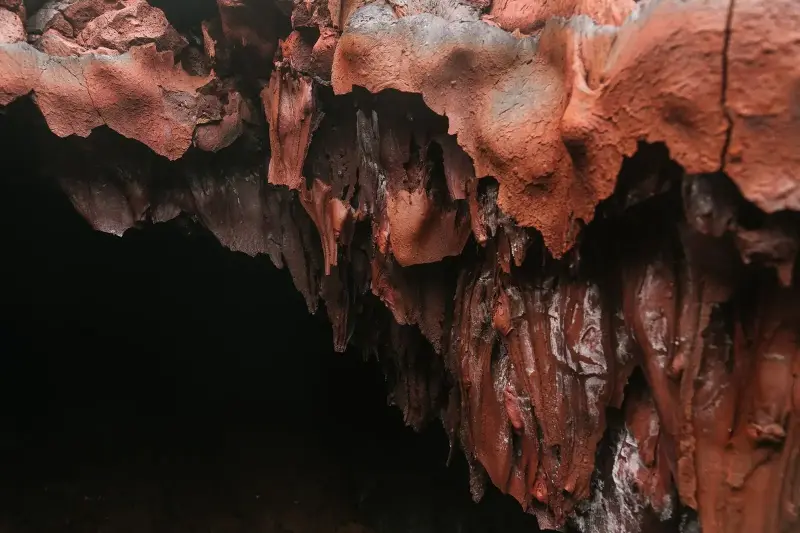
The borehole that let humans in has since been sealed. Only a handful of researchers are permitted to enter Movile each year, for short visits, wearing specialist breathing equipment. Part of the reason is safety — the atmosphere really can kill you — and part is contamination. Skin cells, boot mud, exhaled breath, and stray microbes from the surface would all be alien invaders in a system that has been running its own biochemistry undisturbed since before Australopithecus.
An overview of extreme groundwater invertebrates published in Frontiers in Ecology and Evolution puts Movile alongside other chemoautotrophic and toxic-water systems as a laboratory for understanding how animals survive at the edge of what biochemistry permits. Its residents tolerate hydrogen sulphide concentrations that would poison the mitochondria of surface animals within minutes.
Why astrobiologists care
NASA astrobiologists have been visiting Movile for years, and the reason is not subtle. If life can build a self-sustaining, multi-trophic ecosystem in complete darkness, on chemical energy alone, sealed under 18 metres of rock, then the search parameters for life beyond Earth get considerably wider.
Europa, Jupiter’s ice-locked moon, hides a saltwater ocean beneath a shell of ice several kilometres thick. Enceladus, orbiting Saturn, vents plumes of water and organic molecules through cracks at its south pole. Neither world sees meaningful sunlight at the seafloor. Both are thought to have chemical energy sources — reactions between rock and water that could, in principle, feed something like a Movile-style microbial mat.
Movile is a proof of concept for that possibility. Not a certainty about alien life, but a demonstration that biology does not, in fact, require a star to power it. If you build a food web on hydrogen sulphide instead of photons, you can still get spiders.
Movile is one of several recent reminders that Earth’s surface hides more strangeness than surface-dwelling humans generally give it credit for. Space Daily has written about the enormous thermal lake found in an Albanian cave in 2021, sitting 127 metres below the surface at the bottom of a vertical abyss. There is the Veryovkina chasm in the Caucasus, which drops 2,212 metres straight down and whose explorers report hallucinating light in the deepest chambers. And there is Son Doong in Vietnam, a passage large enough to hold its own jungle, its own river, and its own weather.
Movile is smaller than any of those. It fits inside a football pitch. But the biology is arguably the strangest, because everything living in it has been running an evolutionary experiment in isolation for longer than any other cave ecosystem on the planet.
The residents, catalogued
The species list, as compiled by the biologists who have studied Movile since the late 1980s, reads like something out of a science fiction bestiary. There is Nepa anophthalma, a water scorpion that has, over millions of years, given up on eyes altogether. Asellus aquaticus infernus, a subterranean form of a common surface isopod. Heleobia dobrogica, a snail found only in Movile. Haemopis caeca, a blind leech. Several endemic pseudoscorpions. A range of nematodes and rotifers whose taxonomy is still being resolved.
The discovery of chemosynthetic life at Movile forced biologists to update textbook diagrams that had, for decades, treated the deep-sea hydrothermal vents of the Pacific as the only known ecosystem running independently of sunlight. Movile added a second, radically different example — a freshwater, land-based version, sealed inside continental limestone rather than perched on a mid-ocean ridge.
Even the deep-sea vents get some flux of organic material sinking from the sunlit surface. Movile gets nothing. The seal is essentially complete.
The bacteria are still oxidising sulphide. The sulphuric acid is still eating the limestone. The chamber is still, in geological terms, growing. The 48 species inside are still evolving in the dark, on chemical energy, without ever having encountered a plant.
Above them, at the surface, Mangalia’s suburbs push outward, cars pass along the Black Sea coast road, and the Sun rises and sets on a world the cave residents will never see and would not survive in if they somehow arrived. Their world is warm, wet, sulphurous, silent, and 18 metres beneath your feet — and it has been running, uninterrupted, since the Messinian.
The post In a cave 18 metres below the surface at Movile in Romania, sealed off from the outside world for 5.5 million years, biologists have found 48 species that live on hydrogen sulphide and have never seen sunlight appeared first on Space Daily.