



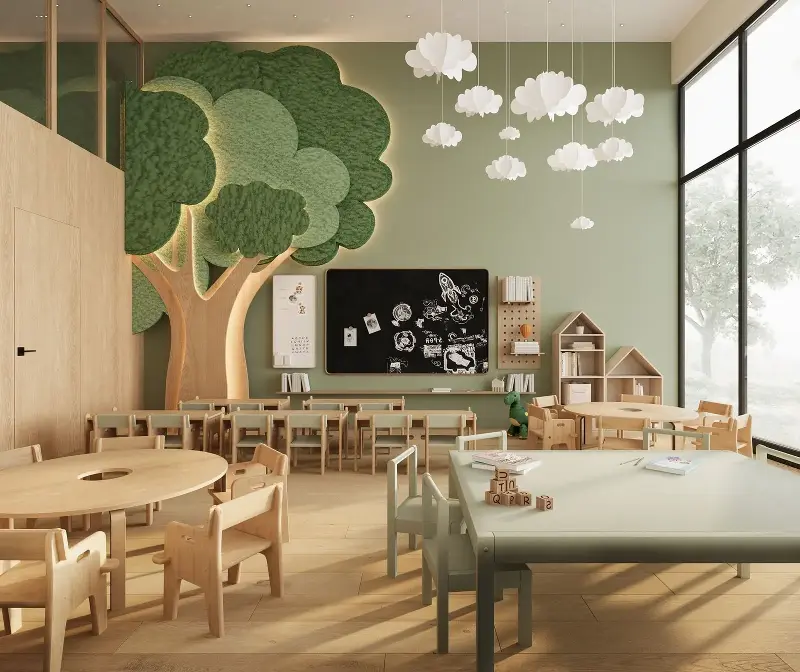
In a typical Japanese preschool classroom, the shoes line up by themselves. Small lockers sit at a child’s height. Hooks are placed where small hands can reach them. Snack bowls are stacked on a low shelf the children can serve themselves from. A four-year-old who walks in doesn’t have to be told what to do — the room has already told them. This is shitsuke, the Japanese concept usually translated as discipline, but understood domestically as something closer to upbringing-through-environment. The room does the teaching. The adult barely has to.
The word itself is built from characters tied to the training of the body until right action becomes posture. In Japanese parenting and early-childhood education, shitsuke is also the last of the five S’s associated with Toyota’s factory floors: seiri, seiton, seiso, seiketsu, shitsuke. Sort, set in order, shine, standardise, sustain. The order matters. Discipline is the last step because it is the consequence of the first four, not a separate act of will.
Discipline as a building, not a sermon
Most Western parenting frameworks treat discipline as a response. A child does something wrong. An adult intervenes. A consequence is applied. Repeat. The loop assumes misbehaviour is the natural state, and adult correction is the corrective force.
Shitsuke inverts the loop. Misbehaviour is treated as the symptom of a poorly designed environment — too much stimulation, too few cues, an object placed where a small child cannot help but grab it, a transition with no ritual to mark it. The adult’s job, in this view, is not to react faster. It is to redesign the surface the child is acting on so that the bad behaviour has nowhere to land.
The idea that the environment does the regulating is not only a cultural intuition. A widely cited series of practice briefs on self-regulation, prepared by Desiree Murray, Katie Rosanbalm and colleagues for the U.S. Administration for Children and Families, describes self-regulation as a capacity that develops through predictable, responsive and supportive environments rather than through correction alone. In their framing, the caregiver’s calm and the structure of the surroundings are the levers; the child’s still-forming self-control is not something an adult can simply demand on the spot.
The mechanism — why design beats correction
A young child’s prefrontal cortex — the part of the brain that handles planning, impulse control, and decision-making — is one of the last regions to mature. According to the U.S. National Institute of Mental Health, the brain finishes developing and maturing in the mid-to-late twenties, with the prefrontal cortex among the last parts to come online. When a toddler is told don’t touch the vase, the instruction is being processed by a brain that is genuinely not yet equipped to override the impulse to touch the vase. The child is not defying the parent. The child is being a child.
Nancy Weaver, a professor of behavioural science at Saint Louis University, has described how a stressed child drops into a fight-or-flight state in which the prefrontal cortex is effectively offline. In that state, she argues, reasoning and correction have little purchase, because the part of the brain that would process them has been temporarily sidelined by the body’s threat response.
Move the vase. The child’s brain catches up in two or three years. The relationship is intact. The vase is intact. No correction was ever required.
This is the engineering principle behind shitsuke. The environment is treated as the variable the adult can actually control. The child’s developing nervous system is treated as the variable the adult cannot.
What the rooms actually look like
Walk into a Japanese youchien or hoikuen — the rough equivalents of kindergarten and nursery — and the architecture of the room is doing most of the work. Shoes come off at a clearly marked threshold called a genkan, set below the level of the main floor. The drop in elevation is the instruction. No one has to say take your shoes off; the floor says it.
Bowls, towels, smocks, and toothbrushes are kept at child height in labelled cubbies. Transitions are marked by short songs that always sound the same — clean-up time has its melody, lunch time has another. The day is sequenced into predictable blocks. A child who knows what comes next does not have to be managed into the next thing.
Crucially, the rooms are not minimalist. They are full of materials children are meant to handle. The shelves are open. Real cups and bowls are used at lunch. The trust is built into the furniture. A child who is given a real cup tends to carry it carefully — the cup itself is a teacher.
The first two years
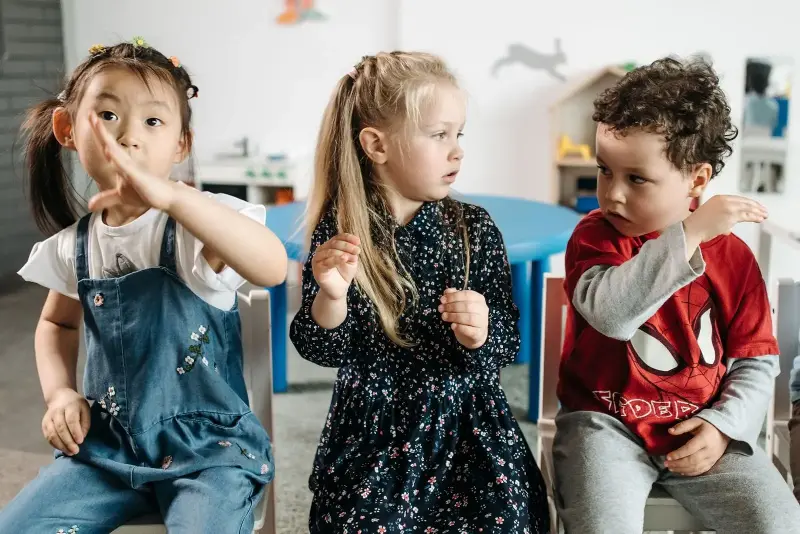
The Japanese model places extraordinary weight on the period before age two — and not in the way Western intensive-parenting culture does. The point is not to drill language or expose the infant to flashcards. The point is to build such a complete sense of security that everything else can be constructed on top of it.
Amae is the word often used for the texture of it — a kind of secure, indulged dependency in which the small child is rarely far from the caregiver. Co-sleeping is common. Carrying the infant on the body is common. Crying is more often read as communication than as manipulation to be extinguished.
The thinking is that a child thoroughly soaked in security in the first two years arrives at age three with a more regulated nervous system, and a regulated nervous system can absorb structure. This sequencing has support in the developmental literature: the Murray and Rosanbalm practice briefs describe self-regulation as something that grows out of earlier co-regulation with a calm, responsive adult. Skip the co-regulation step and demand self-regulation later, and structure is more likely to feel like punishment than like scaffolding.
The missing-skill question
The diagnostic question a shitsuke-minded adult asks when a child misbehaves is not how do I stop this? but what skill is missing here?
A child who hits a sibling over a toy is missing the skill of negotiating a turn. A child who melts down at the grocery store is missing the skill of regulating a flood of sensory input. A child who refuses to put on shoes is missing the skill of transitioning from one activity to another.
Once the missing skill is identified, the adult’s job is to teach it — usually by demonstrating, not by lecturing — and to redesign the environment so the child does not have to use the missing skill before they have it. The toy is moved. The grocery trip is shortened. The shoes are laid out by the door the night before.
This is, in the literal sense, scaffolding. The structure holds the child up until the child can stand alone. Then the structure comes down.
What the evidence on punishment says
The reverse approach — correcting children primarily through punishment — has been studied for decades. The largest synthesis to date, a 2016 meta-analysis by Elizabeth Gershoff and Andrew Grogan-Kaylor in the Journal of Family Psychology, pooled 111 effect sizes covering roughly 160,000 children and found that spanking was consistently associated with detrimental outcomes, including more aggression and more antisocial behaviour, with no evidence it improved compliance over time.
Non-physical correction is more contested than the article’s framing above might suggest. It is worth being precise here: reviews of time-out, including guidance from the American Academy of Pediatrics, generally find that when it is used calmly, predictably, and alongside warm “time-in,” time-out is both safe and effective — not a technique that merely interrupts a parent’s frustration. Where the shitsuke model differs is less in condemning any single tool and more in shifting effort upstream, so that fewer correction episodes are needed in the first place.
The comparative picture across cultures is real but easy to overstate. Ethnographic work on Japanese early-childhood settings — most notably Joseph Tobin and colleagues’ Preschool in Three Cultures Revisited — documents classrooms organised around environmental cues, peer modelling, and predictable routines, with teachers often deliberately holding back from intervening in children’s disputes. That is a description of a pedagogy, not a scoreboard; the same researchers are careful about how much of it transfers.
The Toyota connection
The five S’s of shitsuke-influenced workplace organisation are not a coincidence. Toyota’s production system, developed by Taiichi Ohno in the post-war decades, drew on the same cultural logic. The factory was treated a little like a classroom. Tools were placed where workers could reach them without thinking. Floors were marked so that anomalies — a misplaced part, a leaked drop of oil — were visible immediately. Workers did not have to remember the rule. The floor remembered it for them.
The deepest claim of the system is that quality is a property of the environment, not a property of individual virtue. A worker on a well-designed line will produce fewer defects than a more careful worker on a poorly designed line. A child in a well-designed room will produce fewer tantrums than a more obedient child in a chaotic one.
This view runs against a long Western tradition that treats character as the source of behaviour and environment as background. Shitsuke treats character more as the residue of environment — what is left in the child after the room has shaped them for ten thousand small repetitions.
What it costs and what it asks
The model is not free. It asks the adult to do more thinking upfront and less reacting downstream. The hooks have to be placed at the right height. The morning has to be sequenced. The bowls have to be where the four-year-old can reach them. The vase has to be moved before the toddler arrives.
It also leans on cultural conditions that Western households rarely have in full — extended kin nearby, neighbourhoods where children can move semi-independently from a young age, schools that share the same environmental logic, public spaces designed for small bodies. Shitsuke in the home is reinforced by shitsuke in the train station, the convenience store, and the playground. Without the surrounding architecture, the household version does some of the work but not all of it.
There is also a reporting problem in any cross-cultural comparison of parenting. Surveys of how parents handle their children lean toward the calm, consistent, evidence-based answers respondents believe the researcher wants to hear, which tends to inflate the contrast between the idealised version and daily life. The Japanese-versus-Western difference is real but smaller in practice than the tidy version suggests. Japanese parents lose their tempers too. The architecture just means they have to do it less often.
The quiet inheritance
What stays with the child raised this way is not a set of rules. It is a felt sense that the world is orderly, that things have places, that transitions have shape, that adults can be trusted to have arranged the room before the child walks into it. The child who internalises this carries the architecture inside them. They become, eventually, adults who arrange rooms.
Space Daily has written before about the long arc of early patterning — how bottlenose dolphins invent their signature whistles in the first months of life and carry those calls for decades. The principle rhymes across species. The very early environment writes something that the older animal then performs for the rest of its life.
In a Tokyo kindergarten at three in the afternoon, the children are putting away their snack bowls. No adult is directing them. The shelf is at their height. The bowls have outlines drawn where they belong. The song that signals clean-up time is playing from a small speaker. A four-year-old places her bowl exactly inside its outline, turns, and walks toward the cubby with her name on it. She has not been told to do any of this. The room told her, and she listened, and one day she will build a room like it for somebody else.
The post In a Japanese preschool, the shoes line up by themselves, the snack bowls sit on a low shelf a four-year-old can reach, and a child walks in already knowing what to do because the room, and not the adult, has quietly done the teaching appeared first on Space Daily.