



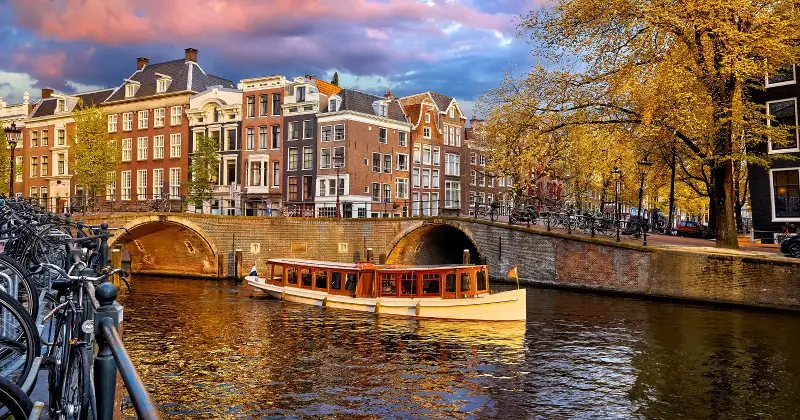
The Dutch have an old line about themselves, half-joke and half-boast: “God created the world, but the Dutch created the Netherlands.”
You earn a line like that by taking land off the water and refusing to give it back. And here’s the strange part: the same country that spent centuries draining and diking its way into existence turned around this century and paid to undo some of that work on purpose.
The reclamation story is well known. The reversal is the part worth understanding.
The old logic: build higher, push the water out
Taking land from water in the Netherlands is genuinely ancient. Impoldering began in the early 11th century, first in coastal lowlands, with later reclamation from the sea and the draining of lakes. Today about 26 percent of Dutch land lies below sea level, and 59 percent is susceptible to flooding.
The logic held for a long time. When the water rose, you raised the dike. When you wanted more farmland, you drained another lake. The direction was usually the same: push the water out, keep the ground you’d won, wall it off higher if it threatened you.
The reversal: giving the river room instead of walls
Then came two bad scares in quick succession. The Rhine and Meuse rose to near-disaster levels in 1993, and again in January 1995, when authorities evacuated more than 250,000 people and around a million animals from the river region. No river dikes failed, but the crisis helped drive a new approach: instead of endlessly raising barriers, lower flood levels by giving rivers more space.
The result was Ruimte voor de Rivier, Room for the River. From 2006 to 2019, national and regional authorities carried out measures at 34 locations along the IJssel, Waal, Nederrijn and Lek. The programme cost €2.3 billion and improved flood protection and the surrounding landscape for roughly four million people.
How you actually give land back to a river
Giving a river room is less poetic than it sounds. It mostly means moving earth on a huge scale.
The programme used a short menu of methods: move dikes back from the water, dig out floodplains so they can carry more, cut side channels to take overflow, and in some places “depolder.” That last one means deliberately allowing former polder land to flood when river levels rise.
The physics is undramatic. Widen the space a river can spread into and its peak level during a flood drops. A lower peak reduces pressure on the dikes that remain. Across the programme, crews shifted about 38 million cubic metres of soil and built around 100 kilometres of new embankments. The Dutch did not abandon concrete-and-earth defenses; they changed the system so those defenses did not have to do all the work.
Noordwaard and Nijmegen: what €2.3 billion bought
The Noordwaard was the programme’s biggest depoldering project and the purest example of the reversal. The 4,450-hectare former polder was redesigned so high water can deliberately flow through it.
Rijkswaterstaat lowered part of the river levee by about 3 metres over 2 kilometres. In an extreme discharge, that extra space can lower the water level near Gorinchem by about 30 centimetres. The project cost roughly €300 million. Land that generations had fought to keep dry was deliberately opened to high water again.
Nijmegen-Lent was another showpiece, costing about €351 million. There the dike was moved 350 metres inland and a 3.5-kilometre relief channel, the Spiegelwaal, was cut alongside the Waal. The work removed a bottleneck, created a new river island and, during an extreme discharge, is calculated to lower the water level at Nijmegen by about 34 centimetres.
Why the old logic hit its limit
The reversal wasn’t really a rejection of the old methods. It was a recognition of their ceiling.
You can keep raising a dike, but a taller dike holds back a taller wall of water, and when it fails the consequences can be greater. At some point the safer move is to lower the peak rather than raise the barrier, and lowering the peak means letting the river spread.
A 2025 review in Nature Water describes a broader shift in flood management, with the “command-and-control approach” beginning to make way for “living with water.” Note the “beginning”: this is not a clean abandonment of hard defenses.
Still, the underlying gesture is hard to mistake. A country that built itself partly by taking ground from water decided its next measure of safety would come from giving rivers some space back. Not surrendering to the river, but agreeing to share space with it.
Standards
Space Daily articles are edited and fact-checked before publication. We use AI tools in the newsroom. See our editorial standards and masthead.