



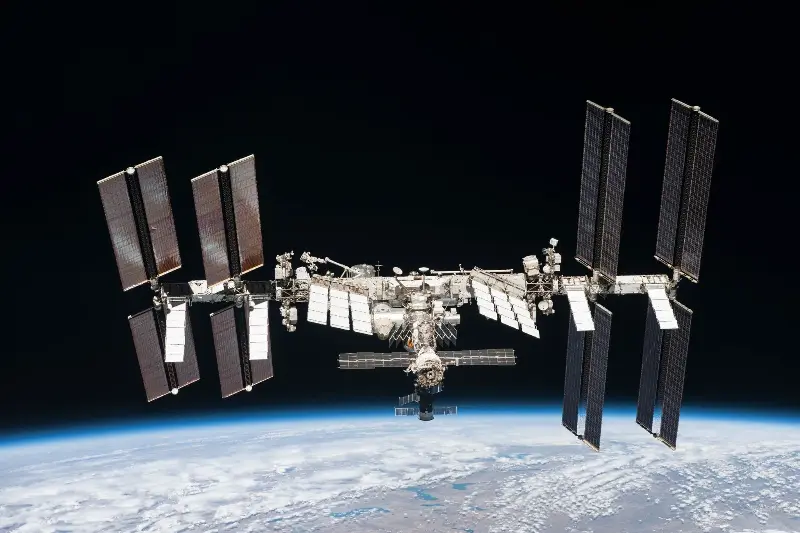
The International Space Station is often described as being “up” in space, but that word can quietly mislead. The station is not held above Earth by engines firing against gravity. It is not hovering. It is falling.
More precisely, it is falling around Earth. Its forward speed is so high that as gravity pulls it downward, Earth’s surface curves away beneath it. The result is orbit: a continuous fall in which the path of the spacecraft matches the curvature of the planet closely enough that the station keeps missing the ground.
That controlled fall has carried a human outpost around Earth without a break since November 2000, when the first long-duration crew arrived. NASA’s station facts page states that the International Space Station has been continuously occupied since that month, with crews living and working while travelling at about five miles per second and circling Earth roughly every 90 minutes.
Gravity is still there
The first misconception to remove is the simplest one: astronauts on the station are not weightless because there is no gravity. NASA’s microgravity explainer notes that at about 250 miles above Earth’s surface, the gravitational field is still roughly 88.8% as strong as it is at the surface.
That is more than enough gravity to matter. It is the force keeping the station in orbit. Without gravity, the station would not circle Earth at all. It would continue in a straight line, drifting away along the direction it was already moving.
The reason astronauts float is that the station, the crew, the air, the laptops, the water bags and a loose apple are all accelerating together. They are in free fall at the same time. There is no floor pushing back against the astronaut in the ordinary Earth-surface way, so the body does not feel its own weight.
NASA puts the point in plain terms: if an astronaut on the station drops an apple, the apple falls too. It simply does not look like falling, because the astronaut and the station are falling with it. What people see as floating is the shared motion of everything inside the spacecraft.
Falling fast enough to miss
The idea is old. Isaac Newton described it with a thought experiment involving a cannon on a high mountain. Fire a cannonball slowly and it falls nearby. Fire it faster and it lands farther away. Fire it at the right speed, neglecting air resistance, and the cannonball keeps falling while Earth’s surface curves away beneath it. That is an orbit.
The station is the same argument made real at human scale. ESA says the International Space Station flies about 400 kilometres above Earth at roughly 28,800 kilometres per hour, completing a circuit of the planet in about 92 minutes. NASA gives the same everyday sense of speed as about five miles per second.
At that speed, “down” and “forward” are not separate in the usual intuitive way. Gravity constantly bends the station’s path downward, while its sideways motion keeps carrying it ahead. The station is not escaping Earth, and it is not dropping straight through the atmosphere. It is tracing a curved path around the planet, again and again.
This is why orbit can look almost serene in video. Inside the station, astronauts push off walls, water gathers into floating blobs and tools drift near a workstation. Outside, the whole structure is moving faster than a rifle bullet, crossing oceans and continents in minutes. The calm interior is possible because everything inside shares the same fall.
Not held up by rockets
Rockets still matter, but not in the way the phrase “held up” suggests. The station was assembled by rockets and spacecraft, supplied by cargo vehicles, and periodically boosted to maintain its orbit. But its day-to-day motion is orbital mechanics, not continuous engine support.
Low Earth orbit is not a perfect vacuum. There are still thin traces of atmosphere at station altitude, and they slowly drag on the structure. Over time, that drag lowers the orbit. Visiting spacecraft and station propulsion systems can raise it again through reboost manoeuvres. Those firings are maintenance, not levitation.
The distinction is useful because it changes the way the station is imagined. The ISS is not like a helicopter fighting gravity second by second. It is more like a thrown object that keeps going around the world because it was thrown sideways fast enough and is nudged when the upper atmosphere steals a little of its energy.
That also explains why the station’s altitude is a compromise. Lower orbits are easier to reach but experience more atmospheric drag. Higher orbits reduce drag but require more energy for crew and cargo vehicles to reach. The ISS sits in low Earth orbit because that region is accessible enough for regular operations while still high enough to remain in orbit with periodic maintenance.
The uninterrupted part is human
The physics is continuous, but the historical achievement is human. Expedition 1’s crew arrived at the station on November 2, 2000. Since then, crews have handed the outpost from one expedition to the next, through shuttle retirements, Soyuz rotations, commercial crew flights, cargo missions, equipment failures, leaks, spacewalks and political strain on Earth.
The station itself has changed during that time. It began as a smaller assembly of modules and became a large orbital laboratory with solar arrays, radiators, trusses, pressurised laboratories, docking ports and the Cupola window looking down at Earth. NASA describes its living and working space as larger than a six-bedroom house, with an international crew usually living and working aboard.
But the basic motion has not changed. Every module, experiment rack and crew quarter is part of the same falling system. The laboratory where astronauts run combustion experiments, grow plants, test fluids and exercise to slow bone and muscle loss is also a spacecraft constantly curving around Earth.
That is the quiet strangeness of the ISS. The most permanent human-built place in space is permanent only because it is never still. It survives by moving, by falling correctly, and by being tended by crews and ground teams who keep the fall precise enough to continue.
A daily orbiting act of balance
In 24 hours, NASA says, the station makes 16 orbits of Earth and passes through 16 sunrises and sunsets. That rhythm has been part of human life in orbit for more than two decades: sleep schedules behind covered windows, exercise machines strapped to the structure, experiments checked between radio calls, Earth sliding beneath the station in repeated arcs.
There is a temptation to make the ISS sound static because it has been there for so long. It is a place, an address, an orbiting laboratory with a history. Yet physically it is an event that never stops happening. Gravity pulls, velocity carries, atmospheric drag nibbles, reboosts correct, and the arc continues.
The station is not held up by rockets. It is held in orbit by speed, gravity and careful maintenance. Since November 2000, that has been enough to keep people living inside a fall that never quite reaches the ground.
Sources
- NASA: International Space Station Facts and Figures
- NASA Glenn Research Center: What is Microgravity?
- European Space Agency: Where is the International Space Station?
The post The International Space Station is not held up by rockets. It is falling constantly, in a precise arc that matches the curvature of Earth — a controlled fall that has continued without interruption since November 2000 appeared first on Space Daily.