



PITTSBURGH — A 2015 honeymoon changed the life of Pittsburgh writer Andrew Moore in ways that weren’t immediately apparent.
An outdoorsy couple, Moore and Erika Beras spent their honeymoon in a cabin just outside of Cook Forest State Park and its old-growth forest. They chose to celebrate their nuptials by living among some of the largest and oldest trees in Pennsylvania.
After visiting the towering white pines and Eastern hemlocks, Moore thought maybe they should see some elk — the herd in Benezette, Elk County, wasn’t far away and it was the peak of fall color.
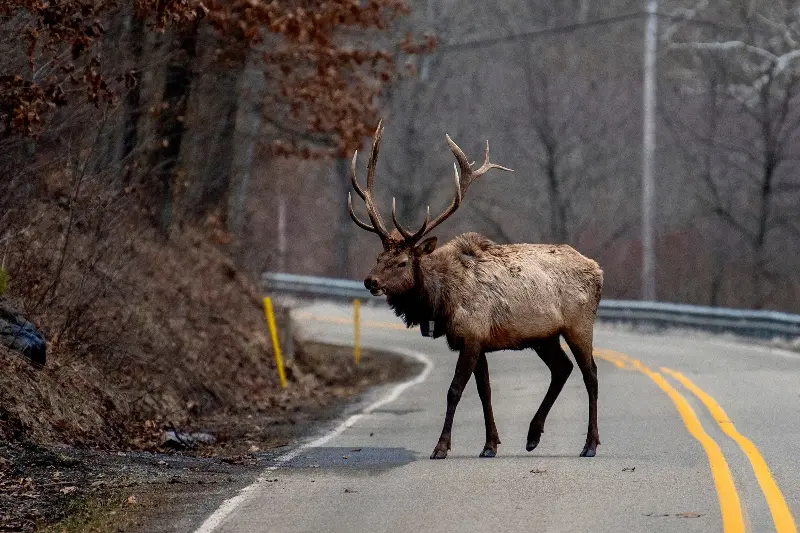
For the first time, they witnessed the sights and sounds of a bull elk bugling and a harem of cows heeding his call, the kind of blockbuster wildlife moments usually experienced only in the western part of the country or in nature films.
“Seeing that was a revelation in that it taught me that spectacles from the grandeur of wildlife were as much at home in Pennsylvania as anywhere in the world,” said Moore, 41, of the North Side.
“To find these animals was the cherry on top of a fun honeymoon.”
But how did they get there, after being extirpated in this part of the country? And why do they live in just a portion of the state, in about five counties in north central Pennsylvania?
Answering that and other questions sparked a 10-year journey culminating in his recent book, “The Beasts of the East: The Fall and Rise of America’s Eastern Wilderness” (Mariner/Harper Collins, $28). The book provides nicely paced storytelling about environmental history through the fates of elk, bison and red wolves.
Moore, a James Beard Award finalist in writing and literature, is also known as the pawpaw guy. He first caught the public’s eye with his 2015 book, “Pawpaw: In Search of America’s Forgotten Fruit” (Chelsea Green Publishing $27.95).
Moore showed up on television, podcasts and radio extolling the sweet and creamy native fruit in the custard apple family. He also grows and sells pawpaws to the East End Food Co-op in Point Breeze, and some specialty markets carry the native fruit in September.
“There still is a thrill when I get my hands on the first ripe one from my backyard,” said Moore, who has six pawpaw trees lovingly grown from seed. He has also nurtured pawpaw trees locally, including on a community farm on the North Side.
Learning about the pawpaw expanded Moore’s interests in biodiversity, plants and animals.
More than a century ago, most of the remaining populations of bison, elk, and red wolves expired in the East. The bulk of the three species died after the arrival of European settlers, many by the barrel of a shotgun. The last elk was famously killed by Jim Jacobs in 1867 in Elk County.
Sportsmen came to rue the depletion of these animals and decided they should be reintroduced. Pennsylvania was the first Eastern state to bring back elk, according to Moore.
Elk were rounded up in Yellowstone National Park, placed in trains’ cattle cars, shipped to the Benezette area, and released beginning in 1913. The first round included 20 elk; then, two years later, 100 were brought to Pennsylvania.
The experiment had spotty results initially. The state had been largely denuded of trees by then. Early successional habitats dominated by tender browse were suitable for elk. In Pennsylvania and in Kentucky, the animals were placed in areas of coal mining reclamation where young plants, often invasives, provided sustenance.
Many of the transplanted elk died from a brain worm epidemic or were shot.
“These 800-pound animals wandered into farm fields, and the farmers did not tolerate them,” Moore said.
Nonetheless, the elk herd grew slowly and became a backwoods curiosity for the better part of the 20th century, he said. The ones that survived stayed out of the farm fields and their numbers reached as high as 1,000 animals by 2000.
The state hired its first elk biologist in the 1980s. An elk zone was established and expanded.
Moore knew that many people were familiar with the elk herds in north central Pennsylvania but not necessarily with the backstory.
“I don’t think I knew when I started to write the book that it was a story as much about land use as about charismatic, large megafauna,” he said.
His book focuses on bison, elk and red wolf, all of which had died out east of the Mississippi. Some have been reintroduced with varying degrees of success.
With the help of the Pittsburgh Foundation, Moore wrote a book proposal and landed a deal with HarperCollins in 2019. The pandemic ensued and Moore and Beras welcomed their first child as Moore dug deeply into research for the book.
Moore’s reporting revealed some critical insights: The fate and reintroduction of the large animals was in part determined by whether or not people consume them.
Elk have remained wild and free-roaming, while bison are contained by fences or geographical features.
“We own bison privately, and that is different from the public ownership of elk,” Moore said.
”As a culture, we have forgotten these animals were here.”
There was a time when the Allegheny Mountains and plateau held the highest density of elk in the Eastern United States. Several centuries ago, old-growth trees were intermixed with openings such as meadows – that is where the elk lived.
“The landscape has been changed and reconfigured so much,” he said. “The diversity of wild nature was incredible, and we have lost much of that.”
Moore’s story wasn’t just one of extirpation of large species but the story of restoration and putting things back together … somewhat.
“What I hope to drive home in the book is that all is not lost. We can restore diversity and animals and landscapes in some cases.”