



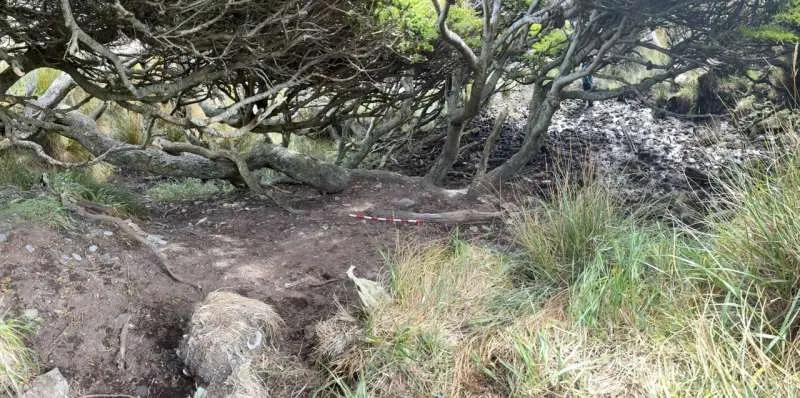
On a desolate island at the end of the world, battered by freezing winds, archaeologists have uncovered the remains of a possible 19th-century castaway camp that may have belonged to a renowned Argentine sailor and his shipwrecked crew.
Isla de los Estados is a frigid island off the coast of Tierra del Fuego. In January 2026, archaeologists came across the remains of a castaway camp and re-examined pieces of a shipwreck at Lacroix Inlet, Franklin Bay, a new study in Antiquity reports. Based on their finds, the authors suggest these may be the remains of a temporary camp and the lost schooner brig "Espora."
Sites like this provide "a unique opportunity to analyze crisis and survival experiences in isolated places, such as Isla de los Estados," said lead author Nicolas Ciarlo, an archaeologist at the University of Cadiz in Spain.
Island at the end of the world
Located on a historic route linking the Atlantic and Pacific, Isla de los Estados has connected Patagonian harbors since the early 1600s. Although it had no permanent settlement, it was home to an old lighthouse that inspired French novelist Jules Verne's "The Lighthouse at the End of the World."
The island's long history, importance to seafaring activity and challenging sailing conditions make it rich in archaeological potential, the study authors write.
The island was granted to Luis Piedra Buena by the early 1870s. Piedra Buena was a renowned Argentine sailor. Ciarlo said he was widely recognized for his commercial, humanitarian and sovereign activities, as well as for saving the lives of numerous sailors from across the globe.
In 1873, he and his crew were on an expedition to obtain penguins for oil when disaster struck, and the Espora was shipwrecked, the study reported.
"Piedra Buena and his crew were castaways on the island for more than two months before they could return to Punta Arenas," Ciarlo said. To survive, they salvaged some supplies from the Espora and built a new vessel, "Luisito."
Clues of the castaways
Hoping to learn more about Isla de los Estados' maritime history, a team of archaeologists set out as part of the expedition "Aquí hay dragones" ("here be dragons").
They spent 10 days on the island, but only two at Lacroix Inlet. The team had to calculate their time carefully, accounting for daylight hours and the rising tide. The island's harsh climate soon became clear when severe weather forced their sailing vessels to depart without them. "… We needed to wait there for a ship of the Argentine Navy to re-embark us and return to Ushuaia (Argentina)," Ciarlo said.
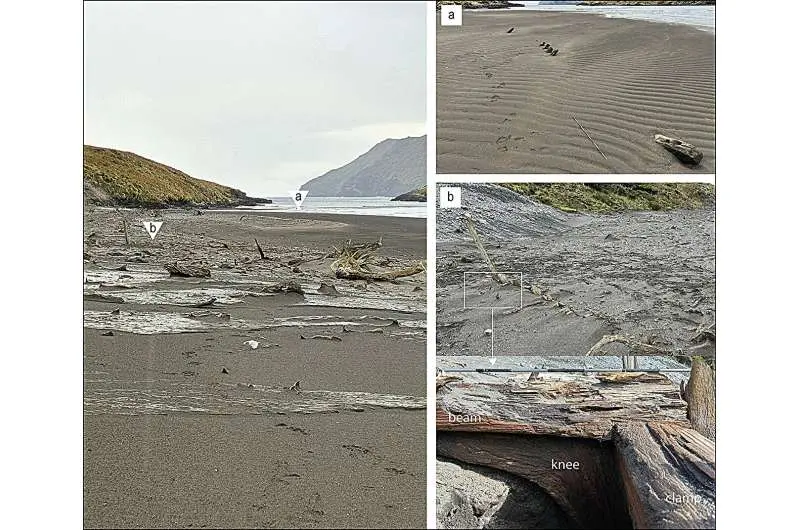
Before returning, the team revisited two bits of hull first spotted by earlier researchers. Then they discovered a new, smaller third section on the north side of the inlet, the researchers write.
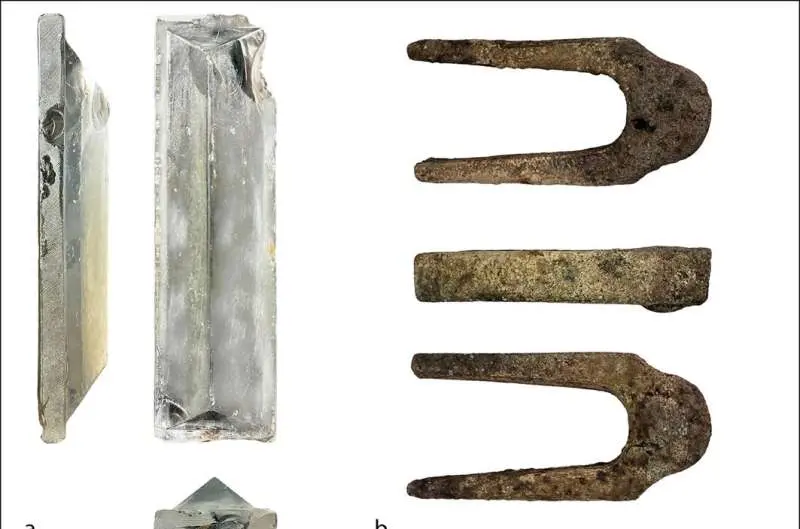
According to the study, the camp lay at the foot of a steep hill, beside a stream. Scattered across its surface were the remains of 19th-century artifacts including glass beads, a bottle, sheets of metal and four-hole ceramic buttons. The remains of a deck prism, a glass block used to let daylight in from a ship's deck, and a rudder hinge suggested these were remnants of a castaway camp.
Although researchers disagree, Piedra Buena's own accounts suggest the Espora sank in Franklin Bay, possibly linking the castaway camp to him.
Even so, some parts simply don't add up. The study reported that historical accounts dispute how thoroughly the Espora was dismantled, and the hull remains don't match accounts of a ship stripped for parts. On top of that, the team has yet to locate the shipyard where the castaways built the Luisito.
Now the team wants to analyze the timbers to try to figure out whether they came from one ship or multiple ships and see whether they can link the camp to the famous Argentine sailor and his crew, the researchers write.
"There is much to do in the coming years, both at the campsite and at the shipwreck remains located in the inlet," Ciarlo said.
Studying the island's seldom-investigated maritime history, including linking the remains to possible known sailors, can help archaeologists better understand how sailors coped with dangerous environments when written records fall silent, the authors write.
Historical accounts of shipwrecks are plentiful, Ciarlo said, but "documentary sources on life and death at the castaway camps are less common."
"As archaeologists, being in this isolated and wild place allowed us to taste what a small group of castaways saw and felt about 150 years ago," Ciarlo said.
Written for you by our author Sandee Oster, edited by Sadie Harley, and fact-checked and reviewed by Robert Egan—this article is the result of careful human work. We rely on readers like you to keep independent science journalism alive. If this reporting matters to you, please consider a donation (especially monthly). You'll get an ad-free account as a thank-you.
Publication details
Nicolas C. Ciarlo et al., Castaways at the end of the world: ongoing archaeological research at Franklin Bay, Isla de los Estados, Antiquity (2026). DOI: 10.15184/aqy.2026.10437
Who's behind this story?
Sandee Oster
Archaeology PhD candidate at Witwatersrand. Science writer for Science X and archaeology blogger. Field research in South Africa. Full profile →
Sadie Harley
BSc Life Sciences & Ecology. Microbiology lab background with pharmaceutical news experience in oil, gas, and renewable industries. Full profile →
Robert Egan
Bachelor's in mathematical biology, Master's in creative writing. Well-traveled with unique perspectives on science and language. Full profile →
© 2026 Science X Network
Citation: Archaeologists uncover possible 19th-century castaway camp on island 'at the end of the world' (2026, November 5) retrieved 5 November 2026 from https://phys.org/news/2026-11-archaeologists-uncover-19th-century-castaway.html
This document is subject to copyright. Apart from any fair dealing for the purpose of private study or research, no part may be reproduced without the written permission. The content is provided for information purposes only.