



Many animal species, ranging from peacocks and birds of paradise to some lizards, fish and beetles, display physical features or ornaments that can attract potential mates. These ornaments can include colorful plumage, elaborate tails or fins, inflatable throat sacs and elongated eye stalks.
Ornaments are believed to arise through an evolutionary process known as sexual selection, which leads to the emergence and development of traits that help individuals secure mates. This same process also underpins the evolution of natural 'weapons' that males use when fighting sexual rivals, such as antlers, horns, tusks, claws and jaws.
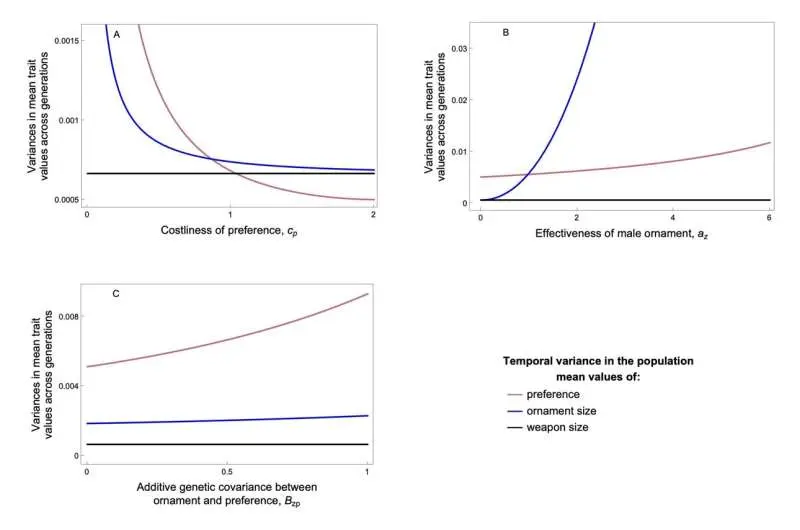
Researchers at the University of Freiburg and Swansea University recently developed a mathematical model that allowed them to investigate the pace at which animal ornaments and weapons evolve. Their paper, published in Proceedings of the Royal Society B: Biological Sciences, suggests that male weaponry generally evolves more slowly than ornaments, as random shifts in female preferences produce fluctuating selection pressures that could accelerate ornament evolution.
"The initial idea came from an excellent paper by Erin McCullough, Christine Miller and Doug Emlen entitled 'Why sexually selected weapons are not ornaments' and published in Trends in Ecology & Evolution," William L. Allen, co-senior author of the paper, told Phys.org.
"Among its several important contributions was the proposal that the evolutionary dynamics of weapons should differ fundamentally from those of ornaments. In particular, as the Fisher process—positive feedback between female mating preferences and male ornament traits—does not operate in the same way for weapons, the authors predicted that weapons should evolve more slowly than ornaments, also noting that this prediction had never been tested."
Modeling the evolution of male ornaments and weapons
Building on the earlier paper by McCullough and her colleagues, the researchers set out to explore the possibility that male weapons evolve more slowly than ornaments. To do this, they developed a quantitative-genetic mathematical model and then tested its predictions using comparative data collected from different animal groups.
"We developed a quantitative-genetic model that allowed us to follow the evolution of male sexually selected traits and, in the case of ornaments, the female mating preferences acting on those traits," explained Mohammadali Dashtbali, first author of the paper. "The key difference we wanted to capture was that ornaments and weapons experience different forms of selection."
The team's framework suggests that ornaments can evolve through interactions between a male trait and a female preference. In other words, changing female preferences can prompt changes in male ornaments, affecting the overall direction in which specific traits evolve. This could allow male ornaments and female mating preferences to coevolve, meaning that changes in each influence the evolution of the other.
The evolution of weaponry, on the other hand, is primarily shaped by competition between males. The researchers thus propose that the evolution of ornaments and weapons is governed by different selection processes.
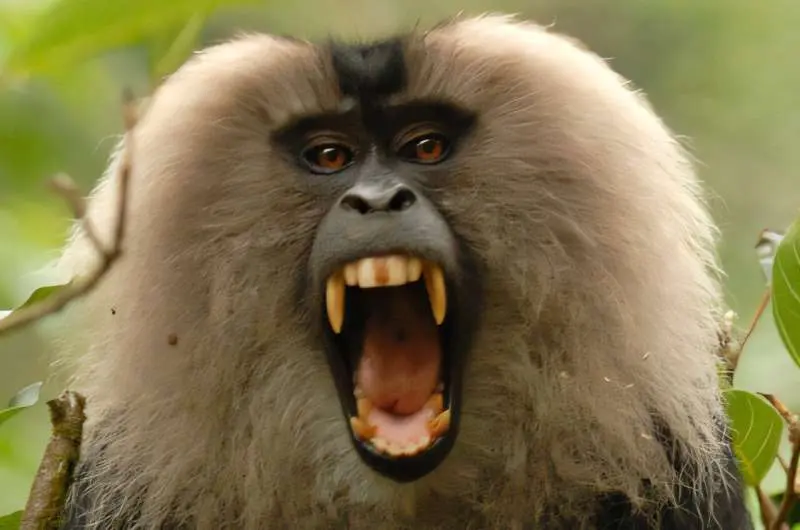
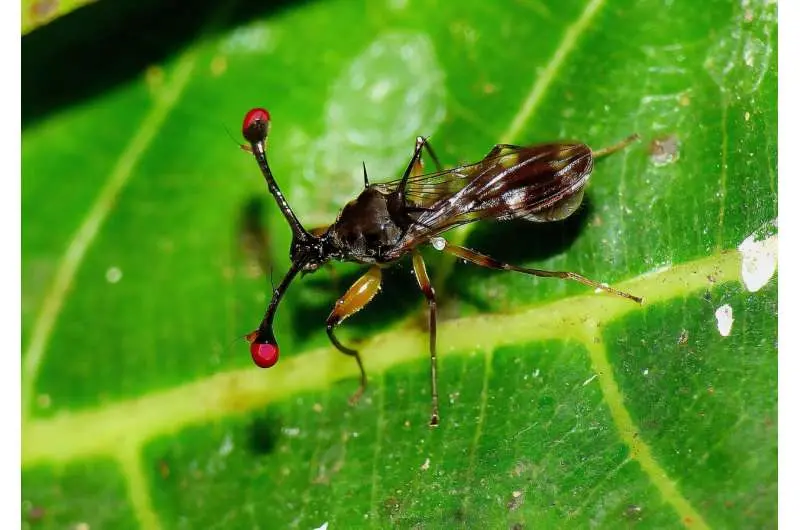
"We used our model to ask how these different forms of sexual selection should affect the rate at which traits evolve over generations," Dashtbali said. "We then tested the resulting prediction using comparative data from 10 animal groups, including primate canine length and stalk-eyed fly eye span. By estimating evolutionary rates from phylogenetic data, we could ask whether ornaments have in fact changed more rapidly than weapons over evolutionary timescales."
Informing future studies into sexual selection
The results of the team's comparative analyses suggest that ornamental traits across the animal groups considered in the study evolved faster than their sexually selected weapons. Notably, these results were also consistent with their theoretical model's predictions.
"Importantly, our work also offers an explanation for why this might be the case: stochastic drift in female preferences can produce fluctuating selection on male ornaments, accelerating their evolution, whereas more stable selection from male–male competition can lead to slower weapon evolution," Allen said.
"This deepens our understanding of how sexually selected traits evolve on macroevolutionary timescales. More broadly, we think the study illustrates how combining theoretical and comparative approaches can reveal mechanisms that would be difficult to identify from either approach alone."
This study offers new insights into how different characteristics that help animals secure mating opportunities may emerge and evolve across animal species. In the future, the combined theoretical and comparative approach employed by Allen, Dashtbali and their colleagues could be adapted and potentially used to study other evolutionary processes.
"The theory generates a prediction, while the comparative analysis allows us to ask whether that prediction is reflected in patterns of evolution across real animal groups," Allen added. "There are several directions we would now like to pursue. One is to understand in more detail why sexually selected traits evolve at different rates in different groups, and how ecological and behavioral factors influence these dynamics."
Written for you by our author Ingrid Fadelli, edited by Gaby Clark, and fact-checked and reviewed by Robert Egan—this article is the result of careful human work. We rely on readers like you to keep independent science journalism alive. If this reporting matters to you, please consider a donation (especially monthly). You'll get an ad-free account as a thank-you.