



Many people believe there are obvious ways to spot a liar without listening to a word they say, such as shifty glances and nervous fidgeting. Psychologists, however, are increasingly looking past these supposed telltale signs, which aren't necessarily reliable, toward subtler, involuntary clues that can be harder to detect.
In a new study published in PLOS One, Valentin Foucher and Anke Huckauf of Ulm University in Germany have identified some promising signs of deception that could be hiding in our eyes.
Testing deception
Foucher and Huckauf wanted to know whether concealed information tests (CITs) could detect when someone is keeping a secret based on their eye movements alone. CITs are sometimes used in criminal investigations to establish whether an individual recognizes something that only the perpetrator might know, such as details of a crime.
So they recruited adult volunteers and encouraged them to deceive.
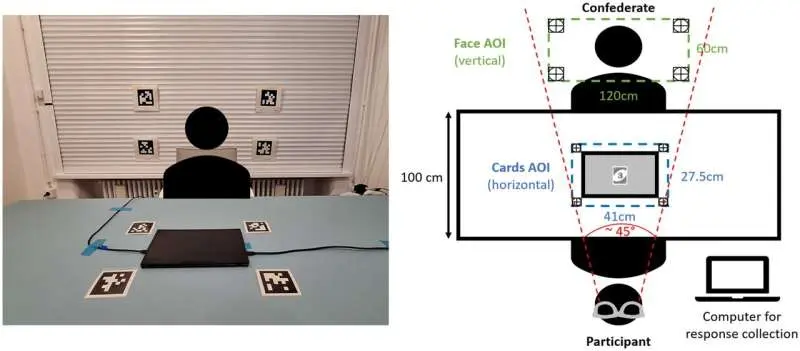
The participants sat across a table from someone pretending to be a mind reader. They were shown six numbered cards on a screen and asked to choose one. The cards were then shown again, one at a time, while the researchers monitored how their eyes reacted. The volunteers had to reveal their choice, keep it secret or trick the mind reader into guessing a different card.
The mentalist then also asked questions about their chosen card, which they had to answer truthfully or falsely, depending on their instructions.
Throughout the experiment, eye-tracking glasses recorded their pupil size, blinking and eye movements. The researchers also measured how long they took to answer.
What gave them away
And the results revealed a possible giveaway.
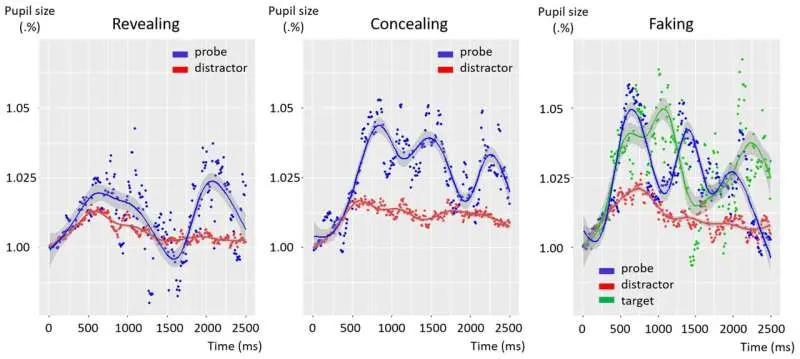
Participants' pupils briefly dilated more when they saw their chosen card than when they saw the others. This happened whether they were being honest or attempting to deceive the mind reader.
"This suggests that the recognition of a significant object may be discernible through pupil signal, even when participants were trying to conceal or fake it," wrote Foucher and Huckauf in their study.
They also found that participants tended to blink less and keep their eyes fixed on one spot for longer when concealing information. And when they had to lie in response to a question, they generally took longer to answer.
While the findings could help investigators detect when someone is hiding information, the researchers acknowledge the experiment's limitations. One reason is that nothing was really at stake for the participants.
"In the present study, deception carried no consequences, and participants faced no risk of being caught by the mentalist."
Written for you by our author Paul Arnold, edited by Gaby Clark, and fact-checked and reviewed by Robert Egan—this article is the result of careful human work. We rely on readers like you to keep independent science journalism alive. If this reporting matters to you, please consider a donation (especially monthly). You'll get an ad-free account as a thank-you.
Publication details
Valentin Foucher et al., Effects of deception on pupils, blinks, fixations, and response times in a social interactive concealed information test, PLOS One (2026). DOI: 10.1371/journal.pone.0361498
Who's behind this story?

Paul Arnold
BSc Biology from University of London. BBC documentary producer with world travel experience. Freelances from southern Spain. Full profile →

Gaby Clark
MA in English, copy editor since 2021 with experience in higher education and health content. Dedicated to trustworthy science news. Full profile →

Robert Egan
Bachelor's in mathematical biology, Master's in creative writing. Well-traveled with unique perspectives on science and language. Full profile →
© 2026 Science X Network
Citation: Trying to hide some information? Your eyes might give you away (2026, November 19) retrieved 19 November 2026 from https://phys.org/news/2026-11-eyes.html
This document is subject to copyright. Apart from any fair dealing for the purpose of private study or research, no part may be reproduced without the written permission. The content is provided for information purposes only.