



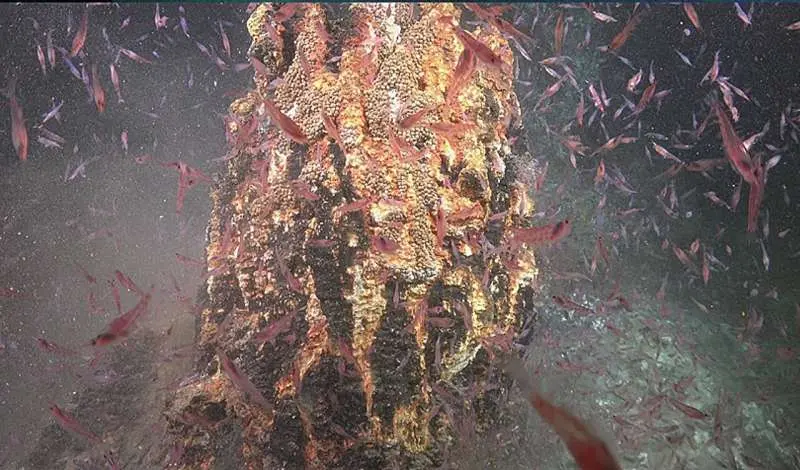
Antarctic krill are tiny shrimp-like creatures that were previously thought to mostly inhabit the upper layer of the Southern Ocean. Although they had occasionally been observed at deeper levels, they were never seen near deep-sea hydrothermal vents until 2024, when a group of oceanographers observed them there for the first time. The team's new study, published in Communications Biology, describes the discovery and why the team thinks pregnant krill may actually be spending a lot of time near hydrothermal vents.
Antarctic krill: The foundation of the Southern Ocean food web
Antarctic krill serve as a major food source for whales, seals, penguins, seabirds and many other animals in the Southern Ocean. The predators that don't eat krill likely eat animals that do. Krill also play a role in nutrient recycling and carbon sequestration in the ocean. By eating algae, they convert nutrients into usable forms of nutrition for other species and turn carbon into sinking fecal pellets that pull carbon down from the surface into the deep ocean.
The researchers say Antarctic krill likely have the highest cumulative biomass of any wild animal species on Earth, at around half a billion tons. Around a third of this biomass is located in the area between the northern Antarctic Peninsula and the Scotia Sea, one of the fastest-warming areas on the planet. In addition to the threat of climate change, Antarctic krill fisheries are also putting their populations at risk.
The study authors write, "Consequently, Antarctic krill populations are under increasing pressure, and there is mounting recognition at an international level of the need to conserve critical Antarctic krill habitat to ensure their populations continue to thrive into the future. However, we still lack fundamental knowledge on what constitutes critical habitat for key parts of the Antarctic krill life cycle—particularly for reproductive females."
A deep-sea discovery
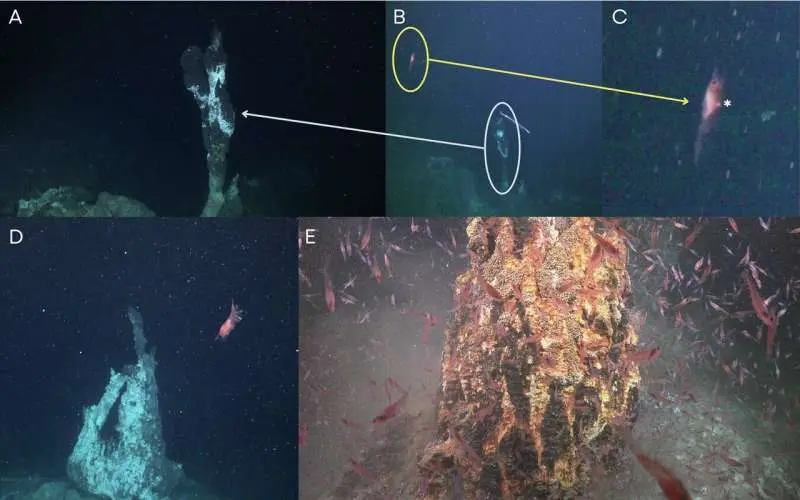
During surveys of active hydrothermal vent fields, Hook Ridge and Quest Caldera, the researchers discovered and collected several Antarctic krill with a remotely operated vehicle. They compared vent-site krill with krill from a non-vent seafloor site and analyzed their gut microbes, stable chemical signatures and trace metals in their tissues.
Of the four captured krill from Hook Ridge, all were mature, egg-carrying females that had recently mated. Video footage at Hook Ridge showed several additional gravid female Antarctic krill swimming near the vent structures, while no male krill were observed during the nearly nine-hour period.
At the Quest Caldera site, many pregnant Antarctic krill were also observed on video during an approximately 21-hour period, along with dense swarms at the active venting site. A comparative group was taken at a non-vent site in the Antarctic Sound and consisted of a mix of juveniles, males and females.
Analysis of gut microbes from the Hook Ridge group included types associated with vent ecosystems, indicating recent consumption of chemosynthetic microbes. Chemical signatures in their tissues also supported repeated exposure to vent-derived food and mineral-rich water.
The study authors write, "Whether these females would have released their eggs at depth or ascended to spawn nearer the surface remains unknown. However, either scenario implies that reproductively active females are undertaking deep vertical migrations during the spawning season when their metabolic resources are generally focused on reproductive output. Such extensive migrations are likely to incur substantial energetic costs, raising the possibility that hydrothermal vents provide physiological, nutritional, or reproductive advantages that outweigh the costs of accessing these habitats."
Hydrothermal vents as a vital source of warmth and nutrition
While not directly tested, the team believes that conditions near the vents should provide benefits to spawning female krill, and they provide a convincing argument. They say temperatures near the vents are generally within the thermal tolerance of Antarctic krill and below the upper threshold for their embryos. They also note that at these temperatures, embryos should develop faster and that this kind of incubation is practiced by other marine animals, including octopuses. In addition, vents are rich in otherwise hard-to-find metals, like Zn and Mn, that are vital to krill.
The researchers say important nutrients are also readily available. They write, "Chemosynthetic food webs associated with hydrothermal vents can supply ample food to vent-dwelling and vent-visiting marine fauna, complementing their pelagic phytoplankton-based diet. Female krill that graze on microbial biofilms at hydrothermal vents could acquire phosphatidylethanolamine (PE) and phosphatidylglycerol (PG)—structural components of krill ovarian and embryonic membranes—as these polar lipids are the predominant lipids in Campylobacteria."
The study provides an eye-opening insight into Antarctic krill and their habitats. The team hopes the work can help develop strategies to protect krill and the larger ecosystems they support. The findings also strengthen the case for protecting hydrothermal vents from future disturbance, including potential deep-sea mining.
Written for you by our author Krystal Kasal, edited by Lisa Lock, and fact-checked and reviewed by Robert Egan—this article is the result of careful human work. We rely on readers like you to keep independent science journalism alive. If this reporting matters to you, please consider a donation (especially monthly). You'll get an ad-free account as a thank-you.
Publication details
Kim S. Bernard et al, Deep Sea hydrothermal vent habitats support gravid Antarctic krill, Communications Biology (2026). DOI: 10.1038/s42003-026-10780-1
Who's behind this story?

Krystal Kasal
Freelance science writer with Master's in physics. Five years clinical research and physics education experience. Science communicator. Full profile →

Lisa Lock
BA art history, MA material culture. Former museum editor, paramedic, and transplant coordinator. Editing for Science X since 2021. Full profile →

Robert Egan
Bachelor's in mathematical biology, Master's in creative writing. Well-traveled with unique perspectives on science and language. Full profile →
© 2026 Science X Network
Citation: Deep-sea hydrothermal vents may be a hot spot for pregnant Antarctic krill (2026, September 17) retrieved 17 September 2026 from https://phys.org/news/2026-09-deep-sea-hydrothermal-vents-hot.html
This document is subject to copyright. Apart from any fair dealing for the purpose of private study or research, no part may be reproduced without the written permission. The content is provided for information purposes only.