



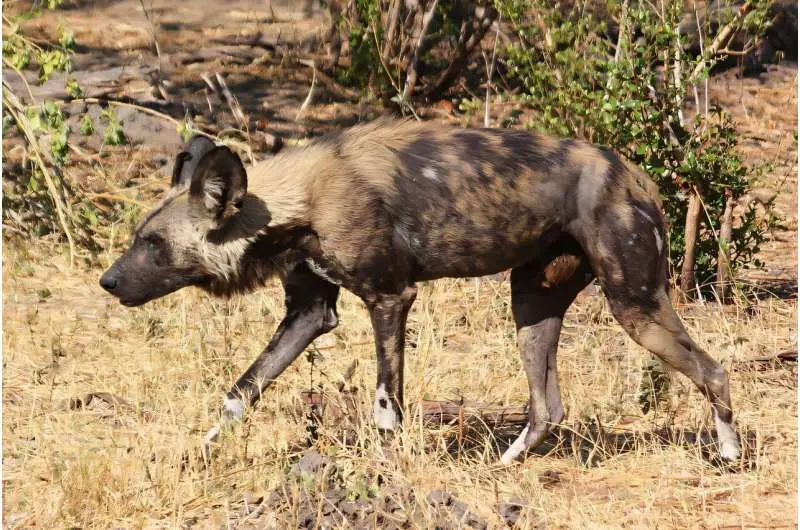
African wild dogs (Lycaon pictus) travel incredibly long distances to search for a mate and new places to breed. They typically embark on these mammoth treks as young adults and often face numerous hazards along the way. These include busy highways, expanding human settlements and deadly wire poaching snares.
Researchers from the Zambian Carnivore Programme and Montana State University wanted to understand how this endangered predator navigates human-dominated landscapes to better help with conservation efforts. So they tracked groups of wild dogs in Zambia after they separated from their packs.
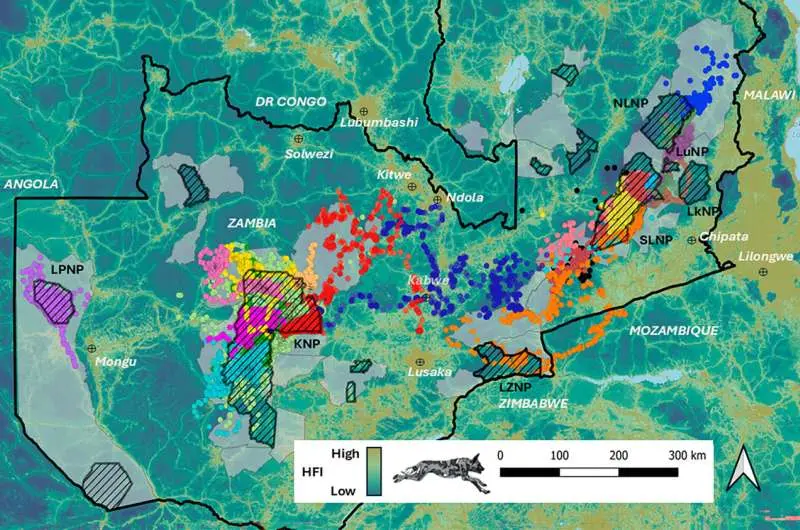
In doing so, they recorded a record-breaking journey. Three of the dogs traveled a staggering 4,126 kilometers (2,564 miles) across the country, the longest journey ever recorded for an African land mammal.
The team, led by Scott Creel of Montana State University, attached tracking collars to some of the dogs. These sent location fixes so researchers could trace their routes, measure how fast they traveled and see whether they found new mates or joined new packs.
The results, published in the journal Ecology, revealed vastly different fates for the animals.
Going the distance
Three females set off together in 2021 and traveled more than 2,300 kilometers (1,429 miles) over 11 months. They never found a new pack to join, and one was eventually killed by a wire snare. The fate of her two sisters is unknown, although the researchers suggest they may also have been caught in snares.
Another group left Kafue National Park in 2025. Four females set off together, although their number soon fell to three. One of the remaining females traveled 1,899 kilometers (1,180 miles) before dying, probably in a snare. The researchers believe another female was also caught in a snare, while the fate of the remaining female is unknown.
However, three males from that pack kept moving, eventually establishing a new home in the Luano Game Management Area in the Luangwa Valley Ecosystem to complete the record journey.
Keeping the routes open
So what do these journeys mean for conservation efforts? Because wild dogs can travel huge distances between protected areas, keeping these places connected is extremely important. So the researchers are calling for protection of the corridors that connect wild dog populations.
"Wild dogs' enduring capacity to move long distances through unfavorable landscapes provides an extraordinary opportunity to conserve a functional meta-population of an endangered large carnivore at the continental scale," they wrote.
The team also warns that wire snares used by poachers to catch wild animals pose a major threat to the dogs, particularly when they leave well-protected areas.
Written for you by our author Paul Arnold, edited by Gaby Clark, and fact-checked and reviewed by Robert Egan—this article is the result of careful human work. We rely on readers like you to keep independent science journalism alive. If this reporting matters to you, please consider a donation (especially monthly). You'll get an ad-free account as a thank-you.
Publication details
Scott Creel et al, Extraordinary movements connecting distant ecosystems by African wild dogs (Lycaon pictus ), Ecology (2026). DOI: 10.1002/ecy.70504
Who's behind this story?

Paul Arnold
BSc Biology from University of London. BBC documentary producer with world travel experience. Freelances from southern Spain. Full profile →

Gaby Clark
MA in English, copy editor since 2021 with experience in higher education and health content. Dedicated to trustworthy science news. Full profile →

Robert Egan
Bachelor's in mathematical biology, Master's in creative writing. Well-traveled with unique perspectives on science and language. Full profile →
© 2026 Science X Network
Citation: Wild dogs make the longest recorded journey of any terrestrial mammal in Africa (2026, September 15) retrieved 15 September 2026 from https://phys.org/news/2026-09-wild-dogs-longest-journey-terrestrial.html
This document is subject to copyright. Apart from any fair dealing for the purpose of private study or research, no part may be reproduced without the written permission. The content is provided for information purposes only.