



For thousands of years, humans shaped their world with stone, wood and bone. Metallurgy, the art and science of working with metals such as copper, bronze and iron, marked a turning point in human history. The mining that fueled metalworking also shaped Europe's and the Mediterranean's economies and politics over centuries.
A recent study found clues that helped reconstruct the region's 6,000-year history of lead and silver mining, metal production and trade, a task hindered by scattered archaeological evidence. This was possible because peat bogs act like nature's archive. As these wetlands slowly build up, they capture airborne dust layer by layer, preserving a record of fallout from silver mining over centuries.
In this study, researchers drilled a peat core at Pilat Massif, an upland area of south-central France. By studying lead (Pb) isotope signatures preserved in peatlands alongside data from the reference Pb Isotope database, researchers developed the Environmental Match Intensity Index (EMII), which revealed that the earliest major lead-silver mining signal emerged during the Late Neolithic and Chalcolithic periods (3700–2200 B.C.), centered around Laurion and the Cycladic islands in Greece.
The findings are published in Science Advances.
Contrary to popular belief, Rome did not rely almost exclusively on Spanish mines. The Iron Age brought changes in mining, and the study showed that mines across France, Germany and Britain also provided major, continuous supplies. Activity was spread across multiple centers in west-central Europe, linked by major rivers and a network of land and sea routes.
Pollutant holds the clues
Lead and silver often occur together in nature in a mineral ore called galena (PbS). Since silver was an essential metal for coins and trade, ancient societies smelted galena to extract the precious metal, which released a significant amount of lead into the atmosphere. Natural bodies like peatlands, lake sediments and polar ice cores trap airborne lead fallout in continuous layers year after year.
This creates an archive of lead pollution that preserves subtle details and provides a chronological record of major events in the region, both natural and human-made. Scientists use the signatures left by the pollutant centuries ago to trace the history of silver production and past metallurgical activity.
In the ancient world, the pursuit of metals drove societies to explore new lands and establish trade across vast distances and helped empires flourish. Reconstructing historical lead exposure can inform broader archaeological debates, such as whether lead poisoning contributed to the decline of the Roman Empire.
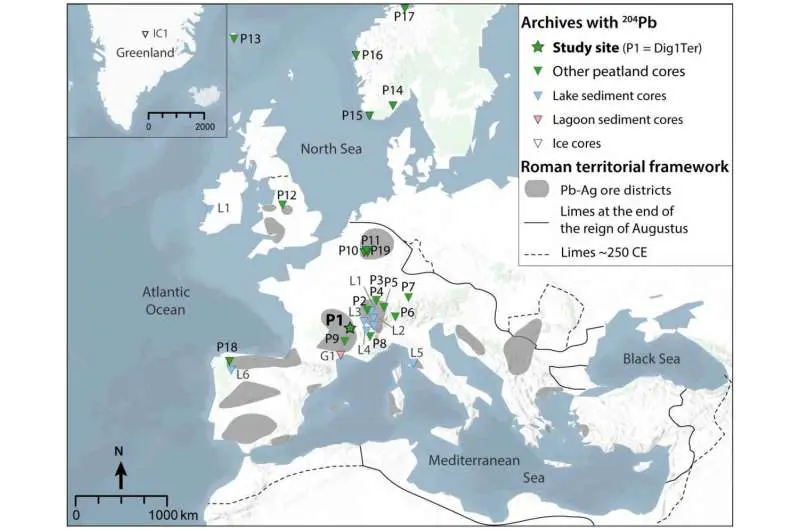
Researchers in this study drilled a 2-meter (6.6-foot) peat core called Dig1Ter in the Pilat Massif of the French Massif Central. To establish a continuous timeline spanning the last 6,000 years, they dated the peat sequence using radiocarbon dating (¹⁴C) for deeper layers and fallout radionuclide markers for the top layers (²¹⁰Pb, ¹³⁷Cs and ²⁴¹Am).
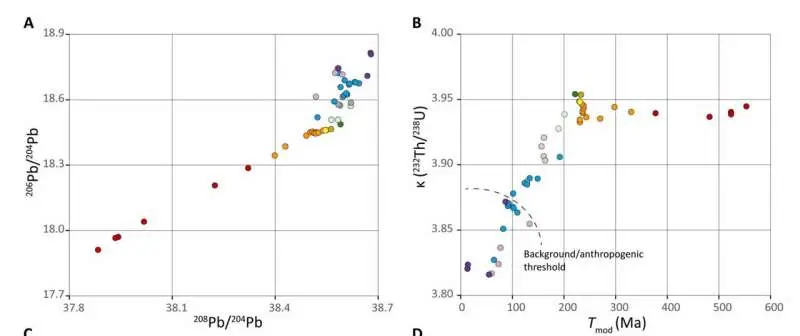
The team collected lead isotope data from 19 peatland archives across Europe, covering 467 individual peat samples sorted into 12 chronological periods. They compared the lead signatures in the samples against the Lyon Pb Isotope Database containing about 7,000 ore analyses.
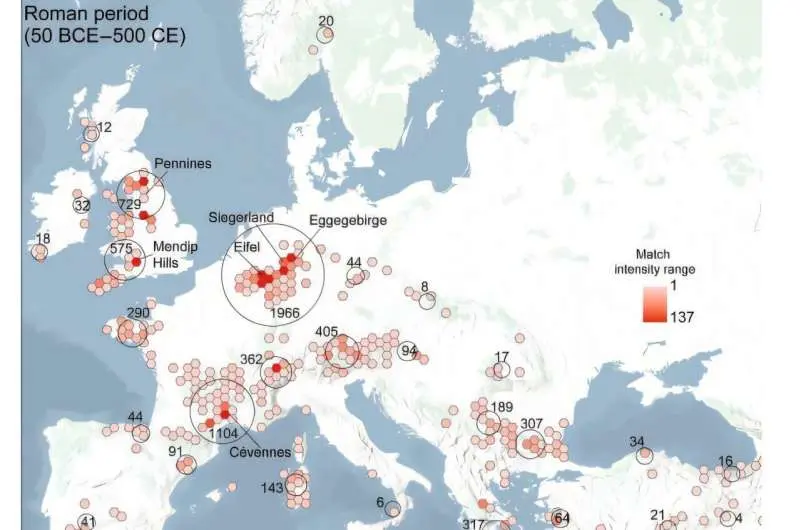
To interpret the patterns, they introduced the Environmental Match Intensity Index (EMII), a statistical tool that acts like a fingerprint matcher, measuring how intense lead-mining pollution was during different historical eras. It allowed the researchers to identify which specific mining regions released it.
Rethinking ancient mining hubs
The earliest pollution fingerprints, dating to roughly 3700–2200 B.C., point strongly to Laurion in Greece and the nearby Aegean islands being major lead and silver mining centers. This agrees with archaeological evidence of early mining in the area. During the Bronze Age, metal production expanded across what would become the modern-day Mediterranean region and Turkey, with maritime trade networks shaping its spread.
Mining shifted inland to Western and Central Europe, including France, Germany and Britain. Emissions peaked in the early Roman period, then dropped sharply in the Early Middle Ages, a decline linked to political disruption, plague and climate change. Production picked up pace again in the High and Late Middle Ages.
The researchers also saw that lead emissions surged during the Industrial Revolution, but the index fell in modern times, not because pollution declined, but because fossil and industrial emissions masked the distinct ore signatures.
The researchers note that this technique of linking environmental records with mining offers a flexible way to reconstruct how metal was produced and moved over the long term. Used in reverse, this approach could also help scientists trace human-driven atmospheric changes back thousands of years before the Industrial Revolution.
Written for you by our author Sanjukta Mondal, edited by Sadie Harley, and fact-checked and reviewed by Robert Egan—this article is the result of careful human work. We rely on readers like you to keep independent science journalism alive. If this reporting matters to you, please consider a donation (especially monthly). You'll get an ad-free account as a thank-you.
Publication details
Hugo Delile et al., Rise and spread of lead-silver metallurgy deciphered from peatland archives, Science Advances (2026). DOI: 10.1126/sciadv.aec1413
Who's behind this story?
Sanjukta Mondal
Master's in Chemistry. Freelance science journalist and communicator. Published in Chemistry World, BioSpace, and The Hindu. Full profile →
Sadie Harley
BSc Life Sciences & Ecology. Microbiology lab background with pharmaceutical news experience in oil, gas, and renewable industries. Full profile →
Robert Egan
Bachelor's in mathematical biology, Master's in creative writing. Well-traveled with unique perspectives on science and language. Full profile →
© 2026 Science X Network
Citation: Peat bogs, the natural archives of mining fallout, reveal ancient Europe's hidden metal networks (2026, October 20) retrieved 20 October 2026 from https://phys.org/news/2026-10-peat-bogs-natural-archives-fallout.html
This document is subject to copyright. Apart from any fair dealing for the purpose of private study or research, no part may be reproduced without the written permission. The content is provided for information purposes only.