



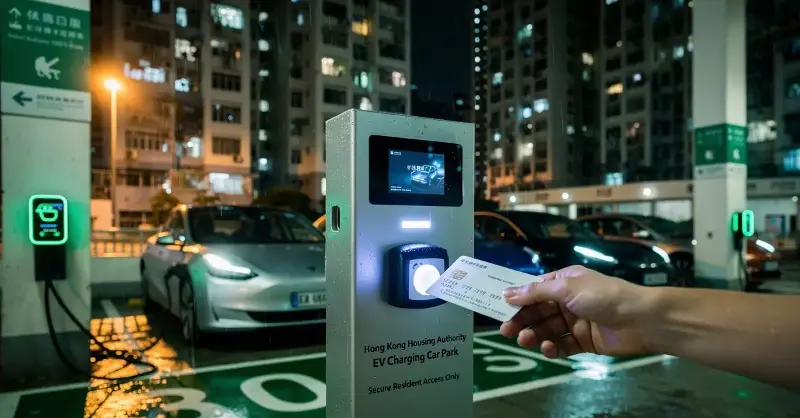
The Hong Kong Housing Authority (HA) is expanding electric vehicle (EV) charging facilities across public housing car parks as part of wider government efforts to support EV adoption. According to a written reply presented in the Legislative Council on 7 October 2026, the HA has already installed charging facilities in more than 170 car parks and plans to add more than 3,500 EV chargers over the next three years. Further details were outlined in the official Legislative Council response.
The measures form part of Hong Kong’s broader transition towards low-emission transport infrastructure, alongside initiatives such as expanded charging infrastructure planning for electric public transport. The HA stated that the programme is intended to improve accessibility to EV charging for residents in public housing developments while supporting the government’s environmental objectives.
Expansion of EV charging facilities
Secretary for Housing Ms Winnie Ho stated that the HA has provided EV chargers for approximately 6,000 private car parking spaces across its existing car parks as of June 2026. These facilities account for around 80 per cent of the HA’s car parks.
The installed infrastructure includes approximately 1,680 standard chargers using 13A sockets, around 4,310 medium chargers and 13 fast chargers. The HA added that more than 30 per cent of private car parking spaces in existing HA car parks are now equipped either with operational charging facilities or with supporting infrastructure such as final circuit cabling.
Under current planning standards, newly built public housing car parks are equipped with EV charging infrastructure for all private cars, motorcycles and light goods vehicles. Medium chargers are installed subject to site conditions, while fast chargers are provided in larger new car parks containing 100 or more parking spaces.
Pilot scheme introduces private sector operation
To expand charging capacity in older facilities, the HA launched a pilot scheme in June 2026 inviting private operators to provide and manage EV charging services in existing car parks. The authority said the initiative is intended to use market-based approaches to improve flexibility, service quality and charging coverage.
The pilot scheme is expected to cover more than 500 parking spaces, with contracts planned for award within 2026. The HA said it will review the implementation outcomes before extending similar tender exercises to additional car parks from 2027 onwards.
The development aligns with other Hong Kong transport electrification initiatives, including the government’s work on new EV charging station infrastructure projects.
Smart payment systems and user access
The HA confirmed that self-service payment terminals accepting Octopus payments have been installed in 14 newly built car parks that provide hourly parking spaces. Additional payment terminals will continue to be deployed in future public housing developments.
Under the pilot scheme, operators will also be required to provide electronic payment systems. These systems will support charging fees calculated according to electricity consumption, rather than charging duration alone. Users will pay electricity charges directly to operators, while fee levels will remain subject to HA approval.
Charging fees and operational arrangements
The HA introduced fee-paying EV charging services at hourly parking spaces on 1 April 2024 as part of efforts to marketise EV charging services. Current charging fees are based on charging duration. Medium chargers installed at hourly parking spaces operate at a rated output of seven kilowatts.
According to the HA, the present charging fee is HK$10 (approximately US$1.29) per 30 minutes, equivalent to around HK$2.99 (approximately US$0.38) per unit of electricity at maximum consumption. The authority stated that pricing levels were determined with reference to prevailing market rates in public and comparable private car parks.
For monthly parking spaces equipped with EV chargers, users are currently required to apply separately to electricity suppliers and pay utility charges directly. The HA noted that it does not maintain statistics on average daily charging duration or electricity consumption data across the past five years.
The authority said it will continue monitoring utilisation rates and operational performance as EV adoption increases across Hong Kong’s transport network.
This article is created with the assistance of OpenGov AI.