



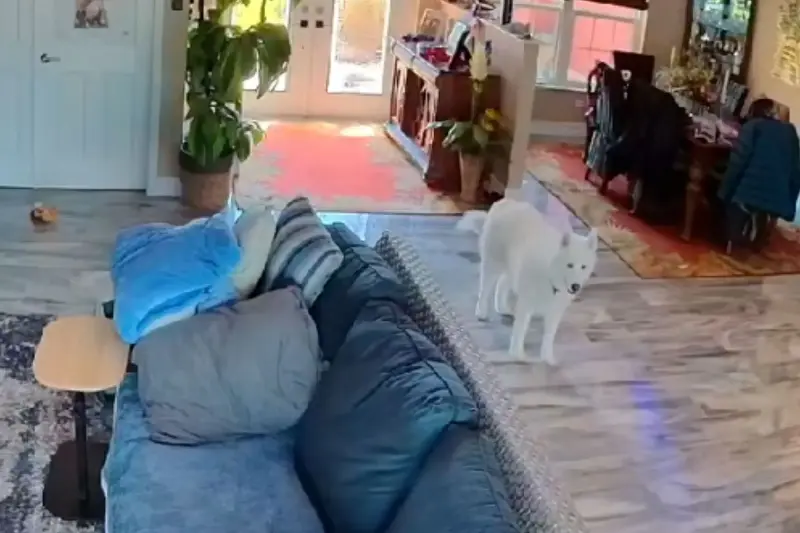
A dog’s barking or whining when left alone may seem like a minor nuisance, but certain behaviors can signal a deeper issue that requires veterinary support.
Separation anxiety can cause dogs to experience significant distress when they are away from their owners, and recognizing the warning signs early can help prevent the condition from worsening, according to Dr. Julie Hunt, a veterinarian at Embrace Pet Insurance.
“Separation anxiety can manifest as panting, hypersalivation, vocalization, pacing, destruction of items, self-injury, and urinary and fecal accidents in the home,” Hunt told Newsweek.
Owners should seek veterinary guidance when these behaviors begin affecting the dog’s quality of life, damaging the home or straining the human-pet bond.
How Separation Anxiety Is Treated
There is no single solution for separation anxiety, and treatment often involves a combination of approaches tailored to the individual dog.
Options can include behavioral modification, desensitization training, calming products, pheromones, supplements, specialized diets, sprays, routines, leaving on dog television or music, and in some cases, medication.
“It can take time to find the best approach that is tailored to each dog,” Hunt said. “But it is worth the effort, as each dog deserves to be calm and happy in its home.”
Some owners also try comfort objects, sometimes called “loveys,” which may provide reassurance when a dog’s owner is away.
Hunt said others attempt to make these objects more familiar by adding their scent, such as sleeping with the item or storing it with their clothing.
But unusual comfort objects do not work for every dog.
One Dog’s Unexpected Source of Comfort
Snow, a 7-year-old Siberian husky and malamute mix, became an unusual example of how some dogs may seek comfort when separated from owners.
The dog’s owners, Stephen and Donna, told Newsweek that she struggled significantly when left alone after Stephen moved into Donna’s home in December.
The rescue dog would howl, wait by the front door and paw at the wood while the couple was away. They installed cameras throughout the home and eventually sought veterinary guidance.
Snow was prescribed trazodone, but Stephen said the medication made her overly sedated.
One day, while Donna was out of town, Stephen realized he had forgotten to give Snow her medication. He expected to see the dog distressed while checking the cameras, but he instead saw Snow calmly lying beside a mannequin.
The mannequin was not purchased for Snow. Donna used it for designing and making clothes. Usually it is in one of the bedrooms, but she just so happened to leave it out in the dining room.
After noticing this new and unexpected behavior, the couple wondered if this accident turned out to be their saving grace.
Why Might a Mannequin Comfort a Dog?
Hunt said one possible explanation could be displacement, a behavioral process where a dog redirects attachment toward a substitute when the person they want is unavailable.
“While there’s little doubt that the dog knows the mannequin is not a real human—dogs have very sensitive noses, and the mannequin does not smell human, and it does not move or look truly human—the dog may be choosing to stay near the mannequin because it does, in form, remind him in some way of his humans who are not home with him,” Hunt said.
However, she cautioned that Snow’s reaction should not be viewed as a universal treatment for separation anxiety.
“I haven’t seen other dogs suffering from separation anxiety comforted by mannequins or other representations of their owner’s forms,” Hunt said, adding that the reaction may be uncommon simply because few owners keep mannequins in their homes.
Snow’s experience may simply show how individual dogs develop their own coping strategies.
For Stephen and Donna, the unexpected discovery has given Snow more confidence when she is home alone. The mannequin now stays in a corner of the dining room, where Snow frequently rests beside it.
“It was an accident,” Stephen said. “We never even thought this would be something.”