



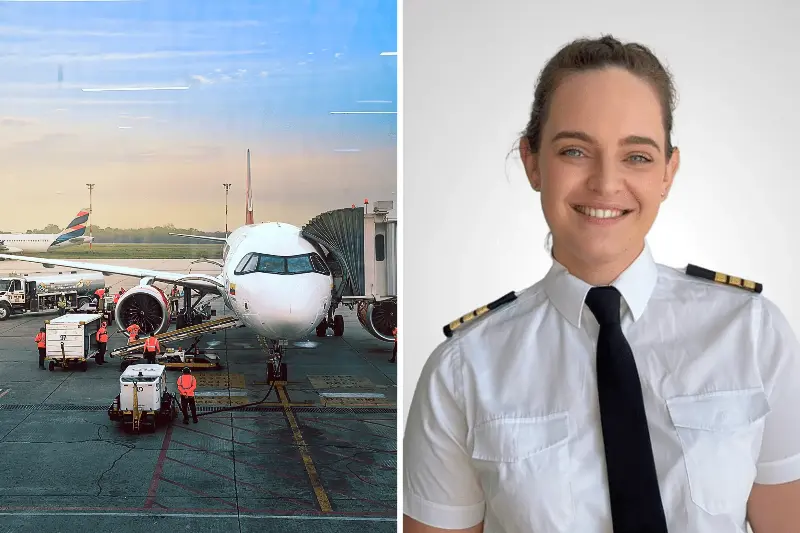
Every time a commercial jet reaches the runway, somewhere on board a passenger’s heart is racing, palms are sweating and their mind is convinced something is about to go wrong. For Hanna, a 38-year-old commercial pilot, that moment used to be the point where facts and figures about aviation safety simply stopped working.
“They’d still get off, say that it helped slightly but that they’d panicked again,” she told Newsweek, recalling the nervous flyers she used to reassure with statistics before takeoff.
Two and a half years ago, Hanna, who would prefer to keep her surname private, began combining her flying career with a growing expertise in psychology, yoga and breathwork to build a following of more than 28,000 people on Instagram, where she posts as @flying_wingwoman. Her message is simple but, for many, transformative: facts about flying only go so far. What actually calms a panicking passenger is learning to support the body first.
From Cabin Crew to Cockpit
Hanna’s path to the flight deck was slightly unusual.
“I started my career in aviation when I was little,” she said. “My mom has been cabin crew my whole life and I grew up on planes with her. I would go into the flight deck and wow at the buttons, the pilots and what they were doing.”
Hanna started flight training two years into her own cabin crew career, working full-time throughout, and landed her first flying job just eight weeks after finishing.
Why Facts Alone Don’t Calm a Nervous Flyer
The turning point in how she approached nervous flyers came when she started a psychology degree six years ago, and trained as a yoga and breathing instructor.
“I realized that I needed to speak to nervous flyers about what was happening in the mind and body, rather than just speak about flying facts,” she said. “I’m not saying that facts about flying don’t help, because they absolutely do.
“However, when someone is anxious and panicking about flying, facts are not going to calm that because the rational side of the brain has gone out the window.”
Hanna explained that fear shuts down the very faculties a nervous flyer needs most.
“The brain is very clever and it shuts down what it thinks you don’t need when it’s reacting to danger,” she said. “It shuts down the rational side that understands facts, because in that moment, when it thinks it’s fighting for its life, it doesn’t need anything rational, it just needs to survive.
“That’s why constantly trying to learn more facts doesn’t stop panic as the mind and body are not under your control anymore.”
Breathing as the Reset Button
Hanna said takeoff is often worse for nervous flyers than turbulence, “because it’s at the start of the journey and the anxiety has peaked.”
She still gives passengers facts to help, she said, but found that they often need more considered support.
“The only way to get the mind and body back under control is through deep breathing,” she said.
Once passengers started using breathing techniques, which she teaches, the response was immediate.
“They’d come and see me after the flight and tell me they didn’t panic for the first time, and felt much better about the flight,” she said. “It kept happening over and over again, that’s when I knew I needed to start working more with nervous flyers.”
What began as in-flight conversations soon became a global support network.
Hanna said people have messaged her to say they have booked their first flight in 15 years or flown for the first time without panicking after following her guidance, which she packages as a 30-second breathing exercise.
“We are so hard on ourselves in life always and this fear is a big burden for people, they are ridiculed, laughed at, told bad things about flying,” she said. “There is zero judgment from me for this fear and everyone thinks they’re being irrational, but I just think it’s their brain working normally to perceived danger.
“However, just because the mind and the body feel danger, doesn’t mean that they’re always correct.”