



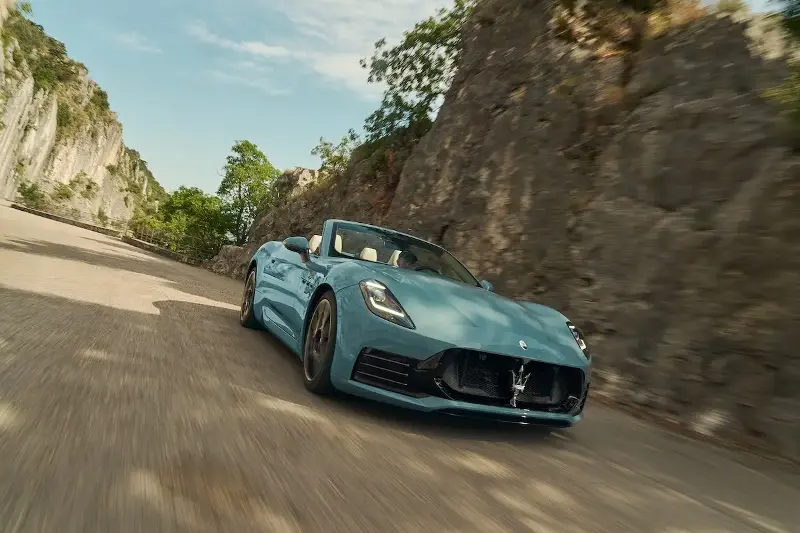
Maserati chose the far northeast corner of Italy to introduce its 2027 range, and it is easy to see why. The coast road out of Trieste runs along the top of limestone cliffs with the Adriatic dropping away below it, and a few miles inland the tarmac climbs abruptly into the vineyards of the Collio. It is beautiful, expensive-looking country, and it flatters a grand tourer in precisely the way a launch venue is meant to.
Despite this, the most consequential thing said all week happened before any of us got behind the wheel. At a press conference held for a small group of invited media including Newsweek, on the evening before the drives began, Davide Danesin, Maserati’s head of engineering, opened the presentation with a question rather than a spec sheet.
“What makes a Maserati a Maserati?” he asked. “We have more than a century of history. Some of the most iconic cars in the automotive world carry the Trident. It starts from our DNA. An Italian icon in motion since 1914. Maserati has always expressed a very specific way of living the automobile. It’s rooted in the Italian style where beauty belongs to everyday life, and emotion is experienced through all the senses. Maserati is a multisensory experience.
“You hear it, you feel the material, you perceive the balance between sound and silence. And then there is Italian design built on proportion, precision, and details. This is where pure elegance comes in. Nothing excessive or added just to be noticed. Everything has to feel right. And that approach extends to the way we think about performance. Performance you can enjoy everyday that gives you comfort without taking away emotion. That is what we mean by comfortable performance over adrenaline.
“When you put all this together, there is a name for it—it is the Italian GranTurismo. It has always been part of who we are. It guides every Maserati we create,” he teased before adding that the two new Grans and the Grecale are the “first expression of the direction of the future we have chosen for the brand.”
It is an unusual thing to say about what is, on paper, a mid-cycle refresh. But after a day behind the wheel of these cars, it started to make sense.
The New Face Started Life on a Car That Never Had to be Road Legal
The design language traces back to the MCXtrema, the track-only machine that let Maserati’s designers work without the compromises street legality imposes. “It let us have a lot of design freedom in order to be very strong with our intent,” said Klaus Busse, Maserati’s head of design. From there it moved to the GT2 Stradale, then the MCPura, which Busse called “the confirmation, because we used the same principle across the brand.” Now, he said, that same face is “all across our lineup: pure elegance, yes, but with stronger proportion, a more confident stance, and of course a more purposeful front end. Because this is elegance with intent.”
The effect is not subtle in person. A GranTurismo has always been a handsome car in a slightly reserved way, a shape that flattered its owner rather than announcing them. Busse said as much of the redesigned GranTurismo and GranCabrio specifically: it “looks more confident. It also looks more purposeful. While remaining a Maserati.”
Reworking the front of a Maserati means touching the one part of the car nobody asked you to fix, and the same thinking reached the Grecale too, where even the new air curtain, Busse said, exists simply “because it works,” part of a car where “every element has a purpose.”
Underneath, the changes are real rather than cosmetic. The twin-turbocharged 3.0-liter Nettuno V6 in Trofeo trim now makes 582 horsepower, up 40 on last year, with 457 lb-ft of torque and a top speed north of 199 mph in the GranTurismo, 196 mph in the drop-top GranCabrio. Maserati says the gain came from extending the turbocharger’s boost window further into the rev range, letting the engine pull harder for longer rather than tapering off near the redline. Lower trims run 483 hp. A new Country Mode raises ride height and retunes the dampers for rough surfaces, a small acknowledgment that grand tourers get driven on real roads and not just launch routes.
The electric Folgore variants keep their tri-motor, 751-hp setup and 800-volt architecture, but a reworked energy management system and a front axle disconnect push the GranTurismo Folgore past 250 miles of range. I drove one alongside the Modena, and it’s the most convincing electric car I’ve been in.
That’s not a small claim, but most EVs I’ve driven ask you to be impressed by the numbers on a spec sheet. The Folgore asks you to forget it’s electric at all. It doesn’t lunge off the line the way a lot of EVs do, all torque and no manners, it builds speed the way a combustion Maserati would, with weight transfer and body language that feel organic rather than, I suppose, perfect. Whatever Maserati’s engineers did to the throttle mapping and the motor calibration, they clearly spent real time making an electric car drive like a Maserati first and an EV second.
The Grecale receives some larger changes. The four-cylinder is gone and the range is now built around a 385-hp version of the Nettuno, which puts Maserati’s Formula 1-derived engine in the brand’s volume model for the first time in North America. The Grecale Trofeo remains the range-topper, unchanged at 523 hp and 457 lb-ft, good for 0-60 mph in 3.6 seconds and a 177 mph top speed, with Corsa mode reserved exclusively for that trim.
After an hour behind the wheel on some of Italy’s greatest roads, it’s clear that the Grecale could well be the new sports SUV benchmark – a position formerly owned by the Porsche Macan. The Grecale Trofeo, with a proper twin-turbo V6 doing the work rather than a four-cylinder hybrid, and a chassis that actually rewards being driven hard, is the more complete performance car of the two. If anything, the Macan should be the one getting benchmarked against it from here.
Hollywood Arrives at an Convenient Moment
Running in parallel is “Maserati: The Brothers,” Bobby Moresco’s biopic tracing the family from the company’s 1914 founding, with a cast headed by Anthony Hopkins and including Al Pacino, Andy Garcia and Jessica Alba. Dozens of period-correct 1920s and 1930s Maseratis were constructed for the production. A release date has not been publicly confirmed, though I was told it’s expected to be later this year.
The commercial reasoning behind this isn’t exactly a secret. Michael Mann’s “Ferrari” in 2023 and last year’s “F1: The Movie” demonstrated that motorsport can carry a mainstream audience, and that audience skews younger and less car-literate than the one automotive marketing usually reaches. Ferrari’s brand equity in America was built over decades of racing results and poster-on-the-wall aspiration. Maserati has no equivalent shorthand in the U.S. market. Most American buyers could not tell you what the trident on the grille refers to, let alone that the Maserati brothers were building successful racing cars a decade before Enzo Ferrari founded his own team.
A film starring Anthony Hopkins does not sell cars directly. What it does do is hand Maserati a story that a general audience can repeat, at precisely the moment the cars have been restyled to bring them into the modern age.
There’s a maybe inperfect precedent for how much a film like this can actually move the needle. In the two years since “Ferrari” landed in theaters, the share of Ferrari’s new buyers under 40 climbed from roughly 30 percent to 40 percent, according to CEO Benedetto Vigna. What didn’t move is total production. Ferrari shipped 13,663 cars in 2023 and 13,752 in 2024, an increase of well under one percent, because the company deliberately caps output to protect its waiting lists and resale values regardless of demand.
Vigna himself credits the younger skew to the broader team’s work rather than to the film specifically, and the correlation doesn’t prove causation. But it’s a useful data point for Maserati all the same: a cultural moment can alter who wants the car far more than it changes how many of them get built.
A Grand Tourer That Knows Exactly What it is
I drove the GranTurismo Modena on the coast road out past Miramare and up into the wine hills behind Trieste, and the car that emerged over that day is not a Ferrari rival in any dynamic sense. It is a fast, unusually well-damped, deliberately restrained grand tourer. The 483-hp Modena does not even offer Corsa mode, which is reserved for the Trofeo. Its natural comparison is a Bentley Continental GT rather than anything from Maranello.
That is not a criticism of the car. It’s simply a realignment of expectations. The styling has moved toward Ferrari’s neighborhood considerably faster than the driving experience has, and a buyer cross-shopping on looks alone may find the two cars have less in common than the front ends suggest.
That’s by design, not by accident. Maserati isn’t trying to out-Ferrari Ferrari, it knows exactly what a grand tourer is supposed to be, and it has built one of the best examples of that niche currently on sale rather than a half-hearted entry into a different one. The V8 conversation says as much: a return for the GranTurismo remains under consideration, but Maserati is treating it as a potential addition rather than a missing piece it’s scrambling to fix.
The face may have moved toward Ferrari’s neighborhood. The car underneath knows exactly which house is actually its own.
Why the Millennial Targeting Actually Makes Sense
Nobody at that press conference used the words “younger buyers.” That idea is mine, but there’s evidence behind this claim.
Start with something that sounds incidental until you think about it. For 2027, the Sportivo exhaust is now standard across every North American GranTurismo and GranCabrio, rather than a paid option reserved for the range-topping car. A quieter, more polite exhaust note has always been a very “old Maserati” instinct, the brand that let the driving do the talking. A standard, more vocal one is aimed at a buyer who wants the car to announce itself a little, and that’s a different customer than the one Maserati has traditionally sold to.
Then there’s Fuoriserie, Maserati’s customization program. One car in four is now personalized through it, up from just 12 percent at the start of 2025, a jump Maserati credits partly to a lower entry price that widened the funnel. Doubling personalization penetration in eighteen months is not a marginal increase, and rising customization rates in luxury follow buyers who want a car that feels like theirs rather than an inherited status symbol.
Put the styling, the standard exhaust and the Fuoriserie numbers together, and a picture emerges.
The rest of the business looks more conventional. Sales split roughly evenly across Europe, North America and the rest of the world. Production of the GranTurismo and GranCabrio has returned to Modena, and at the press conference, Danesin confirmed that Stellantis CEO Antonio Filosa had used the group’s recent Investor Day to lay out the next steps, among them “our return to the full-size premium luxury segment.”
The company’s own stated priority for the year ahead, though, wasn’t product or marketing. It was rebuilding the dealer network, the unglamorous work of actually being present in front of the customer. That’s an honest – and respectable – answer.
A sharper face and a prestige biopic are the visible half of a strategy whose harder half is distribution, and no amount of Hollywood attention fixes a showroom experience on its own.
Put together, though, the sharper face and the fast-growing personalization program says more than any single quote from that stage did: this is a brand building itself around presence and individuality rather than the quiet inheritance the GranTurismo name has always implied. If Maserati’s next chapter works with a younger audience, and I think it will, it’ll be because the company built the case for it into the details rather than the marketing deck.