



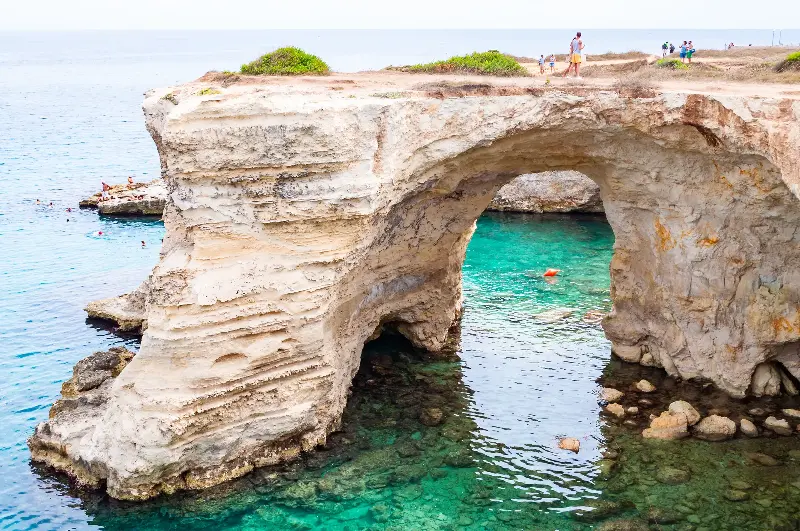
Italy’s famed “Lovers’ Arch,” a natural rock formation that has long symbolized romance along the Adriatic coast, collapsed into the sea over Valentine’s Day weekend after powerful storms battered the region.
The Sant’Andrea Faraglioni Arch, located off Torre Sant’Andrea in Puglia’s Salento region, had stood for centuries against limestone cliffs and turquoise waters, drawing couples who visited to kiss beneath its curve or propose overlooking the sea.
Local legend held that those who kissed under the arch would be destined for eternal love, but severe weather and rough seas ultimately toppled the fragile calcarenite structure.
According to AccuWeather, storms intensified ongoing coastal erosion along the Salento coastline, bringing down the formation during the holiday weekend.
Officials from the Melendugno municipality confirmed the collapse on February 16, two days after Valentine’s Day.
CNN reported that the arch gave way during heavy storms sweeping across southern Italy, reducing the landmark to rubble. Maurizio Cisternino, mayor of Melendugno, described the loss as both emotional and economic.
Its collapse has dealt a “devastating blow to the image of Salento and to tourism,” he told CNN, adding, “It’s a blow to the heart.”
An Instagram Icon
The arch had been formed over centuries by wind and waves carving into the cliffs. Once used as a strategic lookout point to warn of pirates, it became a destination for lovers in the late 18th century.
In recent years, social media amplified its fame, with Instagram photos drawing thousands more visitors, Cisternino said, according to CNN.
Concerns about erosion had circulated for years. In 2024, local authorities applied for a $4.5 million preservation grant aimed at combating coastal erosion but failed to secure funding, Cisternino told local media.
He later reflected on the natural forces behind the loss, telling CNN: “Nature has reclaimed the arch, just as it created it.”
He added: “Nature has been transformed: what was there 30 years ago is no longer there.”
For many visitors, the collapse carries personal meaning.
Lorenzo Barlato, who proposed to his wife overlooking the arch more than four decades ago, wrote on Facebook after the storm, “I couldn’t wait to return. Now, unfortunately, all I have left are the many beautiful photos I took of that piece of paradise,” according to CNN.
The destruction has sparked strong emotional reactions online, with one Instagram user commenting, “Mother Earth is suffering from a broken heart.”
Another wrote, “This is a sign that love is dying,” while a third added, “That’s definitely an omen….an omen for what? I don’t know, but that’s definitely an omen.”
‘Like a funeral’
The collapse comes amid weeks of violent storms across southern Italy. CNN reported that warmer sea temperatures linked to climate change are seen as contributing to extreme weather in the Mediterranean.
The arch had already sustained damage from Cyclone Harry in January before the Valentine’s Day storm delivered the final blow.
Municipal officials said the remnants of the formation will be left to wash out at sea. Puglia tourism councillor Francesco Stella described the moment as “like a funeral,” telling CNN that the site had been one of the happiest places in Italy for generations of visitors.